

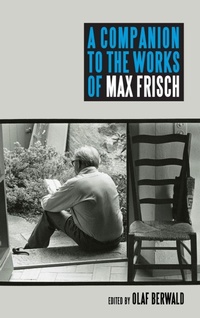
A Companion to the Works of Max Frisch
Published on 1. November 2013
Book
Hardback
256 pages
978-1-57113-418-9 (ISBN)
Description
A comprehensive advanced introduction to and scholarly commentary on the work of the Swiss writer Max Frisch, one of the leading German-language dramatists and novelists of the late twentieth century.
One of the most influential German-language writers of the late twentieth century, Max Frisch (1911-1991) not only has canonical status in Europe, but has also been well received in the English-speaking world. English translationsof his works are available in multiple recent editions. Frisch was a recipient of both the Buechner Award (1958), and the Peace Prize of the German Book Trade (1976); his body of work explores questions of identity, alienation, and ethics in modern society. He is best known for the plays Andorra (1961), a seminal drama that examines indifference and mass psychology in the context of the Shoah and continues to be produced by theaters around the world, and Biedermann und die Brandstifter (1958), another worldwide success and one of the most frequently used texts in advanced undergraduate German courses in the United States, as well as for his novels Stiller (1954), Homo Faber (1957), and Mein Name sei Gantenbein (1964). Yet Frisch has only recently begun to receive the sustained scholarly attention he deserves: neither a comprehensive introductory volume to nor a collaborative handbook on the works of Frisch is available in English, a situation that this volume redresses.
Contributors: Regine Battiston, Klaus van den Berg, Olaf Berwald, Amanda Charitina Boyd, Celine Letawe, Walter Obschlager, John D. Pizer, Beatrice Sandberg, Caroline Schaumann, Frank Schaumann, Walter Schmitz, Margit Unser, Daniel de Vin, Ruth Vogel-Klein, Paul A. Youngman.
Olaf Berwald is Professor of German and Chair of the Departmentof Foreign Languages at Kennesaw State University.
One of the most influential German-language writers of the late twentieth century, Max Frisch (1911-1991) not only has canonical status in Europe, but has also been well received in the English-speaking world. English translationsof his works are available in multiple recent editions. Frisch was a recipient of both the Buechner Award (1958), and the Peace Prize of the German Book Trade (1976); his body of work explores questions of identity, alienation, and ethics in modern society. He is best known for the plays Andorra (1961), a seminal drama that examines indifference and mass psychology in the context of the Shoah and continues to be produced by theaters around the world, and Biedermann und die Brandstifter (1958), another worldwide success and one of the most frequently used texts in advanced undergraduate German courses in the United States, as well as for his novels Stiller (1954), Homo Faber (1957), and Mein Name sei Gantenbein (1964). Yet Frisch has only recently begun to receive the sustained scholarly attention he deserves: neither a comprehensive introductory volume to nor a collaborative handbook on the works of Frisch is available in English, a situation that this volume redresses.
Contributors: Regine Battiston, Klaus van den Berg, Olaf Berwald, Amanda Charitina Boyd, Celine Letawe, Walter Obschlager, John D. Pizer, Beatrice Sandberg, Caroline Schaumann, Frank Schaumann, Walter Schmitz, Margit Unser, Daniel de Vin, Ruth Vogel-Klein, Paul A. Youngman.
Olaf Berwald is Professor of German and Chair of the Departmentof Foreign Languages at Kennesaw State University.
Reviews / Votes
This companion volume will prove rewarding for students and scholars of Frisch's work and for those familiar with Frisch's ?ction and non-fiction. [It] provides the student and scholar with fresh insights, new critical approaches, and an overview of the secondary literature. * MONATSHEFTE * Given the canonical status enjoyed by Max Frisch . . . , this volume has been a long time coming. It enhances in particular the relatively scant English-speaking secondary literature on Frisch. . . . The volume as a whole offers the reader a well-rounded picture of Frisch's works, their literary context and influences, and thematic affinities with the works of other writers. . . . With some particularly discerning contributions, the volume is an important and informative contribution to Frisch studies in English. . . . [E]ither in hardback or as an e-book, it is a handsome Companion and an essential library acquisition. -- Siobhan Donovan * MODERN LANGUAGE REVIEW * This is a true companion to the works of Max Frisch . . ., not, as some 'companions' are, a collection of loosely connected conference papers assembled as an afterthought. There are informative chapters on all the genres Frisch worked in . . . . Frisch's speeches and essays are [also] discussed. . . . Highly recommended. * CHOICE *More details
Series
Language
English
Place of publication
Columbia, MD
United States
Publishing group
Boydell & Brewer Ltd
Target group
Professional and scholarly
Product notice
Cloth over boards
Dimensions
Height: 235 mm
Width: 157 mm
Thickness: 19 mm
Weight
565 gr
ISBN-13
978-1-57113-418-9 (9781571134189)
Copyright in bibliographic data and cover images is held by Nielsen Book Services Limited or by the publishers or by their respective licensors: all rights reserved.
Schweitzer Classification
Other editions
Additional editions
Olaf Berwald
A Companion to the Works of Max Frisch
E-Book
11/2013
1st Edition
De Gruyter
€48.99
Available for download
Person
OLAF BERWALD is Department Chair of World Languages, Literatures, and Cultures and Professor of German at Middle Tennessee State University.
Content
Introduction: Max Frisch in the Twenty-First Century
Max Frisch's Early Plays
Spielraum in Max Frisch's Graf OEderland and Don Juan: Transparency as Mode of Performance
Max Frisch's Biedermann und die Brandstifter and Die grosse Wut des Philipp Hotz
Max Frisch's Andorra: Balancing Act between Pattern and Particular
Eternal Recurrence in Life and Death in Max Frisch's Late Plays
Max Frisch's Early Fiction
From Life to Literature: Max Frisch's Frisch's Tagebuecher
"Writing in order to be a stranger to oneself": Max Frisch's Stiller
Cybernetic Flow, Analogy, and Probability in Max Frisch's Homo Faber
The Ends of Blindness in Max Frisch's Mein Name sei Gantenbein
Max Frisch's Montauk. Eine Erzaehlung
Man, Culture, and Nature in Max Frisch's Der Mensch erscheint im Holozaen
"My life as a man. Everyman": Max Frisch's Blaubart. Erzaehlung
Max Frisch's Essays and Speeches
Frisch's Major Works
Select Bibliography
Notes on the Contributors
Index
Max Frisch's Early Plays
Spielraum in Max Frisch's Graf OEderland and Don Juan: Transparency as Mode of Performance
Max Frisch's Biedermann und die Brandstifter and Die grosse Wut des Philipp Hotz
Max Frisch's Andorra: Balancing Act between Pattern and Particular
Eternal Recurrence in Life and Death in Max Frisch's Late Plays
Max Frisch's Early Fiction
From Life to Literature: Max Frisch's Frisch's Tagebuecher
"Writing in order to be a stranger to oneself": Max Frisch's Stiller
Cybernetic Flow, Analogy, and Probability in Max Frisch's Homo Faber
The Ends of Blindness in Max Frisch's Mein Name sei Gantenbein
Max Frisch's Montauk. Eine Erzaehlung
Man, Culture, and Nature in Max Frisch's Der Mensch erscheint im Holozaen
"My life as a man. Everyman": Max Frisch's Blaubart. Erzaehlung
Max Frisch's Essays and Speeches
Frisch's Major Works
Select Bibliography
Notes on the Contributors
Index