

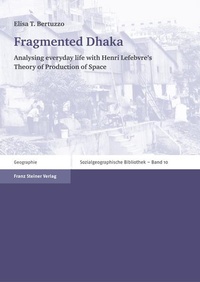
Fragmented Dhaka
Analysing everyday life with Henri Lefebvre's Theory of Production of Space
1st Edition
Published on 26. August 2009
Book
Paperback/Softback
226 pages
978-3-515-09404-7 (ISBN)
Description
Bangladesh's capital city Dhaka is one of the world's fastest growing cities, passing from a population of one million to twelve million people in its extended area within three decades (1970-2000). This confronts its inhabitants, observers as well as planners with contradictions that ask for redefining our ways of living in and thinking about the city.
In particular, Western conceptions of public space and urban societies are challenged by a symptomatic fragmentation.
This empirical study observes the megacity's everyday spaces and situations directly and with a non-generalising approach. By means of ethnographic field research it describes the production of "enriched" or multifunctional spaces through everyday life practices, recognising in the inhabitants' appropriation and adaptation processes a potential for sustainable mixed forms of urban development.
For the first time, Henri Lefebvre's theory of production of space is applied with all of its implications to an empirical study. City and urbanity emerge then as the result of three continuously interacting and interdependent production processes: physical, mental and social.
In particular, Western conceptions of public space and urban societies are challenged by a symptomatic fragmentation.
This empirical study observes the megacity's everyday spaces and situations directly and with a non-generalising approach. By means of ethnographic field research it describes the production of "enriched" or multifunctional spaces through everyday life practices, recognising in the inhabitants' appropriation and adaptation processes a potential for sustainable mixed forms of urban development.
For the first time, Henri Lefebvre's theory of production of space is applied with all of its implications to an empirical study. City and urbanity emerge then as the result of three continuously interacting and interdependent production processes: physical, mental and social.
Reviews / Votes
"So leistet die Autorin einen nicht zu unterschätzenden Beitrag zur aktuellen sozialwissenschaftichen Debatte um geeignete theoretische Zugänge zu Raum und Stadt und ihre Umsetzung in Form von empirischen Studien. Es bleibt zu hoffen, dass Bertuzzos Beispiel noch weitere Arbeiten folgen."More details
Series
Thesis
Doctoral thesis
2008
Berlin, Techn. Univ.
Language
English
Place of publication
Germany
Product notice
Paperback (trade)
Unsewn / adhesive bound
Illustrations
16 Taf. m. 6 Farbabb. u. 16 Farbfot., 13 s/w Zeichnungen, 10 s/w Abbildungen
6 Abbildungen, 13 Zeichnungen, 4 Schemata und 16 Tafeln mit 6 Farbabbildungen, 16 Farbfotos
Dimensions
Height: 24 cm
Width: 17 cm
Thickness: 15 mm
Weight
440 gr
ISBN-13
978-3-515-09404-7 (9783515094047)
Schweitzer Classification
Other editions
Additional editions
Elisa T. Bertuzzo
Fragmented Dhaka
Analysing everyday life with Henri Lefebvre's Theory of Production of Space
E-Book
08/2012
1st Edition
Franz Steiner Verlag
€72.00
Available for download
Person
Elisa T. Bertuzzo, geb. 1980, ist zurzeit Visiting Fellow des Graduiertenkollegs Berlin Graduate School of Muslim Cultures and Societies der Freien Universität Berlin und assoziierte Forscherin am Institut für Asien- und Afrikawissenschaften (IAAW) der Humboldt Universität Berlin.
Forschungsschwerpunkte: Urbanität, Raum und Zeitrepräsentationen, "gelebte Geographien", Henri Lefebvres Theorien zur Urbanisierung, Walter Benjamins Geschichtsphilosophie und Stadtwanderungen.
Forschungsschwerpunkte: Urbanität, Raum und Zeitrepräsentationen, "gelebte Geographien", Henri Lefebvres Theorien zur Urbanisierung, Walter Benjamins Geschichtsphilosophie und Stadtwanderungen.