

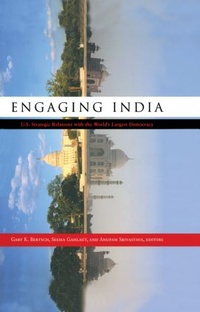
Engaging India
U.S. Strategic Relations with the World's Largest Democracy
1st Edition
Published on 12. July 1999
Book
Hardback
304 pages
978-0-415-92282-1 (ISBN)
Description
Recent nuclear tests in India and Pakistan make it clear that the US can no longer continue a policy of benign neglect toward India. This book engages the key issues for nonproliferation and foreign policy that affect Indo-American relations. It addresses under-explored areas such as missile control and space cooperation, chemical and biological weapons, and the use of sanctions versus incentives. This book goes beyond historical analysis to offer practical recommendations for policymakers in both countries.
Reviews / Votes
"Blending history with analysis of current affairs and future dilemmas, these essays provide a clear picture of the perceptual, political, legislative and bureaucratic hurdles that the U.S. and India must negotiate if they are to build a relationship befitting the world's largest democracies." -- George Perkovich, Director, Secure World Program, W. Alton Jones Foundation and author of India'sNuclear Bomb"Engaging India is indeed a timely and significant volume, which puts together a wide array of scholarship and analysis on several crucial aspects of the relationship between India and the United States. It is important that a book on this subject be an intelligent appreciation of facts, various views and differing standpoints. Engaging India does this expertly and is a creditable achievement." -- Naresh Chandra, Ambassador of India to the United States
"In Engaging India, a well-informed group of authors provide broad insight into India's relations with the rest of the world in the shadow of India's 1998 nuclear tests. This book should be read by anyone who wants to understand how these relations developed and where they are headed." -- Clifford E. Singer, Director, Program in Arms Control, Disarmament, and International Security, University of Illinois at Urbana-Champaign
More details
Language
English
Place of publication
London
United Kingdom
Publishing group
Taylor & Francis Ltd
Target group
College/higher education
Professional and scholarly
Dimensions
Height: 229 mm
Width: 152 mm
Weight
720 gr
ISBN-13
978-0-415-92282-1 (9780415922821)
Copyright in bibliographic data and cover images is held by Nielsen Book Services Limited or by the publishers or by their respective licensors: all rights reserved.
Schweitzer Classification
Other editions
Additional editions
Gary K. Bertsch | Seema Gahlaut | Anupam Srivastava
Engaging India
U.S. Strategic Relations with the World's Largest Democracy
E-Book
07/1999
1st Edition
Routledge
€63.49
Available for download
Gary K. Bertsch | Seema Gahlaut | Anupam Srivastava
Engaging India
U.S. Strategic Relations with the World's Largest Democracy
E-Book
07/1999
1st Edition
Routledge
€63.49
Available for download
Gary K. Bertsch | Seema Gahlaut | Anupam Srivastava
Engaging India
U.S. Strategic Relations with the World's Largest Democracy
Book
07/1999
1st Edition
Routledge
€69.80
Shipment within 15-20 days
Persons
Gary K. Bertsch is University Professor of Political Science and Director of the Center for International Trade and Security at the University of Georgia. He is co-editor of Arms on the Market: Reducing the Risk ofProliferation in the Former Soviet Union (Routledge, 1998) and co-author of U.S. and Japanese NonproliferationExport Controls (1996) and International Cooperation onNonproliferation Export Controls (1994). Seema Gahlaut isResearch Associate for the Center for International Tradeand Security and Instructor of Political Science at theUniversity of Georgia. Anupam Srivastava is Project Coordinator of Us-India research projects and Research Associate at the Center for International Trade and Security and Instructor of Political Science at the University of Georgia.
Content
Gary Bertsch --Introduction: Issues in Strategic Cooperation SECTION ONE: Broad Strokes on the Strategic Canvas P.R. Chari --U.S.-India Nonproliferation Concerns C. Raja Mohan --Promoting Strategic Stability and Fostering Regional Cooperation in South Asia Peter Lavoy and Sharon Burke --U.S.-Indian Cooperation and the Promotion of Regional Security in South Asia SECTION TWO: Security and Nonproliferation Issues Anupam Srivastava --Missile Control and Space Cooperation Seema Gahlaut --Indo-U.S. Nuclear Cooperation: Re-energizing the Debate Aabha Dixit --Cooperation on Chemical and Biological Weapons Jyotika Saksena and Suzette Grillot --The Emergence of Indo-U.S. Defense Cooperation: From Specific to Diffuse Reciprocity? Richard Cupitt and Seema Gahlaut --Non-Proliferation Export Controls: U.S. and Indian Perspectives Virginia Foran --Indo-U.S. Relations in the Next Century: Using Sanctions v. Incentives SECTION THREE: The Regional Context Kanti Bajpai --Indo-U.S. Foreign Policy Concerns Amitabh Mattoo --Indo-U.S. Cooperation: The China Factor Milind Thakar --Indo-U.S. Cooperation: The Pakistan Factor Igor Khripunov and Anupam Srivastava --Indo-U.S. Cooperation: The Russia Factor CONCLUSION: Summarizing the Next Steps