

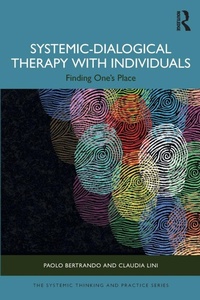
Systemic-Dialogical Therapy with Individuals
Finding One's Place
1st Edition
Published on 4. September 2025
Book
Paperback/Softback
252 pages
978-1-032-43855-9 (ISBN)
Description
In this book, Paolo Bertrando and Claudia Lini provide a comprehensive and cutting-edge overview of the systemic-dialogical approach, adapted to the ever-evolving requirements of modern-day therapy with individuals.
Following on from the field-defining work Systemic Therapy with Individuals, and easily used as a companion, this book introduces a new dialogical approach which will encourage practising therapists to adopt a collaborative and empowered stance in their work. The authors interweave clinical examples and transcripts of sessions collated from over a decade of work to illustrate the applied benefits of this approach in the contemporary therapeutic space. The case studies include work with those experiencing the oppression of patriarchal relationships, social and emotional isolation, physical abuse and pathological shame, reinvigorating and modernising the therapist's understanding of these lived experiences. Moving from general concepts to practical issues, the book explores queer theory, feminist theory, non-traditional family formats, and the impact of neoliberalism. The holistic and systemic approach will guide the reader to work better with clients from all genders, races and economic situations. Building on the foundations of systemic therapy, the theories develop our understanding of emotions and the body, while Bertrando and Lini introduce the concept of 'finding one's place' as a means of encouraging individual positional responsibility.
Presenting an empathetic and inclusive understanding of contemporary life and psychic experiences, as well as personal, couple and familial relationships, this book provides invaluable techniques on how to conduct sessions, and will benefit students and practitioners of psychotherapy, including systemic family therapists, psychoanalysts, psychiatrists, psychologists, psychiatric nurses, occupational therapists, and social workers.
Following on from the field-defining work Systemic Therapy with Individuals, and easily used as a companion, this book introduces a new dialogical approach which will encourage practising therapists to adopt a collaborative and empowered stance in their work. The authors interweave clinical examples and transcripts of sessions collated from over a decade of work to illustrate the applied benefits of this approach in the contemporary therapeutic space. The case studies include work with those experiencing the oppression of patriarchal relationships, social and emotional isolation, physical abuse and pathological shame, reinvigorating and modernising the therapist's understanding of these lived experiences. Moving from general concepts to practical issues, the book explores queer theory, feminist theory, non-traditional family formats, and the impact of neoliberalism. The holistic and systemic approach will guide the reader to work better with clients from all genders, races and economic situations. Building on the foundations of systemic therapy, the theories develop our understanding of emotions and the body, while Bertrando and Lini introduce the concept of 'finding one's place' as a means of encouraging individual positional responsibility.
Presenting an empathetic and inclusive understanding of contemporary life and psychic experiences, as well as personal, couple and familial relationships, this book provides invaluable techniques on how to conduct sessions, and will benefit students and practitioners of psychotherapy, including systemic family therapists, psychoanalysts, psychiatrists, psychologists, psychiatric nurses, occupational therapists, and social workers.
Reviews / Votes
'Systemic-Dialogical Therapy with Individuals is a groundbreaking exploration of therapy in today's complex world. Bertrando and Lini seamlessly integrate systemic, dialogical, and feminist perspectives to address the evolving challenges of modern individuals shaped by neoliberalism, digital life, and shifting intimacies. Rich with theoretical insights and clinical examples, the book offers a compassionate, relational approach that is both practical and inspiring. A must-read for therapists, this work redefines individual therapy for our time while honoring the roots of systemic thought.'Prof. Dr. Peter Rober, author of Becoming an Effective Family Therapist (Routledge 2024)
More details
Series
Language
English
Place of publication
London
United Kingdom
Publishing group
Taylor & Francis Ltd
Target group
Professional and scholarly
College/higher education
Professional Practice & Development and Professional Reference
Dimensions
Height: 234 mm
Width: 156 mm
Thickness: 14 mm
Weight
406 gr
ISBN-13
978-1-032-43855-9 (9781032438559)
Copyright in bibliographic data and cover images is held by Nielsen Book Services Limited or by the publishers or by their respective licensors: all rights reserved.
Schweitzer Classification
Other editions
Additional editions
E-Book
09/2025
1st Edition
Routledge
€36.99
Available for download
E-Book
09/2025
1st Edition
Routledge
€36.99
Available for download
Book
09/2025
1st Edition
Routledge
€206.50
Shipment within 10-20 days
Persons
Paolo Bertrando is a psychiatrist and systemic-dialogical therapist based in Milan, Italy. He is the co-director of the Systemic-Dialogical School of Therapy based in Italy and is the author of The Time of Times: A Perspective on Time in Systemic Therapy and Consultation (2019), Emotions and the Therapist: A Systemic-Dialogical Approach (2015) and The Dialogical Therapist: Dialogue in Systemic Practice (2007).
Claudia Lini is a psychologist and systemic-dialogical therapist based in Milan, Italy. She is the co-director of the Systemic-Dialogical School of Therapy. Her main interests are gender issues and creative processes in therapy.
Claudia Lini is a psychologist and systemic-dialogical therapist based in Milan, Italy. She is the co-director of the Systemic-Dialogical School of Therapy. Her main interests are gender issues and creative processes in therapy.
Content
Series Editor Foreword Foreword by Sheila McNamee Introduction 1. Individuals 2. Genders 3. Practices 4. (Systemic) Dialogues 5. Emotions 6. Finding one's place 7. Responsibilities 8. Expectations Epilogue: Conscientious individualism Appendix 1: the evolution of an approach Appendix 2: Feminisms