

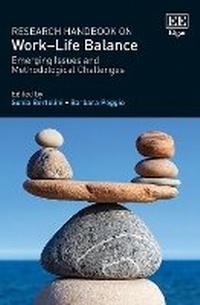
Research Handbook on Work-Life Balance
Emerging Issues and Methodological Challenges
Published on 8. August 2023
Book
Paperback/Softback
336 pages
978-1-0353-2364-7 (ISBN)
Description
This innovative and thought-provoking Research Handbook explores the theoretical debate surrounding work-life balance, and provides a reflection on the opportunity to adopt multilevel research approaches and perspectives, along gender and temporal axes. The Research Handbook is an international overview of current research on work-life balance, considered in macro, meso and micro perspectives.
Offering both theoretical reflections and empirical research examples illustrating the multiple strategies through which the different articulations that characterize the work-life intersection can be analysed, this Research Handbook includes analyses of gendered labour, generational assets and technological changes. Contributors provide translation and actualization of specific research practices and methodological choices, focused on different national contexts. The empirical analysis ranges from comparative research based on quantitative methods, to qualitative approaches centered on longitudinal, discursive and narrative perspectives, and mixed-method studies. Further contributions adopt innovative research methods based on the use of digital and visual technologies.
This Research Handbook will be an inspiring read for both undergraduate and postgraduate sociology and social policy students. The book is also addressed to researchers, consultants and policy makers interested in work-life balance issues.
Offering both theoretical reflections and empirical research examples illustrating the multiple strategies through which the different articulations that characterize the work-life intersection can be analysed, this Research Handbook includes analyses of gendered labour, generational assets and technological changes. Contributors provide translation and actualization of specific research practices and methodological choices, focused on different national contexts. The empirical analysis ranges from comparative research based on quantitative methods, to qualitative approaches centered on longitudinal, discursive and narrative perspectives, and mixed-method studies. Further contributions adopt innovative research methods based on the use of digital and visual technologies.
This Research Handbook will be an inspiring read for both undergraduate and postgraduate sociology and social policy students. The book is also addressed to researchers, consultants and policy makers interested in work-life balance issues.
Reviews / Votes
'This wonderful Research Handbook introduces scholarly debates on work-life balance, provides new theoretical approaches and insights, proposes innovative qualitative and quantitative research methods, and uses longitudinal and cross-national research examples in the analysis of how people define and reconcile family and work relationships.' -- Hans-Peter Blossfeld, Emeritus of Excellence, TRAc, Otto-Friedrich-Universitaet Bamberg, Germany 'This excellent collection enriches substantially the work-life balance literature both at the theoretical and empirical level. Focusing on the changing and diversified contexts in which work-life tensions are experienced and balances negotiated across gender and employment relations, the authors shed new light on the different micro and macro dimensions involved, as well as on the importance of a life course perspective. Using a variety of research methods, they look at different kinds of workers and working conditions, highlighting also the ongoing redefinition of the boundaries between (paid) work and other life spheres.' -- Chiara Saraceno, Collegio Carlo Alberto, Turin, ItalyMore details
Language
English
Place of publication
Cheltenham
United Kingdom
Target group
Professional and scholarly
Dimensions
Height: 244 mm
Width: 169 mm
ISBN-13
978-1-0353-2364-7 (9781035323647)
Copyright in bibliographic data and cover images is held by Nielsen Book Services Limited or by the publishers or by their respective licensors: all rights reserved.
Schweitzer Classification
Persons
Edited by Sonia Bertolini, Department of Cultures, Politics and Society, University of Turin and Barbara Poggio, Department of Sociology and Social Research, University of Trento, Italy
Content
Contents:
1 Introduction to the Research Handbook on Work-Life Balance 1
Sonia Bertolini and Barbara Poggio
PART I THEORETICAL AND METHODOLOGICAL FRAMEWORK
2 Work-life balance and beyond: premises and challenges 8
Anna Carreri, Annalisa Dordoni, and Barbara Poggio
3 Doing research on work-life balance 27
Sonia Bertolini and Rosy Musumeci
PART II MULTILEVEL PERSPECTIVES ALONG GENDER AND
TEMPORAL AXES
4 Research on work-life balance: a gender structure analysis 50
Emily Hallgren and Barbara J. Risman
5 Work-life balance through the life course 72
Jeanne Ganault and Ariane Pailhe
6 Work-(later) life balance: shifting the temporal frame 90
Anne E. Barrett, Rachel Douglas and Jessica Noblitt
PART III COMPARATIVE RESEARCH (APPROACHES AND STUDIES)
7 The household division of labour in Europe: a multilevel perspective 102
Dirk Hofaecker and Simone Braun
8 Subjective work-family conflicts: the challenge of studying
self-employed workers 118
Rossella Bozzon and Annalisa Murgia
PART IV LONGITUDINAL, DISCURSIVE AND NARRATIVE ANALYSIS
9 Qualitative longitudinal research for studying work-family balance
(before and after childbirth) 142
Manuela Naldini
10 Fathers in focus: two discursive analyses on addressing men, work and care 160
Suvi Heikkinen, Marjut Jyrkinen and Emilia Kangas
11 Work-life balance for fathers during paternal leave in Norway:
a narrative approach 176
Kristine Warhuus Smeby and Ulla Forseth
PART V MIXED AND MULTIMETHOD RESEARCH
12 Beyond the lines: gender, work, and care in the new economy - a view
from the U.S. 194
Kathleen Gerson and Mauro Migliavacca
13 The effect of childcare facilities on labour market participation among
young adults in Estonia: a mixed-methods study 217
Kadri Taeht, Marge Unt and Epp Reiska
14 Flexible work arrangements and diversity through a comparative and
multilevel lens 237
Eleni Stavrou and Myrto Anastassiadou
PART VI DIGITAL AND VISUAL METHODS
15 The gendered labour of work-life balance: using a new method to
understand an enduring dilemma 258
Julia Cook and Dan Woodman
16 'My work is full of gossipers so I tried to keep my pregnancy secret':
'distant' netnography as a qualitative method for exploring work-life
balance among pregnant and breastfeeding employees 274
Caroline Gatrell
17 The performance of oneself through visuals in interviews: queering the
work-life binary 293
Marjan De Coster and Patrizia Zanoni
Index
1 Introduction to the Research Handbook on Work-Life Balance 1
Sonia Bertolini and Barbara Poggio
PART I THEORETICAL AND METHODOLOGICAL FRAMEWORK
2 Work-life balance and beyond: premises and challenges 8
Anna Carreri, Annalisa Dordoni, and Barbara Poggio
3 Doing research on work-life balance 27
Sonia Bertolini and Rosy Musumeci
PART II MULTILEVEL PERSPECTIVES ALONG GENDER AND
TEMPORAL AXES
4 Research on work-life balance: a gender structure analysis 50
Emily Hallgren and Barbara J. Risman
5 Work-life balance through the life course 72
Jeanne Ganault and Ariane Pailhe
6 Work-(later) life balance: shifting the temporal frame 90
Anne E. Barrett, Rachel Douglas and Jessica Noblitt
PART III COMPARATIVE RESEARCH (APPROACHES AND STUDIES)
7 The household division of labour in Europe: a multilevel perspective 102
Dirk Hofaecker and Simone Braun
8 Subjective work-family conflicts: the challenge of studying
self-employed workers 118
Rossella Bozzon and Annalisa Murgia
PART IV LONGITUDINAL, DISCURSIVE AND NARRATIVE ANALYSIS
9 Qualitative longitudinal research for studying work-family balance
(before and after childbirth) 142
Manuela Naldini
10 Fathers in focus: two discursive analyses on addressing men, work and care 160
Suvi Heikkinen, Marjut Jyrkinen and Emilia Kangas
11 Work-life balance for fathers during paternal leave in Norway:
a narrative approach 176
Kristine Warhuus Smeby and Ulla Forseth
PART V MIXED AND MULTIMETHOD RESEARCH
12 Beyond the lines: gender, work, and care in the new economy - a view
from the U.S. 194
Kathleen Gerson and Mauro Migliavacca
13 The effect of childcare facilities on labour market participation among
young adults in Estonia: a mixed-methods study 217
Kadri Taeht, Marge Unt and Epp Reiska
14 Flexible work arrangements and diversity through a comparative and
multilevel lens 237
Eleni Stavrou and Myrto Anastassiadou
PART VI DIGITAL AND VISUAL METHODS
15 The gendered labour of work-life balance: using a new method to
understand an enduring dilemma 258
Julia Cook and Dan Woodman
16 'My work is full of gossipers so I tried to keep my pregnancy secret':
'distant' netnography as a qualitative method for exploring work-life
balance among pregnant and breastfeeding employees 274
Caroline Gatrell
17 The performance of oneself through visuals in interviews: queering the
work-life binary 293
Marjan De Coster and Patrizia Zanoni
Index