

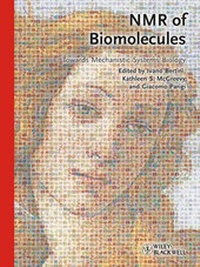
NMR of Biomolecules
Towards Mechanistic Systems Biology
1st Edition
Published on 14. March 2012
Book
Paperback/Softback
XXXVIII, 612 pages
978-3-527-32850-5 (ISBN)
Description
This practical approach title is the ultimate NMR guide for researchers in the biomedical community and gives not only background and practical tips but also a forward looking view on the future of NMR in systems biology.
Website: www.wiley-vch.de/home/nmrbiomol
Website: www.wiley-vch.de/home/nmrbiomol
More details
Edition
1. Auflage
Language
English
Place of publication
Berlin
Germany
Publishing group
Wiley-VCH
Target group
Professional and scholarly
Illustrations
110
20 s/w Tabellen, 98 s/w Abbildungen, 110 farbige Abbildungen
208 Abb. (110 Farbabb.), 20 Tab.
Dimensions
Height: 28 cm
Width: 21 cm
Thickness: 3.3 cm
Weight
1984 gr
ISBN-13
978-3-527-32850-5 (9783527328505)
Schweitzer Classification
Other editions
Additional editions

Ivano Bertini | Kathleen S. McGreevy | Giacomo Parigi
NMR of Biomolecules
Towards Mechanistic Systems Biology
E-Book
09/2012
1st Edition
Wiley-Blackwell
€99.99
Available for download

Ivano Bertini | Kathleen S. McGreevy | Giacomo Parigi
NMR of Biomolecules
Towards Mechanistic Systems Biology
E-Book
02/2012
1st Edition
Wiley-Blackwell
€99.99
Available for download
Persons
Ivano Bertini is a Professor of Chemistry and Founding Director of the Magnetic Resonance Center (CERM) at the University of Florence. His main research interests include advancements in nuclear magnetic resonance spectroscopy, the expression and preparation of metalloproteins, their structural characterization, and the investigation of their interactions, with an emphasis on understanding cellular processes at the molecular level. He has authored over 600 scientific publications and several books, and is or has been on the editorial staff or advisory board of over 20 of the most authoritative journals in chemistry, biochemistry and inorganic chemistry. He is a member of the Academia Europaea and the Italian Accademia dei Lincei.
Kathleen S. McGreevy is a researcher in bioinformatics at the Magnetic Resonance Center (CERM) at the University of Florence. After obtaining a degree in Mechanical Engineering from the University of Virginia in 2002, she became involved in the support and management of research activities in the biomedical sciences before moving to her current position. She has been involved in the management of several European projects, notably the FP6-funded Coordination Action NMR-Life, from which this volume takes its inspiration.
Giacomo Parigi, degree in Physics at the University of Florence (1992) and PhD in Chemistry, is Associate Professor of General and Inorganic Chemistry at the Magnetic Resonance Center (CERM) and the Department of Chemistry of the University of Florence. His research interests are mainly oriented to the study of NMR effects related to paramagnetism for the structural and dynamic characterization of biomolecules, to the analysis of the relaxometric profiles of paramagnetic systems and biomolecules, and to nuclear and electron relaxation.
Kathleen S. McGreevy is a researcher in bioinformatics at the Magnetic Resonance Center (CERM) at the University of Florence. After obtaining a degree in Mechanical Engineering from the University of Virginia in 2002, she became involved in the support and management of research activities in the biomedical sciences before moving to her current position. She has been involved in the management of several European projects, notably the FP6-funded Coordination Action NMR-Life, from which this volume takes its inspiration.
Giacomo Parigi, degree in Physics at the University of Florence (1992) and PhD in Chemistry, is Associate Professor of General and Inorganic Chemistry at the Magnetic Resonance Center (CERM) and the Department of Chemistry of the University of Florence. His research interests are mainly oriented to the study of NMR effects related to paramagnetism for the structural and dynamic characterization of biomolecules, to the analysis of the relaxometric profiles of paramagnetic systems and biomolecules, and to nuclear and electron relaxation.
Content
Website: www.wiley-vch.de/home/nmrbiomol
INTRODUCTION
NMR and its place in Mechanistic Systems Biology (Bertini, McGreevy, Parigi)
The structure of biomolecules: fundamentals
Structural features of proteins (Banci, Cantini)
Structural features of nucleic acids (Cevec, Jonker, Nozinovic, Richter, Schwalbe)
What can be learned about the structure and dynamics of biomolecules from NMR
Proteins studied by NMR (Ferella, Rosato, Turano)
Nucleic acids studied by NMR (Plavec)
THE ROLE OF NMR IN THE STUDY OF THE STRUCTURE AND DYNAMICS OF BIOMOLECULES
Determination of protein structure and dynamics (Ferella, Rosato, Turano)
DNA (Plavec)
RNA (Stefl, Sklenár)
Intrinsically disordered proteins (Felli, Pierattelli, Tompa)
Paramagnetic molecules (Bertini, Luchinat, Parigi)
THE ROLE OF NMR IN THE STUDY OF THE STRUCTURE AND DYNAMICS OF BIOMOLECULAR INTERACTIONS
NMR methodologies for the analysis of protein interactions (Madl, Sattler)
Metal-mediated interactions (Ciofi-Baffoni)
Protein-paramagnetic protein interactions (Keizers, Hiruma, Ubbink)
Protein-RNA interactions (Manoharan, Perez-Canadillas, Ramos)
Protein-DNA interactions (Kovacic, Boelens)
NMR IN DRUG DISCOVERY
High-throughput screening and fragment-based design: general considerations for lead discovery and optimization (Pellecchia)
Ligand-observed NMR in fragment-based approaches (Sledz, Abell, Ciulli)
Interactions of metallodrugs with DNA (Sadler)
RNA as a drug target (Ferner, Duchardt-Ferner, Rinnenthal, Buck, Wöhnert, Schwalbe)
Fluorine NMR spectroscopy for biochemical screening in drug discovery (Dalvit)
NMR of peptides (Beck, Frank, Kessler)
SOLID-STATE NMR
Biomolecular solid state NMR - basics (Barbet-Massin, Pintacuda)
Protein dynamics in the solid-state (Lewandowski, Emsley)
Microcrystalline proteins - An ideal benchmark for methodology development (Franks, van Rossum, Bardiaux, Ravera, Parigi, Luchinat, Oschkinat)
Structural studies of protein fibrils by solid-state NMR (Böckmann, Meier)
Membrane proteins (Cukkemane, Renault, Baldus)
FRONTIERS IN NMR SPECTROSCOPY
Dynamic nuclear polarization (Prisner)
13C direct detection NMR (Felli, Pierattelli)
Speeding up multidimensional NMR data acquisition (Brutscher, Marion, Frydman)
Metabolomics (Tenori)
In cell NMR spectroscopy (Burz, Cowburn, Dutta, Shekhtman)
Structural investigation of cell-free expressed membrane proteins (Sobhanifar, Reckel, Löhr, Bernhard, Dötsch)
COMPUTATIONAL ASPECTS
Grid computing (Rosato)
Protein-protein docking with HADDOCK (Schmitz, Melquiond, de Vries, Karaca, van Dijk, Kastritis, Bonvin)
Automated protein structure determination methods (Guerry, Herrmann)
NMR structure determination of protein-ligand complexes (Schieborr, Sreeramulu, Schwalbe)
SAXS/SANS as methods complementary to NMR (Petoukhov, Svergun)
INTRODUCTION
NMR and its place in Mechanistic Systems Biology (Bertini, McGreevy, Parigi)
The structure of biomolecules: fundamentals
Structural features of proteins (Banci, Cantini)
Structural features of nucleic acids (Cevec, Jonker, Nozinovic, Richter, Schwalbe)
What can be learned about the structure and dynamics of biomolecules from NMR
Proteins studied by NMR (Ferella, Rosato, Turano)
Nucleic acids studied by NMR (Plavec)
THE ROLE OF NMR IN THE STUDY OF THE STRUCTURE AND DYNAMICS OF BIOMOLECULES
Determination of protein structure and dynamics (Ferella, Rosato, Turano)
DNA (Plavec)
RNA (Stefl, Sklenár)
Intrinsically disordered proteins (Felli, Pierattelli, Tompa)
Paramagnetic molecules (Bertini, Luchinat, Parigi)
THE ROLE OF NMR IN THE STUDY OF THE STRUCTURE AND DYNAMICS OF BIOMOLECULAR INTERACTIONS
NMR methodologies for the analysis of protein interactions (Madl, Sattler)
Metal-mediated interactions (Ciofi-Baffoni)
Protein-paramagnetic protein interactions (Keizers, Hiruma, Ubbink)
Protein-RNA interactions (Manoharan, Perez-Canadillas, Ramos)
Protein-DNA interactions (Kovacic, Boelens)
NMR IN DRUG DISCOVERY
High-throughput screening and fragment-based design: general considerations for lead discovery and optimization (Pellecchia)
Ligand-observed NMR in fragment-based approaches (Sledz, Abell, Ciulli)
Interactions of metallodrugs with DNA (Sadler)
RNA as a drug target (Ferner, Duchardt-Ferner, Rinnenthal, Buck, Wöhnert, Schwalbe)
Fluorine NMR spectroscopy for biochemical screening in drug discovery (Dalvit)
NMR of peptides (Beck, Frank, Kessler)
SOLID-STATE NMR
Biomolecular solid state NMR - basics (Barbet-Massin, Pintacuda)
Protein dynamics in the solid-state (Lewandowski, Emsley)
Microcrystalline proteins - An ideal benchmark for methodology development (Franks, van Rossum, Bardiaux, Ravera, Parigi, Luchinat, Oschkinat)
Structural studies of protein fibrils by solid-state NMR (Böckmann, Meier)
Membrane proteins (Cukkemane, Renault, Baldus)
FRONTIERS IN NMR SPECTROSCOPY
Dynamic nuclear polarization (Prisner)
13C direct detection NMR (Felli, Pierattelli)
Speeding up multidimensional NMR data acquisition (Brutscher, Marion, Frydman)
Metabolomics (Tenori)
In cell NMR spectroscopy (Burz, Cowburn, Dutta, Shekhtman)
Structural investigation of cell-free expressed membrane proteins (Sobhanifar, Reckel, Löhr, Bernhard, Dötsch)
COMPUTATIONAL ASPECTS
Grid computing (Rosato)
Protein-protein docking with HADDOCK (Schmitz, Melquiond, de Vries, Karaca, van Dijk, Kastritis, Bonvin)
Automated protein structure determination methods (Guerry, Herrmann)
NMR structure determination of protein-ligand complexes (Schieborr, Sreeramulu, Schwalbe)
SAXS/SANS as methods complementary to NMR (Petoukhov, Svergun)