

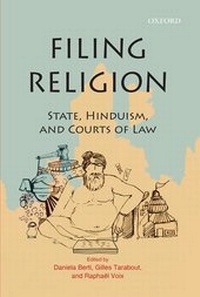
Filing Religion
State, Hinduism, and Courts of Law
Published on 30. June 2016
Book
Hardback
372 pages
978-0-19-946379-4 (ISBN)
Description
The Indian Constitution posits a separation between a secular domain that the state can regulate and a religious one in which it should not interfere. However, defining the separation between the two has proved contentious: the state is involved in various ways in the direct administration of many religious institutions; and courts are regularly asked to decide on rights linked to religious functions and bodies. Such decisions contribute to (re)defining religious categories and practices.
This edited volume aims at exploring how apparently technical legalistic action taking place in courts of law significantly shapes the place Hinduism occupies in Indian and Nepalese societies, perhaps even more so than the ideology of any political party. Thus, this volume does not deal so much with politics of secularism in general, but with how courts deal in practice with Hinduism. The approach developed in this volume is resolutely historical and anthropological. It considers law as part of social, religious, and political dynamics while relying on in-depth ethnography and archival research.
This edited volume aims at exploring how apparently technical legalistic action taking place in courts of law significantly shapes the place Hinduism occupies in Indian and Nepalese societies, perhaps even more so than the ideology of any political party. Thus, this volume does not deal so much with politics of secularism in general, but with how courts deal in practice with Hinduism. The approach developed in this volume is resolutely historical and anthropological. It considers law as part of social, religious, and political dynamics while relying on in-depth ethnography and archival research.
More details
Language
English
Place of publication
New Delhi
India
Target group
College/higher education
Dimensions
Height: 223 mm
Width: 148 mm
Thickness: 35 mm
Weight
540 gr
ISBN-13
978-0-19-946379-4 (9780199463794)
Copyright in bibliographic data and cover images is held by Nielsen Book Services Limited or by the publishers or by their respective licensors: all rights reserved.
Schweitzer Classification
Persons
Daniela Berti is a social anthropologist and research fellow at the National Centre for Scientific Research (CNRS), Paris, and a member of the Centre for Himalayan Studies (CEH), Villejuif.
Gilles Tarabout is a social anthropologist and Emeritus Senior Fellow at the National Centre for Scientific Research (CNRS), Paris.
Raphael Voix is a research fellow at National Center for Scientific Research (CNRS), Paris, and a member of the Center for Indian and South Asian Studies (CEIAS).
Gilles Tarabout is a social anthropologist and Emeritus Senior Fellow at the National Centre for Scientific Research (CNRS), Paris.
Raphael Voix is a research fellow at National Center for Scientific Research (CNRS), Paris, and a member of the Center for Indian and South Asian Studies (CEIAS).
Editor
, Social anthropologist and research fellow at the National Centre for Scientific Research (CNRS), Paris, and a member of the Centre for Himalayan Studies (CEH), Villejuif.
, Social anthropologist and Emeritus Senior Fellow at the National Centre for Scientific Research (CNRS), Paris.
, Research fellow at National Center for Scientific Research (CNRS), Paris, and a member of the Center for Indian and South Asian Studies (CEIAS).
Content
Foreword; Acknowledgments; Introduction; 1. Birth vs Merit: Kerala Temple Priests and the Courts; Gilles Tarabout; 2. National Gods at Court: Secularism and the Judiciary in Nepal; Chiara Letizia; 3. Plaintiff Deities: Ritual Honours as Fundamental Rights in India; Daniela Berti; 4. Celibate Gods and 'Essential Practices' Jurisprudence at Sabarimala, 1991-2011; Deepa Das Acevedo; 5. Slaves and Sons: The Court Dynamics of a Religious Dispute in South India; Ute
Huesken; 6. The Legal Making of a 'Hindu Sect': Understanding the Tandava Case in Its Context; Raphael Voix; 7. British Justice and the Lustful Mahant; France Bhattacharya; 8. 'This Land is Mine':
Mahants, Civil Law and Political Articulations of Hinduism in Twentieth Century North India; Malavika Kasturi; 9. Claiming Religious Rights from a Secular Power: Judgment Regarding the Rules of Succession to the Position of Shebait in a North Indian Temple; Catherine Clementin-Ojha; 10. Recent Changes in Case Law Concerning Hindu Marriage; Jean-Louis Halperin; 11. Unfair Advantage? Polygyny and Adultery in Indian Personal Law; Srimati Basu; Index; Notes on Editors and Contributors
Huesken; 6. The Legal Making of a 'Hindu Sect': Understanding the Tandava Case in Its Context; Raphael Voix; 7. British Justice and the Lustful Mahant; France Bhattacharya; 8. 'This Land is Mine':
Mahants, Civil Law and Political Articulations of Hinduism in Twentieth Century North India; Malavika Kasturi; 9. Claiming Religious Rights from a Secular Power: Judgment Regarding the Rules of Succession to the Position of Shebait in a North Indian Temple; Catherine Clementin-Ojha; 10. Recent Changes in Case Law Concerning Hindu Marriage; Jean-Louis Halperin; 11. Unfair Advantage? Polygyny and Adultery in Indian Personal Law; Srimati Basu; Index; Notes on Editors and Contributors