

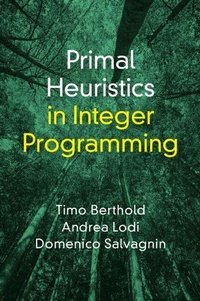
Primal Heuristics in Integer Programming
Published on 3. April 2025
Book
Paperback/Softback
139 pages
978-1-009-57480-8 (ISBN)
Description
Primal heuristics guarantee that feasible, high-quality solutions are provided at an early stage of the solving process, and thus are essential to the success of mixed-integer programming (MIP). By helping prove optimality faster, they allow MIP technology to extend to a wide variety of applications in discrete optimization. This first comprehensive guide to the development and use of primal heuristics within MIP technology and solvers is ideal for computational mathematics graduate students and industry practitioners. Through a unified viewpoint, it gives a unique perspective on how state-of-the-art results are integrated within the branch-and-bound approach at the core of the MIP technology. It accomplishes this by highlighting all the required knowledge needed to push the heuristic side of MIP solvers to their limit and pointing out what is left to do to improve them, thus presenting heuristic approaches for MIP as part of the MIP solving process.
Reviews / Votes
'Primal Heuristics in Integer Programming by Timo Berthold, Andrea Lodi, and Domenico Salvagnin is a groundbreaking work that offers deep insights and practical approaches to design sound heuristics for integer programming. This book will be an invaluable resource for both researchers and practitioners in the field. I will highly recommend the book to anyone looking to deepen their understanding of this crucial area.' Matteo Fischetti, University of Padua, Italy 'Primal Heuristics in Integer Programming is a singular work in the area of computational integer optimization. It aggregates many of the most important techniques that state-of-the-art solvers use for actually producing high-quality solutions to large-scale and/or difficult mixed-integer linear optimization problems. This book fills a big gap left by the many textbooks on mixed-integer linear optimization problems. Certainly it should be on the shelf of any student, researcher or practitioner who wants a complete picture of how such solvers work.' Jon Lee, University of MichiganMore details
Language
English
Place of publication
Cambridge
United Kingdom
Product notice
Paperback (trade)
Illustrations
Worked examples or Exercises
Dimensions
Height: 229 mm
Width: 152 mm
Thickness: 8 mm
Weight
215 gr
ISBN-13
978-1-009-57480-8 (9781009574808)
Copyright in bibliographic data and cover images is held by Nielsen Book Services Limited or by the publishers or by their respective licensors: all rights reserved.
Schweitzer Classification
Other editions
Additional editions
Timo Berthold | Andrea Lodi | Domenico Salvagnin
Primal Heuristics in Integer Programming
Book
04/2025
Cambridge University Press
€107.10
Shipment within 15-20 days
Persons
Timo Berthold is Lecturer at TU Berlin and a Director at FICO, leading the MIP research and development team of the FICO Xpress Solver. He is an expert on heuristic methods and computational mixed-integer linear and nonlinear programming. He has won multiple awards for his research. Andrea Lodi is Andrew H. and Ann R. Tisch Professor at the Jacobs Technion-Cornell Institute at Cornell Tech and the Technion - ITT. His main research interests are in mixed-integer linear and nonlinear programming and data science. He has been recognized by IBM and Google faculty awards, and the INFORMS Optimization Society 2021 Farkas Prize. He is a 2023 INFORMS Fellow. Domenico Salvagnin is Associate Professor in Operations Research at the University of Padua, Italy. He was lead development scientist in the IBM CPLEX team in 2015-2017 and is currently scientific consultant for FICO Xpress. His research interests include computational integer programming, constraint programming and hybrid methods for optimization.
Content
1. Introduction and concepts; 2. Large neighborhood search; 3. Rounding, propagation and diving; 4. The feasibility pump family; 5. Pivoting and line search heuristics; 6. Computational study; 7. Primal heuristics for mixed integer nonlinear programming; 8. Machine learning for primal heuristics; Appendix. Quiz solutions; References; Index.