

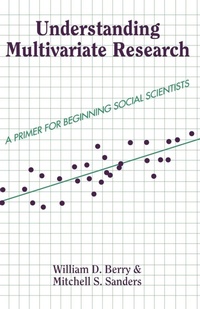
Understanding Multivariate Research
A Primer For Beginning Social Scientists
1st Edition
Published on 5. May 2000
Book
Paperback/Softback
216 pages
978-0-8133-9971-3 (ISBN)
Description
Although nearly all major social science departments offer graduate students training in quantitative methods, the typical sequencing of topics generally delays training in regression analysis and other multivariate techniques until a student's second year. William Berry and Mitchell Sanders's Understanding Multivariate Research fills this gap with a concise introduction to regression analysis and other multivariate techniques. Their book is designed to give new graduate students a grasp of multivariate analysis sufficient to understand the basic elements of research relying on such analysis that they must read prior to their formal training in quantitative methods. Berry and Sanders effectively cover the techniques seen most commonly in social science journals--regression (including nonlinear and interactive models), logit, probit, and causal models/path analysis. The authors draw on illustrations from across the social sciences, including political science, sociology, marketing and higher education. All topics are developed without relying on the mathematical language of probability theory and statistical inference. Readers are assumed to have no background in descriptive or inferential statistics, and this makes the book highly accessible to students with no prior graduate course work.
More details
Language
English
Place of publication
Oxford
United States
Publishing group
Taylor & Francis Inc
Target group
College/higher education
Professional and scholarly
Dimensions
Height: 216 mm
Width: 140 mm
Thickness: 6 mm
Weight
143 gr
ISBN-13
978-0-8133-9971-3 (9780813399713)
Copyright in bibliographic data and cover images is held by Nielsen Book Services Limited or by the publishers or by their respective licensors: all rights reserved.
Schweitzer Classification
Other editions
Additional editions
Book
05/2019
1st Edition
Routledge
€205.30
Shipment within 15-20 days
E-Book
05/2018
1st Edition
Routledge
€55.49
Available for download
E-Book
05/2018
1st Edition
Routledge
€55.49
Available for download
Person
William D. Berry is Professor of Political Science at Florida State University. He is a contributor to American Political Science Review, Public Administration Review, American Journal of Political Science, and Journal of Politics, and has served on the editorial board of the latter two journals. He has published several other books on related subjects, and has received the Policy Studies Organization's Harold Laswell Award for outstanding career contributions to the study of the policy making process. Berry has also served as president of the State Politics and Policy section of the American Political Science Association. Mitchell Sanders is Assistant Professor of Political Science at Florida State University. His research can be found in American Journal of Political Science, Political Research Quarterly, Public Choice, and Political Analysis.William D. Berry is Professor of Political Science at Florida State University. He is a contributor to American Political Science Review, Public Administration Review, American Journal of Political Science, and Journal of Politics, and has served on the editorial board of the latter two journals. He has published several other books on related subjects, and has received the Policy Studies Organization's Harold Laswell Award for outstanding career contributions to the study of the policy making process. Berry has also served as president of the State Politics and Policy section of the American Political Science Association. Mitchell Sanders is Assistant Professor of Political Science at Florida State University. His research can be found in American Journal of Political Science, Political Research Quarterly, Public Choice, and Political Analysis.
Content
* List of Tables and Figures * Preface for Teachers and Students * Acknowledgments Introduction * The Concept of Causation * Experimental Research * The Logic Underlying Regression Analysis * Some Necessary Math Background The Bivariate Regression Model * The Equation * The Intercept * The Slope Coefficient * The Error or Disturbance Term * Some Necessary Assumptions * Estimating Coefficients with Data from a Sample The Multivariate Regression Model * The Value of Multivariate Analysis * Interpreting the Coefficients of a Multivariate Regression Model * Dichotomous and Categorical Independent Variables * The Assumptions of Multivariate Regression * Choosing the Independent Variables for a Regression Model Evaluating Regression Results * Standardized Coefficients * Strong Relationships Among the Independent Variables: The Problem of Multicollinearity * Measuring the Fit of a Regression Model * Statistical Significance * Cross-Sectional vs. Time-Series Data Some Illustrations of Multiple Regression * Lobbying in Congress * Population Dynamics and Economic Development Advanced Topics * Interaction vs. Nonlinearity * Interactive Models * Nonlinear Models * Dichotomous Dependent Variables: Probit and Logit * Multi-equation Models: Simultaneous Equation Models and Recursive Causal Models Conclusion * Glossary * References * Index