

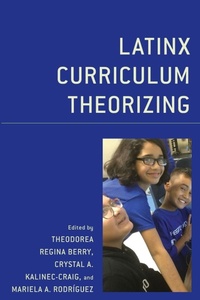
Latinx Curriculum Theorizing
Published on 5. April 2023
Book
Paperback/Softback
186 pages
978-1-4985-7382-5 (ISBN)
Description
This edited volume is a collection of empirical scholarship that focuses on curriculum as knowledge connected to the Latinx diaspora from three perspectives: content/subject matter; goals, objectives, and purposes; and experiences. In an effort to fill a void in scholarship in curriculum studies/theory for/from Latinx perspectives, this book is a beginning toward answering two important questions: first, what is the significance of the presence and absence of Latinx curriculum theorizing? And second, in what ways is Latinx curriculum theorizing connected to curriculum, as a general concept, schools' purposes, goals, and objectives and curriculum as autobiographical? This book opens a door into understanding curriculum for/from an important population in U.S. society.
More details
Series
Language
English
Place of publication
United States
Publishing group
Bloomsbury Publishing Plc
Target group
Professional and scholarly
Dimensions
Height: 229 mm
Width: 152 mm
Thickness: 10 mm
Weight
279 gr
ISBN-13
978-1-4985-7382-5 (9781498573825)
Copyright in bibliographic data and cover images is held by Nielsen Book Services Limited or by the publishers or by their respective licensors: all rights reserved.
Schweitzer Classification
Other editions
Additional editions
Persons
Theodorea Regina Berry is professor and chair of the Department of African American studies at San Jose State University.
Crystal Kalinec Craig is assistant professor of mathematics education in the Department of Interdisciplinary Learning and Teaching at the University of Texas at San Antonio.
Mariela A. Rodriguez professor in the Department of Educational Leadership and Policy Studies and associate dean of teaching, learning, and professional development for the graduate school at the University of Texas at San Antonio.
Crystal Kalinec Craig is assistant professor of mathematics education in the Department of Interdisciplinary Learning and Teaching at the University of Texas at San Antonio.
Mariela A. Rodriguez professor in the Department of Educational Leadership and Policy Studies and associate dean of teaching, learning, and professional development for the graduate school at the University of Texas at San Antonio.
Content
Prologue
Acknowledgments
Introduction
Section One: Latinx Curriculum and Content/Subject Matter
Chapter 1: Insurrection and the Decolonial Imaginary at Academia Cuauhtli: The Liberating Potential of Third Space Pedagogies in a Third Space, Angela Valenzuela
Chapter 2: "To Serve the People": Transformational Praxis of the Chicago Young Lords, Ann Aviles, Richard Benson, and Erica Davila
Chapter 3: Mathematics for Borderland Identities, Cristina Valencia Mazzanti and Martha Allexsaht-Snider
Section Two: Latinx Curriculum in Schools: Addressing Goals, Objectives, and Purposes
Chapter 4: Southern Latinxs: Toward a Curricular Epistemology of Dissent and Possibility, Juan F. Carrillo and Lucia I. Mock Munoz de Luna
Chapter 5: "Illegality" and the Curriculum: Making New Civics with Undocumented Activists, Jesus A. Tirado
Chapter 6: Radical Literacy: Building Curriculum on Mexican American Youth's Lived Experiences, Stacy Saathoff
Section Three: Latinx Currere, Latinx Curriculum as Autobiographical
Chapter 7: Conocimientos Mios: Engaging Possibilities for School Curriculum, Alba Isabel Lamar and Lynette DeAun Guzman
Chapter 8: "Un Puno de Tierra": Curriculum and Pedagogy Theorizing Along the U.S./Mexico Border, Ganiva Reyes
Chapter 9: Currere from the Borderlands: An Exercise in Possibilities for Latinx Transgender Visibility, Mario Itzel Suarez
Epilogue
About the Authors
Acknowledgments
Introduction
Section One: Latinx Curriculum and Content/Subject Matter
Chapter 1: Insurrection and the Decolonial Imaginary at Academia Cuauhtli: The Liberating Potential of Third Space Pedagogies in a Third Space, Angela Valenzuela
Chapter 2: "To Serve the People": Transformational Praxis of the Chicago Young Lords, Ann Aviles, Richard Benson, and Erica Davila
Chapter 3: Mathematics for Borderland Identities, Cristina Valencia Mazzanti and Martha Allexsaht-Snider
Section Two: Latinx Curriculum in Schools: Addressing Goals, Objectives, and Purposes
Chapter 4: Southern Latinxs: Toward a Curricular Epistemology of Dissent and Possibility, Juan F. Carrillo and Lucia I. Mock Munoz de Luna
Chapter 5: "Illegality" and the Curriculum: Making New Civics with Undocumented Activists, Jesus A. Tirado
Chapter 6: Radical Literacy: Building Curriculum on Mexican American Youth's Lived Experiences, Stacy Saathoff
Section Three: Latinx Currere, Latinx Curriculum as Autobiographical
Chapter 7: Conocimientos Mios: Engaging Possibilities for School Curriculum, Alba Isabel Lamar and Lynette DeAun Guzman
Chapter 8: "Un Puno de Tierra": Curriculum and Pedagogy Theorizing Along the U.S./Mexico Border, Ganiva Reyes
Chapter 9: Currere from the Borderlands: An Exercise in Possibilities for Latinx Transgender Visibility, Mario Itzel Suarez
Epilogue
About the Authors