

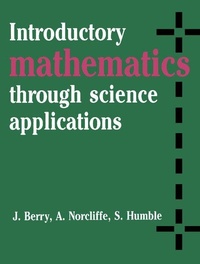
Introductory Mathematics through Science Applications
Published on 8. June 1989
Book
Paperback/Softback
560 pages
978-0-521-28446-2 (ISBN)
Description
This textbook, covering the basic mathematics taught to first-year students of science and engineering, reflects the growing awareness that ancillary mathematics should not be taught in isolation from its applications. Topics covered include calculus, ordinary and partial differential equations and statistics. Each chapter starts with two or three examples setting the new techniques to be studied in the context of the scientific world; the mathematics is then presented, along with worked examples. Numerical methods are integrated with analytical techniques where appropriate. The resulting textbook provides the teacher with a rich and varied source of applications for classroom use and students with a textbook for self-learning, giving insight into the significance and role of mathematics in science and engineering.
More details
Language
English
Place of publication
Cambridge
United Kingdom
Target group
College/higher education
Product notice
Paperback (trade)
Dimensions
Height: 246 mm
Width: 189 mm
Thickness: 30 mm
Weight
1069 gr
ISBN-13
978-0-521-28446-2 (9780521284462)
Copyright in bibliographic data and cover images is held by Nielsen Book Services Limited or by the publishers or by their respective licensors: all rights reserved.
Schweitzer Classification
Other editions
Additional editions
J. Berry | A. Norcliffe | S. Humble
Introductory Mathematics through Science Applications
Book
06/1989
Cambridge University Press
€68.09
Article exhausted; check for reprint
Previous edition
J. Berry | A. Norcliffe | S. Humble
Introductory Mathematics through Science Applications
Book
06/1989
Cambridge University Press
€68.09
Article exhausted; check for reprint
Content
Preface; 1. Basic functions; 2. Functions for science I: the exponential functions; 3. Functions for science II: trigonometric functions; 4. Functions for science III: inverse functions; 5. Other functions of science; 6. Differentiation I: rates of change; 7. Differentiation II: stationary points; 8. Differentiation III: approximation of functions; 9. Integration I: introduction and standard forms; 10. Integration II: techniques of integration; 11. Integration III: further techniques; 12. First-order differential equations; 13. Second-order ordinary differential equations; 14. Statistics I: frequency distributions and associated measures; 15. Statistics II: probability and probability distributions; 16. Statistics III: sampling, sampling distributions and hypothesis testing; 17. Partial differentiation I: introduction; 18. Partial differentiation II: stationary points; Answers to the exercises; Index.