

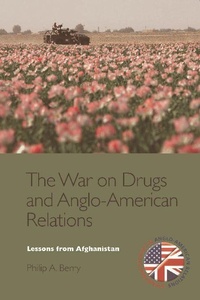
The War on Drugs and Anglo-American Relations
Lessons from Afghanistan, 2001-2011
Published on 30. November 2019
Book
Hardback
256 pages
978-1-4744-2108-9 (ISBN)
Description
Reveals the inside story of the formulation and implementation of the US and UK's counter-narcotics policies in Afghanistan Through interviews with key policy practitioners on both sides of the Atlantic, this study reveals the complex picture of counter narcotics strategy in Afghanistan. It highlights the key points of cooperation and contention, and details the often contradictory and competitive objectives of the overall war effort in Afghanistan.
Western counter-narcotics policies in Afghanistan failed dismally after opium poppy cultivation surged to unprecedented levels. The Anglo-American partnership at the centre of this battleground was divided by competing and opposing views of how to address the opium problem, which troubled the well-established Anglo-American relationship.
Western counter-narcotics policies in Afghanistan failed dismally after opium poppy cultivation surged to unprecedented levels. The Anglo-American partnership at the centre of this battleground was divided by competing and opposing views of how to address the opium problem, which troubled the well-established Anglo-American relationship.
Reviews / Votes
'Anyone who believes that western democracies should expend treasure and blood to curtail the production of illicit drugs in hostile, distant lands must read Philip Berry's work. It illuminates the confusion of purpose, lack of resources and any semblance of clear leadership among the British and American agencies in Afghanistan who were tasked with reducing that benighted country's opium harvests and rampant corruption.' - Kim Howells, Former Minister of State, Foreign and Commonwealth Office; 'A very informative and insightful account of Anglo-American counter-narcotics policies in Afghanistan between 2001 and 2011 that explains how common goals were affected by close cooperation, intense competition, and strong disagreements when devising policies and actions. Berry skillfully demonstrates how flawed analyses and inadequate solutions failed to address opium production in Afghanistan.' - Pierre-Arnaud Chouvy, UMR Prodig; 'Providing the definitive account of Anglo-American counter narcotic policies in Afghanistan between 2001 and 2011, this important work sheds new light on the oscillations, resilience and limitations of the special relationship within a fluid and complex policy environment. Informed by an impressive array of key informant interviews, Berry's work provides not only a fine-grained and nuanced account but also offers lessons learned for policy design in settings where multi-actor cooperation and competition is inherent.' - David R. Bewley-Taylor, Swansea University; 'Philip Berry has provided a rare and invaluable insight into the policy making process of international drug control. Drawing on first hand interviews with many of the main protagonists and extensive documentation from both sides of the Atlantic he exposes the challenges government officials faced in the messy policy process of Afghan nation building and drug control. A must read for all interested in international relations, drugs policy and Afghanistan.' - David Mansfield, London School of Economics.More details
Series
Language
English
Place of publication
Edinburgh
United Kingdom
Target group
College/higher education
Product notice
sewn/stitched
Cloth over boards
Dimensions
Height: 226 mm
Width: 155 mm
Thickness: 20 mm
Weight
522 gr
ISBN-13
978-1-4744-2108-9 (9781474421089)
Copyright in bibliographic data and cover images is held by Nielsen Book Services Limited or by the publishers or by their respective licensors: all rights reserved.
Schweitzer Classification
Other editions
Additional editions
E-Book
11/2019
Edinburgh University Press
€0.00
Available for download
Person
Philip A. Berry is Lecturer in War Studies Education in the Centre for Defence Studies at King's College London. He gained a PhD in Politics from the University of Dundee, where his research examined Anglo-American counter-narcotics policies in Afghanistan in the post-2001 era. His work on the subject has been published in The International History Review and Diplomacy & Statecraft.
Content
Acknowledgements
List of Acronyms
Maps and Chart
1. Introduction
Part 1
2. Anglo-American Relations and 9/11
3. The Legacy of Drugs and a Weak State 2
Part 2
4. Taliban Drugs on British Streets, 2001-2002
5. Lead Nation on Counter-Narcotics, 2002
6. Counter-Narcotics on the Hoof, 2002-2004
Part 3
7. Plan Afghanistan, 2004-2005
8. Afghanistan's Poppy Capital, 2005-2006
9. The Lesser of Two Evils, 2006-2007
10. The Showdown over Aerial Eradication, 2007
11. Counter-Narcotics in Transition, 2008
Part 4
12. Obama and Shifting Anglo-American Relations,
13. A Poisoned Chalice, 2009-2011
14. Conclusion
Appendix
Notes
Bibliography
Index
List of Acronyms
Maps and Chart
1. Introduction
Part 1
2. Anglo-American Relations and 9/11
3. The Legacy of Drugs and a Weak State 2
Part 2
4. Taliban Drugs on British Streets, 2001-2002
5. Lead Nation on Counter-Narcotics, 2002
6. Counter-Narcotics on the Hoof, 2002-2004
Part 3
7. Plan Afghanistan, 2004-2005
8. Afghanistan's Poppy Capital, 2005-2006
9. The Lesser of Two Evils, 2006-2007
10. The Showdown over Aerial Eradication, 2007
11. Counter-Narcotics in Transition, 2008
Part 4
12. Obama and Shifting Anglo-American Relations,
13. A Poisoned Chalice, 2009-2011
14. Conclusion
Appendix
Notes
Bibliography
Index