

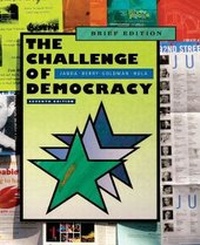
The Challenge of Democracy
American Government in a Global World, Brief Edition
7th Edition
Published on 30. December 2008
Book
Paperback/Softback
464 pages
978-0-547-21631-7 (ISBN)
Description
Based on the best-selling, full-length text THE CHALLENGE OF DEMOCRACY: GOVERNMENT IN AMERICA, Tenth Edition, this brief version maintains the same framework and motifs in a shorter format. The pedagogy is linked to two main themes: the conflicting values of freedom, order, and equality, and the majoritarianism versus pluralism debate. Extensively updated, this edition includes new examples, figures, data, and discussions about current issues. The authors have also added a balanced retrospective of the Bush presidency, as well as a focus on globalization and its implications and new comparative features that place the U.S. in a global context.
The Seventh Edition also includes access to AmericansGoverning.org, an online learning environment designed specifically to engage students in the political process through a variety of media, including original videos, campaign commercials, writing excerpts, simulations, and additional sources. Additional media tools include the new "In Our Own Words" feature-downloadable chapter overviews in MP3 format narrated by the authors-and marginal references to the award-winning site, IDEAlog.org.
The Seventh Edition also includes access to AmericansGoverning.org, an online learning environment designed specifically to engage students in the political process through a variety of media, including original videos, campaign commercials, writing excerpts, simulations, and additional sources. Additional media tools include the new "In Our Own Words" feature-downloadable chapter overviews in MP3 format narrated by the authors-and marginal references to the award-winning site, IDEAlog.org.
Reviews / Votes
1. Dilemmas of Democracy. 2. The Constitution. 3. Federalism. 4. Public Opinion, Political Socialization, and the Media. 5. Participation and Voting. 6. Political Parties, Campaigns, and Elections. 7. Interest Groups. 8. Congress. 9. The Presidency. 10. The Bureaucracy. 11. The Courts. 12. Order and Civil Liberties. 13. Equality and Civil Rights. 14. Policymaking and the Budget. Appendix. The Declaration of Independence. The Constitution of the United States of America.More details
Edition
7th edition
Language
English
Place of publication
Belmont, CA
United States
Publishing group
Cengage Learning, Inc
Target group
Professional and scholarly
Dimensions
Height: 238 mm
Width: 188 mm
Thickness: 20 mm
Weight
717 gr
ISBN-13
978-0-547-21631-7 (9780547216317)
Copyright in bibliographic data and cover images is held by Nielsen Book Services Limited or by the publishers or by their respective licensors: all rights reserved.
Schweitzer Classification
Persons
Jeffrey M. Berry is the John Richard Skuse Professor of Political Science at Tufts University. In addition to the American Political Science Association's Samuel Eldersveld Lifetime Achievement Award (2009), Dr. Berry received APSA best book" awards for THE REBIRTH OF URBAN DEMOCRACY (1994), A VOICE FOR NONPROFITS (2004) and LOBBYING AND POLITICAL CHANGE (2009) as well as an award from the Policy Studies Organization for THE NEW LIBERALISM (1999). His most recent book is THE OUTRAGE INDUSTRY: POLITICAL OPINION MEDIA AND THE NEW INCIVILITY (with Sarah Sobieraj). Following undergraduate work at the University of California, Berkeley, he completed his doctorate at Johns Hopkins University." Jerry Goldman is professor emeritus of political science at Northwestern University. He is the 2010 recipient of the first American Political Science Association/CQ Press Award for Teaching Innovation in Political Science and has received many other awards, including the American Bar Association's Silver Gavel for increasing the public's understanding of the law, the EDUCOM Medal and the Roman & Littlefield Prize for Teaching Innovation. In 2012, Dr. Goldman made the Fastcase 50: the 50 most interesting, provocative and courageous leaders in the world of law, scholarship and legal technology". Through the Oyez multimedia Supreme Court archive project at oyez.org, he has brought the U.S. Supreme Court closer to everyone. Following undergraduate work at Brooklyn College, he completed his Ph.D. at Johns Hopkins University." Kevin W. Hula (Ph.D., Harvard 1994) is Associate Professor of Political Science at Loyola University Maryland, where he teaches the introductory American Government course, as well as courses in the presidency, intelligence organizations, and interest groups. His research is in interest groups and the executive branch. He is author of Lobbying Together: Interest Group Coalitions in Legislative Politics, for which he received the Emerging Scholar Award from the APSA's Political Organizations and Parties section. Kenneth Janda is the Payson S. Wild Professor Emeritus of Political Science at Northwestern University. He has published extensively in comparative party politics, research methodology and early use of computer technology in political science, for which he received awards from EDUCOM and support from Apple. His American Political Science Association awards include the Samuel Eldersveld Lifetime Achievement Award for his studies of party politics (2000) and the Frank J. Goodnow Award for distinguished service to the profession and the association (2009). Dr. Janda and fellow author Dr. Jerry Goldman shared APSA technology awards in 1992 for the IDEAlog computer program and in 2005 for the IDEAlog website. His most recent books are A TALE OF TWO PARTIES; LIVING AMONGST DEMOCRATS AND REPUBLICANS SINCE 1952 (2021) and THE REPUBLICAN EVOLUTION: FROM GOVERNING PARTY TO ANTIGOVERNMENT PARTY, 1860-2020 (2022).
Content
1. Dilemmas of Democracy.
2. The Constitution.
3. Federalism.
4. Public Opinion, Political Socialization, and the Media.
5. Participation and Voting.
6. Political Parties, Campaigns, and Elections.
7. Interest Groups.
8. Congress.
9. The Presidency.
10. The Bureaucracy.
11. The Courts.
12. Order and Civil Liberties.
13. Equality and Civil Rights.
14. Policymaking and the Budget.
Appendix.
The Declaration of Independence.
The Constitution of the United States of America.
2. The Constitution.
3. Federalism.
4. Public Opinion, Political Socialization, and the Media.
5. Participation and Voting.
6. Political Parties, Campaigns, and Elections.
7. Interest Groups.
8. Congress.
9. The Presidency.
10. The Bureaucracy.
11. The Courts.
12. Order and Civil Liberties.
13. Equality and Civil Rights.
14. Policymaking and the Budget.
Appendix.
The Declaration of Independence.
The Constitution of the United States of America.