

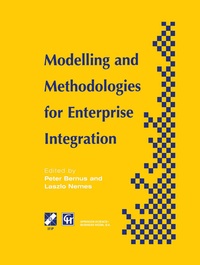
Modelling and Methodologies for Enterprise Integration
Proceedings of the IFIP TC5 Working Conference on Models and Methodologies for Enterprise Integration, Queensland, Australia, November 1995
Published on 31. May 2013
Book
Paperback/Softback
X, 454 pages
978-1-4757-5862-7 (ISBN)
Description
Enterprise integration and enterprise engineering has become a focal point of discussions during the past few years with active contribution of many disciplines... The evolution from the concept of CAD/CAM, through CIM to the Integrated Enterprise is based on the assumption that the integrated enterprise can (and should) be engineered just as any complex system can.
More details
Series
Edition
Softcover reprint of the original 1st ed. 1996
Language
English
Place of publication
New York
United States
Target group
Professional and scholarly
Research
Product notice
Paperback (trade)
Unsewn / adhesive bound
Illustrations
X, 454 p.
Dimensions
Height: 279 mm
Width: 210 mm
Thickness: 26 mm
Weight
1131 gr
ISBN-13
978-1-4757-5862-7 (9781475758627)
DOI
10.1007/978-0-387-34983-1
Schweitzer Classification
Other editions
Additional editions
Peter Bernus | Laszlo Nemes
Modelling and Methodologies for Enterprise Integration
Proceedings of the IFIP TC5 Working Conference on Models and Methodologies for Enterprise Integration, Queensland, Australia, November 1995
Book
07/1996
Chapman and Hall
€212.50
Shipment within 10-20 days
Content
One Papers.- 1 Enterprise integration - engineering tools for designing enterprises.- 2 Use of the Purdue enterprise reference architecture and methodology in industry (the Fluor Daniel example).- 3 Process oriented presentation of modelling methodologies.- 4 Enterprise representation: an analysis of standard issues.- 5 Process-oriented modelling and analysis of business processes using the R/3 reference model.- 6 A framework for business renovation: toward an intellectual infrastructure for the extended enterprise.- 7 Multicriteria-based decision making models for computer integrated enterprise.- 8 Conceptual design of information systems based on enterprise modelling.- 9 Manufacturing strategy assessment for enterprise integration.- 10 The logic of enterprise modelling.- 11 Repository structures for evolving federated database schemas.- 12 CIM business process and enterprise activity modelling.- 13 The meaning of an enterprise model.- 14 A situation theoretic approach to the representation of processes.- 15 Enterprise engineering methods and tools which facilitate simulation, emulation and enactment via formal models.- 16 Workflow-management-systems as enterprise engineering tools.- 17 Objects and environments in dynamic CIMOSA models.- 18 A systematic approach to the analysis and (re)design of logistic networks.- 19 Modeling and simulation in enterprise integration - a framework and an application in the offshore oil industry.- 20 Production scheduling: a generic building block for enterprise integration.- 21 Challenges and directions for EI: a distributed AI perspective.- 22 A methodology for developing agent based systems for enterprise integration.- 23 A change architecture for enterprises: a semiotic model.- 24 Distributed object oriented logic programming asa tool for enterprise modelling.- Two Transcript of Discussions and Panel Session.- Index of contributors.- Keyword index.