

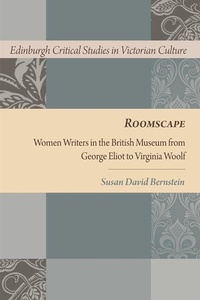
Roomscape
Women Writers in the British Museum from George Eliot to Virginia Woolf
Published on 14. March 2013
Book
Hardback
248 pages
978-0-7486-4065-2 (ISBN)
Description
Examines the Reading Room of the British Museum as a space of imaginative and historically generative potential in relation to the emergence of modern women writers in Victorian and early twentieth-century London
Drawing on archival materials around this national library reading room, Roomscape is the first study that integrates documentary, theoretical, historical, and literary sources to examine the significance of this public interior space for women writers and their treatment of reading and writing spaces in literary texts. This book challenges an assessment of the Reading Room of the British Museum as a bastion of class and gender privilege, an image firmly established by Virginia Woolf's 1929 A Room of One's Own and the legions of feminist scholarship that uphold this spatial conceit.
Susan David Bernstein argues not only that the British Museum Reading Room facilitated various practices of women's literary traditions, she also questions the overdetermined value of privacy and autonomy in constructions of female authorship, a principle generated from Woolf's feminist manifesto. Rather than viewing reading and writing as solitary, individual events, Roomscape considers the meaning of exteriority and the public and social and gendered dimensions of literary production.
In addition to new perspectives on George Eliot, Christina Rossetti, and Virginia Woolf, Roomscape offers original research on other novelists, poets, and translators including Amy Levy, Mathilde Blind, Eleanor Marx, Clementina Black, Constance Black Garnett, A. Mary F. Robinson, and Vernon Lee (Violet Paget). Looking at the Reading Room of the British Museum as a networking site for a variety of readers, this study examines political radicals and women activists who found a transnational community in this London public space. An appendix of notable readers lists details of more than 200 women readers who registered for admission to the Reading Room of the British Museum from the middle of the nineteenth century through the early twentieth century.
Drawing on archival materials around this national library reading room, Roomscape is the first study that integrates documentary, theoretical, historical, and literary sources to examine the significance of this public interior space for women writers and their treatment of reading and writing spaces in literary texts. This book challenges an assessment of the Reading Room of the British Museum as a bastion of class and gender privilege, an image firmly established by Virginia Woolf's 1929 A Room of One's Own and the legions of feminist scholarship that uphold this spatial conceit.
Susan David Bernstein argues not only that the British Museum Reading Room facilitated various practices of women's literary traditions, she also questions the overdetermined value of privacy and autonomy in constructions of female authorship, a principle generated from Woolf's feminist manifesto. Rather than viewing reading and writing as solitary, individual events, Roomscape considers the meaning of exteriority and the public and social and gendered dimensions of literary production.
In addition to new perspectives on George Eliot, Christina Rossetti, and Virginia Woolf, Roomscape offers original research on other novelists, poets, and translators including Amy Levy, Mathilde Blind, Eleanor Marx, Clementina Black, Constance Black Garnett, A. Mary F. Robinson, and Vernon Lee (Violet Paget). Looking at the Reading Room of the British Museum as a networking site for a variety of readers, this study examines political radicals and women activists who found a transnational community in this London public space. An appendix of notable readers lists details of more than 200 women readers who registered for admission to the Reading Room of the British Museum from the middle of the nineteenth century through the early twentieth century.
Reviews / Votes
...the sheer force of material reality described and analyzed by this astute, generous writer makes for rich, provocative reading. -- Gail Turley Houston, University of New Mexico * Journal of British Studies, Volume 53, Issue 01 * Roomscape [demonstrates] the continuing relevance, across time and space, of keeping our ears and eyes trained on the past in the interest of shaping our collective future as feminist scholars. -- Mary Jean Corbett, Miami University * Nineteenth Century Gender Studies; Issue 9.3 * Roomscape [demonstrates] the continuing relevance, across time and space, of keeping our ears and eyes trained on the past in the interest of shaping our collective future as feminist scholars. -- Mary Jean Corbett, Miami University * Nineteenth Century Gender Studies; Issue 9.3 * In a work of pioneering archival recovery and dazzling theoretical innovation, Susan Bernstein discovers a space where British women writers from George Eliot to Virginia Woolf found solace, intimacies, and communities crucial to their professional identities and intellectual development. Bernstein's ground-breaking feminist study produces startling new discoveries. No one will regard Virginia Woolf the same way. Roomscape is a tour de force of interdisciplinary cultural history of the highest order. * Priya Joshi, Temple University * By drawing women back towards the foci of 19th-century intellectual life, Bernstein has done library history a great service. -- Colin Higgins, Librarian, St Catharine's College, Cambridge * THE * Roomscape deserves to find a readership, for its original pursuit of a rich topic and the possibilities it suggests for further study. -- Matthew Ingleby * TLS * Roomscape deserves to find a readership, for its original pursuit of a rich topic and the possibilities it suggests for further study. -- Matthew Ingleby * TLS * In a work of pioneering archival recovery and dazzling theoretical innovation, Susan Bernstein discovers a space where British women writers from George Eliot to Virginia Woolf found solace, intimacies, and communities crucial to their professional identities and intellectual development. Bernstein's ground-breaking feminist study produces startling new discoveries. No one will regard Virginia Woolf the same way. Roomscape is a tour de force of interdisciplinary cultural history of the highest order. -- Priya Joshi, Temple UniversityMore details
Series
Language
English
Place of publication
Edinburgh
United Kingdom
Target group
College/higher education
Product notice
sewn/stitched
Cloth over boards
Illustrations
9 black and white illustrations
Dimensions
Height: 236 mm
Width: 157 mm
Thickness: 20 mm
Weight
522 gr
ISBN-13
978-0-7486-4065-2 (9780748640652)
Copyright in bibliographic data and cover images is held by Nielsen Book Services Limited or by the publishers or by their respective licensors: all rights reserved.
Schweitzer Classification
Other editions
Additional editions
Susan David Bernstein
Roomscape
Women Writers in the British Museum from George Eliot to Virginia Woolf
E-Book
03/2013
Edinburgh University Press
€0.00
Available for download
Person
Susan David Bernstein is Professor of English at the University of Wisconsin-Madison
Content
Acknowledgements; List of Figures; Abbreviations; Chapter One: Exteriority: Women Readers at the British Museum; Chapter Two: Translation Work and Women's Labour from the British Museum; Chapter Three: Poetry in the Round: Mutual Mentorships; Chapter Four: Researching Romola: George Eliot and Dome Consciousness; Chapter Five: Reading Woolf's Roomscapes; Coda: Closing Years and Afterlives; Notes; Bibliography; Appendix; Index.