

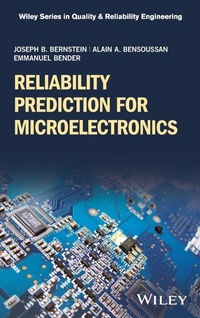
Reliability Prediction for Microelectronics
Published on 21. March 2024
Book
Hardback
400 pages
978-1-394-21093-0 (ISBN)
Description
Revolutionize your approach to reliability assessment with this groundbreaking book
Reliability evaluation is a critical aspect of engineering, without which safe performance within desired parameters over the lifespan of machines cannot be guaranteed. With microelectronics, in particular, the challenges to evaluating reliability are considerable, and statistical methods for creating microelectronic reliability standards are complex. With nano-scale microelectronic devices increasingly prominent in modern life, it has never been more important to understand the tools available to evaluate reliability.
Reliability Prediction for Microelectronics meets this need with a cluster of tools built around principles of reliability physics and the concept of remaining useful life (RUL). It takes as its core subject the 'physics of failure', combining a thorough understanding of conventional approaches to reliability evaluation with a keen knowledge of their blind spots. It equips engineers and researchers with the capacity to overcome decades of errant reliability physics and place their work on a sound engineering footing.
Reliability Prediction for Microelectronics readers will also find:
Focus on the tools required to perform reliability assessments in real operating conditions
Detailed discussion of topics including failure foundation, reliability testing, acceleration factor calculation, and more
New multi-physics of failure on DSM technologies, including TDDB, EM, HCI, and BTI
Reliability Prediction for Microelectronics is ideal for reliability and quality engineers, design engineers, and advanced engineering students looking to understand this crucial area of product design and testing.
Reliability evaluation is a critical aspect of engineering, without which safe performance within desired parameters over the lifespan of machines cannot be guaranteed. With microelectronics, in particular, the challenges to evaluating reliability are considerable, and statistical methods for creating microelectronic reliability standards are complex. With nano-scale microelectronic devices increasingly prominent in modern life, it has never been more important to understand the tools available to evaluate reliability.
Reliability Prediction for Microelectronics meets this need with a cluster of tools built around principles of reliability physics and the concept of remaining useful life (RUL). It takes as its core subject the 'physics of failure', combining a thorough understanding of conventional approaches to reliability evaluation with a keen knowledge of their blind spots. It equips engineers and researchers with the capacity to overcome decades of errant reliability physics and place their work on a sound engineering footing.
Reliability Prediction for Microelectronics readers will also find:
Focus on the tools required to perform reliability assessments in real operating conditions
Detailed discussion of topics including failure foundation, reliability testing, acceleration factor calculation, and more
New multi-physics of failure on DSM technologies, including TDDB, EM, HCI, and BTI
Reliability Prediction for Microelectronics is ideal for reliability and quality engineers, design engineers, and advanced engineering students looking to understand this crucial area of product design and testing.
More details
Series
Edition
1
Language
English
Place of publication
New York
United States
Target group
Professional and scholarly
Dimensions
Height: 229 mm
Width: 152 mm
Thickness: 22 mm
Weight
703 gr
ISBN-13
978-1-394-21093-0 (9781394210930)
Copyright in bibliographic data and cover images is held by Nielsen Book Services Limited or by the publishers or by their respective licensors: all rights reserved.
Schweitzer Classification
Other editions
Additional editions
Joseph B. Bernstein | Alain Bensoussan | Emmanuel Bender
Reliability Prediction for Microelectronics
E-Book
02/2024
1st Edition
Wiley-ISTE
€120.99
Available for download
Joseph B. Bernstein | Alain Bensoussan | Emmanuel Bender
Reliability Prediction for Microelectronics
E-Book
02/2024
1st Edition
Wiley-ISTE
€120.99
Available for download
Persons
Joseph B. Bernstein, PhD, is director of the Laboratory for Failure Analysis and Reliability of Electronic Systems at Ariel University, Israel. He has worked and published extensively on failure analysis and defect avoidance in microelectronics, and is a senior member of IEEE.
Alain Bensoussan, PhD, is a consulting reliability engineer with decades of experience as an Expert on Optics and Opto-Electronics Parts at Thales Alenia Space. He has conducted research in many areas of microelectronics reliability and physics of failure.
Emmanuel Bender, PhD, completed his PhD in Electrical and Electronics Engineering, specializing in Microelectronics Reliability, at Ariel University, Israel, in 2022.
Alain Bensoussan, PhD, is a consulting reliability engineer with decades of experience as an Expert on Optics and Opto-Electronics Parts at Thales Alenia Space. He has conducted research in many areas of microelectronics reliability and physics of failure.
Emmanuel Bender, PhD, completed his PhD in Electrical and Electronics Engineering, specializing in Microelectronics Reliability, at Ariel University, Israel, in 2022.
Content
Author Biography
Series foreword
Preface
Scope
Introduction
Chapter 1. Conventional Electronic System Reliability Prediction
Chapter 2. The Fundamentals of Failure
Chapter 3. Physics of Failure Based Circuit Reliability
Chapter 4. Transition State Theory
Chapter 5. Multiple Failure Mechanism in Reliability Prediction
Chapter 6. System reliability
Chapter 7. Device Failure Mechanism
Chapter 8. Reliability Modeling of Electronic Packages
?
Series foreword
Preface
Scope
Introduction
Chapter 1. Conventional Electronic System Reliability Prediction
Chapter 2. The Fundamentals of Failure
Chapter 3. Physics of Failure Based Circuit Reliability
Chapter 4. Transition State Theory
Chapter 5. Multiple Failure Mechanism in Reliability Prediction
Chapter 6. System reliability
Chapter 7. Device Failure Mechanism
Chapter 8. Reliability Modeling of Electronic Packages
?