


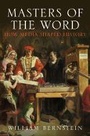
Masters of the Word
How Media Shaped History
Published on 2. January 2014
Book
Paperback/Softback
432 pages
978-1-78239-003-9 (ISBN)
Description
In Masters of the Word, Bernstein chronicles the development of the technology of human communication, or media, starting with the birth of writing thousands of years ago in Mesopotamia. In Sumer, and then Egypt, this revolutionary tool allowed rulers to extend their control far and wide, giving rise to the world's first empires. When Phoenician traders took their alphabet to Greece, literacy's first boom led to the birth of drama and democracy. In Rome, it helped spell the downfall of Empire.
As Bernstein illustrates, new communication technologies - from the clay tablet to the radio - have all had a profound effect on human society. But it's not just the technologies themselves that have changed the world, it's access to them. Medieval scriptoria and vernacular bibles gave rise to religious dissent, but it was only when the combination of cheaper paper and Gutenberg's printing press drove down the cost of books by some 97% that the dynamite of Reformation was lit.
The Industrial Revolution brought the telegraph and the steam driven printing press, allowing information to move faster than ever before and to reach an even larger audience. But along with radio and television, these new technologies were more easily exploited by the powerful, as seen in Germany, the Soviet Union, and even Rwanda, where radio incited genocide. With the rise of carbon duplicates (Russian samizdat), photocopying (the Pentagon Papers), and the internet and mobile phones (the Arab Spring), access has again spread and the world is both more connected, and more free, than ever before.
As Bernstein illustrates, new communication technologies - from the clay tablet to the radio - have all had a profound effect on human society. But it's not just the technologies themselves that have changed the world, it's access to them. Medieval scriptoria and vernacular bibles gave rise to religious dissent, but it was only when the combination of cheaper paper and Gutenberg's printing press drove down the cost of books by some 97% that the dynamite of Reformation was lit.
The Industrial Revolution brought the telegraph and the steam driven printing press, allowing information to move faster than ever before and to reach an even larger audience. But along with radio and television, these new technologies were more easily exploited by the powerful, as seen in Germany, the Soviet Union, and even Rwanda, where radio incited genocide. With the rise of carbon duplicates (Russian samizdat), photocopying (the Pentagon Papers), and the internet and mobile phones (the Arab Spring), access has again spread and the world is both more connected, and more free, than ever before.
Reviews / Votes
An engaging mix of theory, fact and enlightenment * Observer * There's something refreshing about a book that sees the digital revolution as being part of a far longer story than a 21st century game-changer... Bernstein alerts us to what we should be monitoring as we hurtle forward. * Prospect * [Bernstein's] narrative is succinct and extremely well sourced... [He] reminds us of a number of technologies whose changed roles are less widely chronicled in conventional histories of the media. * Irish Times *More details
Edition
Main
Language
English
Place of publication
London
United Kingdom
Target group
College/higher education
Professional and scholarly
Illustrations
1 x 16pp b/w plates
Dimensions
Height: 229 mm
Width: 149 mm
Thickness: 34 mm
Weight
678 gr
ISBN-13
978-1-78239-003-9 (9781782390039)
Copyright in bibliographic data and cover images is held by Nielsen Book Services Limited or by the publishers or by their respective licensors: all rights reserved.
Schweitzer Classification
Other editions
Previous edition
Book
05/2013
Atlantic Books
€37.50
Article not available at the moment
Person
William J. Bernstein is a historian and financial theorist whose books include The Birth of Plenty, The Four Pillars of Investing, and most recently, A Splendid Exchange, which was an Economist 'Book of the Year' and was shortlisted for the Financial Times/Goldman Sachs Business Book of the Year Award, 2008. He lives in the United States.