

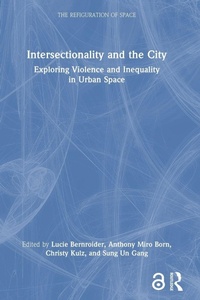
Intersectionality and the City
Exploring Violence and Inequality in Urban Space
1st Edition
Published on 6. June 2025
Book
Hardback
266 pages
978-1-032-65899-5 (ISBN)
Description
This book combines intersectional perspectives and urban research to demonstrate the importance of intersectionality as a concept that can complement "refigurational" understandings of social change as the outcome of spatial conflicts. Showing how intersectionality enables us to grasp the intersecting categories of inequality in these spatial tensions, it remains attentive to the role of social difference and power in these processes, as well as to modes of normativity and resistance. With case studies gathered from a range of national contexts, it provides rich empirical insights into the relationship between urban spatialities, power dynamics, and embodied social inequalities, addressing the manner in which different conflicts are made manifest intersectionally in and through situated urban spaces. The chapters consider issues such as the gendering and racialization of urban spaces; urban marginality and environmental pressures; intersectional power dynamics in research; heteronormative and cisgender- centric structures in the city; aging in the city; young people, control, and insecurity; police violence; migrant emplacement and activism; racialized gentrification and commoning, and pandemic safety and protest, to explore the uneven outcomes of spatial planning and urban development. As such, it draws attention to the interplay of various forces in the production of exclusion and injustice and will therefore appeal to scholars of sociology, geography, and urban studies with interests in inequality, social change, and resistance to exclusion.
More details
Series
Language
English
Place of publication
London
United Kingdom
Publishing group
Taylor & Francis Ltd
Target group
College/higher education
Professional and scholarly
Academic, Postgraduate, and Undergraduate Advanced
Illustrations
26 s/w Abbildungen, 6 farbige Abbildungen, 26 s/w Photographien bzw. Rasterbilder, 6 Farbfotos bzw. farbige Rasterbilder, 1 s/w Zeichnung
1 Line drawings, black and white; 6 Halftones, color; 26 Halftones, black and white; 6 Illustrations, color; 27 Illustrations, black and white
Dimensions
Height: 260 mm
Width: 183 mm
Thickness: 20 mm
Weight
730 gr
ISBN-13
978-1-032-65899-5 (9781032658995)
Copyright in bibliographic data and cover images is held by Nielsen Book Services Limited or by the publishers or by their respective licensors: all rights reserved.
Schweitzer Classification
Other editions
Additional editions
Lucie Bernroider | Anthony Miro Born | Christy Kulz
Intersectionality and the City
Exploring Violence and Inequality in Urban Space
E-Book
06/2025
1st Edition
Routledge
€0.00
Available for download
Lucie Bernroider | Anthony Miro Born | Christy Kulz
Intersectionality and the City
Exploring Violence and Inequality in Urban Space
E-Book
06/2025
1st Edition
Routledge
€0.00
Available for download
Lucie Bernroider | Anthony Miro Born | Christy Kulz
Intersectionality and the City
Exploring Violence and Inequality in Urban Space
Book
06/2025
1st Edition
Routledge
€82.60
Shipment within 10-20 days
Persons
Lucie Bernroider, Dr., is an anthropologist at the Collaborative Research Center "Re-Figuration of Spaces" at Technische Universitaet Berlin. Her research interests include space, gender and class, neoliberal urban development, and the anthropology of violence, with a regional focus on South Asia. She holds a doctorate from the University of Heidelberg and has been a visiting scholar at the Delhi School of Planning and Architecture.
Anthony Miro Born, PhD, is a sociologist and geographer with a particular interest in social inequality. Born's research focuses on the intersections of urban inequality and social class from multiple perspectives. He is currently an ESRC Postdoctoral Research Fellow at the London School of Economics and Political Science.
Christy Kulz, PhD, is a guest professor of sociology at Technische Universitaet Berlin. Her research interests focus on cultural sociology, with particular attention to how intersectional inequalities are made through everyday practices in urban space. Her publications include the research monograph Factories for Learning (2017) and the edited collection Inside the English Education Lab (2022).
Sung Un Gang, Dr., is a scholar of media and cultural studies at the Institute of Architecture, Technische Universitaet Berlin. As a research associate at the Collaborative Research Center "Re-Figuration of Spaces," he investigates the everyday spaces and digital communication practices of queer inhabitants in Seoul, South Korea. His main research areas include queer and intersectional feminism, urban culture and space, and postcolonial historiography.
Anthony Miro Born, PhD, is a sociologist and geographer with a particular interest in social inequality. Born's research focuses on the intersections of urban inequality and social class from multiple perspectives. He is currently an ESRC Postdoctoral Research Fellow at the London School of Economics and Political Science.
Christy Kulz, PhD, is a guest professor of sociology at Technische Universitaet Berlin. Her research interests focus on cultural sociology, with particular attention to how intersectional inequalities are made through everyday practices in urban space. Her publications include the research monograph Factories for Learning (2017) and the edited collection Inside the English Education Lab (2022).
Sung Un Gang, Dr., is a scholar of media and cultural studies at the Institute of Architecture, Technische Universitaet Berlin. As a research associate at the Collaborative Research Center "Re-Figuration of Spaces," he investigates the everyday spaces and digital communication practices of queer inhabitants in Seoul, South Korea. His main research areas include queer and intersectional feminism, urban culture and space, and postcolonial historiography.
Content
1. Introduction: Exploring urban violence and inequality from intersectional perspectives
Part 1: Conceptual terrains
2. Intersectionality: Gendering and racializing urban spaces
3. Arriving/being stopped: Six fatal shots and the sociology of place
4. Only a researcher's struggle? Reconceiving the ethnographic field as a relational space
5. Exploring urban spaces of socio-environmental entanglement in Lagos: A collaboration between a researcher and a visual artist
6. Urban violence, the state, and intersectionality: A conversation with Javier Auyero
Part 2: The social life of urban violence
7. "Half bread is better than none": Surviving in the Accra airport city
8. Negotiating everyday symbolic violence: Young Londoners imagining their futures from a deprived area
9. Escaping territories of terror: Protective strategies against intersectional violence at checkpoints
10. Young, female, disadvantaged: How parental guidance and societal gender stereotypes shape girls' and young women's spatial knowledge
11. Aging and intersectionality in the city: A critique of spaces of thrownapartness in Berlin (Germany)
12. Affective violence of the gaze in gender-segregated restrooms: An intersectional analysis
13. Kreuzberg is a construction site: A grounded theory in pictures
Part 3: Challenging urban violence
14. Intersectional geographies in the urban grid: (B)ordering technologies and migrant agency and resistance
15. The making of Keung To Bay: Fandom, urban space and affective alliance in Hong Kong
16. Risky migrants and citizens in need of protection: The transformation of safety on the conjuncture of pandemic and protest
17. Struggles in search of a ground: Protests after lockdown
Part 1: Conceptual terrains
2. Intersectionality: Gendering and racializing urban spaces
3. Arriving/being stopped: Six fatal shots and the sociology of place
4. Only a researcher's struggle? Reconceiving the ethnographic field as a relational space
5. Exploring urban spaces of socio-environmental entanglement in Lagos: A collaboration between a researcher and a visual artist
6. Urban violence, the state, and intersectionality: A conversation with Javier Auyero
Part 2: The social life of urban violence
7. "Half bread is better than none": Surviving in the Accra airport city
8. Negotiating everyday symbolic violence: Young Londoners imagining their futures from a deprived area
9. Escaping territories of terror: Protective strategies against intersectional violence at checkpoints
10. Young, female, disadvantaged: How parental guidance and societal gender stereotypes shape girls' and young women's spatial knowledge
11. Aging and intersectionality in the city: A critique of spaces of thrownapartness in Berlin (Germany)
12. Affective violence of the gaze in gender-segregated restrooms: An intersectional analysis
13. Kreuzberg is a construction site: A grounded theory in pictures
Part 3: Challenging urban violence
14. Intersectional geographies in the urban grid: (B)ordering technologies and migrant agency and resistance
15. The making of Keung To Bay: Fandom, urban space and affective alliance in Hong Kong
16. Risky migrants and citizens in need of protection: The transformation of safety on the conjuncture of pandemic and protest
17. Struggles in search of a ground: Protests after lockdown