

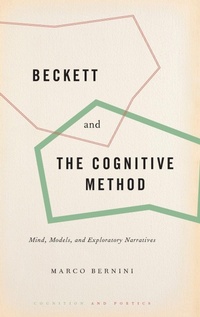
Beckett and the Cognitive Method
Mind, Models, and Exploratory Narratives
Published on 25. March 2022
Book
Hardback
264 pages
978-0-19-066435-0 (ISBN)
Description
Does literature merely represent cognitive processes, or can it enhance, parallel, or reassess the scientific study of the mind? Beckett and the Cognitive Method argues that Samuel Beckett's narrative work, rather than just expressing or rendering mental states, inaugurates an exploratory use of narrative as an introspective modeling technology. Through a detailed analysis of Beckett's entire corpus and published volumes of letters, this book argues that Beckett pioneered a new method of writing to construct (in a mode analogous to scientific inquiry) models for the exploration of core laws, processes, and dynamics in the human mind.
Marco Bernini integrates frameworks from contemporary narrative theory, cognitive sciences, phenomenology, and philosophy of mind to make a case for Beckett's modeling practice. Bernini demonstrates how this modeling applies to a vast array of processes including the (narrative) illusion of a sense of self, the dialogic interaction with memories and felt presences, the synesthetic nature of inner experience and mental imagery, the role of moods and emotions as cognitive drives, and the emergent quality of consciousness. Beckett and the Cognitive Method also reflects on how Beckett's fictional cognitive models are transformed into reading, auditory, or spectatorial experiences generating through narrative devices insights on what the sciences can only discursively report. As such, Bernini argues that literature should be considered a proper exploration of the mind, with its own tools and models for cognitive inquiry.
Marco Bernini integrates frameworks from contemporary narrative theory, cognitive sciences, phenomenology, and philosophy of mind to make a case for Beckett's modeling practice. Bernini demonstrates how this modeling applies to a vast array of processes including the (narrative) illusion of a sense of self, the dialogic interaction with memories and felt presences, the synesthetic nature of inner experience and mental imagery, the role of moods and emotions as cognitive drives, and the emergent quality of consciousness. Beckett and the Cognitive Method also reflects on how Beckett's fictional cognitive models are transformed into reading, auditory, or spectatorial experiences generating through narrative devices insights on what the sciences can only discursively report. As such, Bernini argues that literature should be considered a proper exploration of the mind, with its own tools and models for cognitive inquiry.
Reviews / Votes
Beckett is presumed to have hated philosophy but his plays tell us otherwise. He disliked academic pomp, but plumbed ideas to the depth. If you appreciate Beckett's theater you may want to use this well-researched book to go backstage and consider the thinking behind the words. * Antonio Damasio, Professor, David Dornsife Chair in Neuroscience, and Director of Brain and Creativity Institute, University of Southern California * In this meticulously researched book, Marco Bernini addresses the most perplexing aspects of Beckett's writing: his representation of altered states of consciousness, of voice hearing, and of varieties of introspection beyond everyday phenomenological levels of awareness. Through an intricate interweaving of narrative and cognitive theory, paired with arresting close readings, Beckett and the Cognitive Method advances a strikingly new argument that will transform our understanding of Beckett's work. * Ulrika Maude, Professor of Modern Literature, University of Bristol * The word 'landmark' is overused, but I believe it applies to this book. It reflects the author's sparkling intelligence and, at the same time, the book's deep research in philosophy, psychology, the cognitive sciences, narratology, literary criticism, and still other disciplines. Marco Bernini makes a genuine contribution that more than fulfills the promise of a genuine literary-scientific cross-pollinization in narratological and literary discourse. * Porter Abbott, Research Professor Emeritus of English, University of California, Santa Barbara * Marco Bernini...makes a convincing case, and his book offers fresh perspectives for anyone with an interest in Beckett, as well as being an excellent introduction for those curious about the methods and accomplishments of cognitive literary criticism right now. * Simon Kemp, Somerville College, Oxford, United Kingdom, French Studies *More details
Series
Language
English
Place of publication
New York
United States
Target group
Professional and scholarly
Dimensions
Height: 240 mm
Width: 161 mm
Thickness: 19 mm
Weight
561 gr
ISBN-13
978-0-19-066435-0 (9780190664350)
Copyright in bibliographic data and cover images is held by Nielsen Book Services Limited or by the publishers or by their respective licensors: all rights reserved.
Schweitzer Classification
Other editions
Additional editions
E-Book
10/2021
OUP eBook
€56.99
Available for download
E-Book
10/2021
OUP eBook
€56.99
Available for download
Person
Marco Bernini is Assistant Professor of Cognitive Literary Studies at Durham University. He specializes in narrative theory, modernism, and cognitive approaches to literature.
Content
Preface
Acknowledgments
Chapter 1: Modeling the Apparent Self
1.1. Awakening in the Bioscope: Wertheimeras Law, Predictive Self, and Chronotopic Groundlessness
1.2. A aTorrent of Meiosisa: Fissions, Relations, and the aPearl Viewa Explored
1.3. Introspection by Simulation: Inner Third-Person, Polyphony, and Centerless Storyworlds
1.4. Toward the aSeed of Motiona: Close and Beyond the Center of Narrative Gravity
Chapter 2: A Brain Listening to Itself
2.1. Tracing a Phenomenological Continuum: From the Clinical to the Fictional
2.2. Theorizing a Modeling Continuum: From AVHs to Inner Speech
2.3. Detuning a Fundamental Sound: Mediacy, Co-Modeling, and the Narrated Self
2.4. The Dialogic Cloud: On Memory and Co-Presence
Chapter 3: Synesthetic Innerscapes
3.1. Landscapes of Consciousness as Landscapes of Action: QuasiPerceptual Minds and the Basics of Innerscapes
3.2. Sculpting Latencies: Introspective Affordances, Narrativity, and Personal Geographies
3.3. Windows of Presence: Inner Ecologies and Dreamlike Worlds
3.4. aIn the Night That Tells No Talesa: Synesthesia, Narrative, Table Lamps, and Magic Lanterns
Chapter 4: Cognitive Liminalism
4.1. The Principle of Liminality: Limens and Limes across Domains
4.2. Toward Cognitive Liminalism: Impeded Logomotion and Deflated Narrative Gravity
4.3. Residual Teleodynamics and Maximal Prediction Errors: Emotions, Absential Features, and Cognitive Impenetrability
4.4. Cognitive Conceptual Personae: Enacting Sense-Making without Making Sense
Chapter 5: Emergence and Complexity
5.1. Against the Aboutness of Complexity: From Narrative Chaotics to Blueprints for Emergence
5.2. Neural and Mental Complexity: A Matter of Levels
5.3. The Dynamic Core of the Onion: Patterns, Nodes, Signals, and Boundaries
Conclusion: Toward a Phenomenogeology of Consciousness and the Co-Modeling of Cognition
References
Beckettas Works Cited
Index
Acknowledgments
Chapter 1: Modeling the Apparent Self
1.1. Awakening in the Bioscope: Wertheimeras Law, Predictive Self, and Chronotopic Groundlessness
1.2. A aTorrent of Meiosisa: Fissions, Relations, and the aPearl Viewa Explored
1.3. Introspection by Simulation: Inner Third-Person, Polyphony, and Centerless Storyworlds
1.4. Toward the aSeed of Motiona: Close and Beyond the Center of Narrative Gravity
Chapter 2: A Brain Listening to Itself
2.1. Tracing a Phenomenological Continuum: From the Clinical to the Fictional
2.2. Theorizing a Modeling Continuum: From AVHs to Inner Speech
2.3. Detuning a Fundamental Sound: Mediacy, Co-Modeling, and the Narrated Self
2.4. The Dialogic Cloud: On Memory and Co-Presence
Chapter 3: Synesthetic Innerscapes
3.1. Landscapes of Consciousness as Landscapes of Action: QuasiPerceptual Minds and the Basics of Innerscapes
3.2. Sculpting Latencies: Introspective Affordances, Narrativity, and Personal Geographies
3.3. Windows of Presence: Inner Ecologies and Dreamlike Worlds
3.4. aIn the Night That Tells No Talesa: Synesthesia, Narrative, Table Lamps, and Magic Lanterns
Chapter 4: Cognitive Liminalism
4.1. The Principle of Liminality: Limens and Limes across Domains
4.2. Toward Cognitive Liminalism: Impeded Logomotion and Deflated Narrative Gravity
4.3. Residual Teleodynamics and Maximal Prediction Errors: Emotions, Absential Features, and Cognitive Impenetrability
4.4. Cognitive Conceptual Personae: Enacting Sense-Making without Making Sense
Chapter 5: Emergence and Complexity
5.1. Against the Aboutness of Complexity: From Narrative Chaotics to Blueprints for Emergence
5.2. Neural and Mental Complexity: A Matter of Levels
5.3. The Dynamic Core of the Onion: Patterns, Nodes, Signals, and Boundaries
Conclusion: Toward a Phenomenogeology of Consciousness and the Co-Modeling of Cognition
References
Beckettas Works Cited
Index