

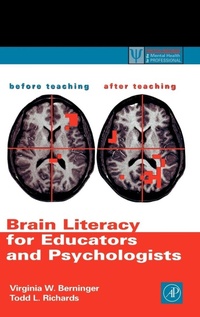
Brain Literacy for Educators and Psychologists
Published on 6. June 2002
Book
Hardback
400 pages
978-0-12-092871-2 (ISBN)
Description
Although educators are expected to bring about functional changes in the brain--the organ of human learning--they are given no formal training in the structure, function or development of the brain in formal or atypically developing children as part of their education. This book is organized around three conceptual themes: First, the interplay between nature (genetics) and nurture (experience and environment) is emphasized. Second, the functional systems of the brain are explained in terms of how they lead to reading, writing and mathematics and the design of instruction. Thirdly, research is presented, not as a finished product, but as a step forward within the field of educational neuropsychology. The book differs from neuropsychology and neuroscience books in that it is aimed at practitioners, focuses on high incidence neuropsychological conditions seen in the classroom, and is the only book that integrates both brain research with the practice of effective literacy, and mathematics instruction of the general and special education school-aged populations.
Reviews / Votes
"The authors, respected researchers and educators in this field, have developed an excellent resource for psychologists, educators, and graduate students... Brain Literacy for Educators and Psychologists is an excellent book... The book's content and explicit and implicit messages need to be widely disseminated to 21st-century educators." --CONTEMPORARY PSYCHOLOGYMore details
Series
Language
English
Place of publication
San Diego
United States
Publishing group
Elsevier Science Publishing Co Inc
Target group
Professional and scholarly
This practical primer is designed for educators interested in making sense of the cascading information on brain function and classroom learning for normal and disabled school aged children, This includes teachers in training at graduate and undergraduate levels, educational psychologists, learning disabilities specialists, school psychologists, school administrators and speech and language specialists.
Product notice
Laminated cover
Dimensions
Height: 233 mm
Width: 158 mm
Thickness: 24 mm
Weight
658 gr
ISBN-13
978-0-12-092871-2 (9780120928712)
Copyright in bibliographic data and cover images is held by Nielsen Book Services Limited or by the publishers or by their respective licensors: all rights reserved.
Schweitzer Classification
Other editions
Additional editions
Virginia W. Berninger | Todd L. Richards
Brain Literacy for Educators and Psychologists
E-Book
06/2002
Academic Press
€73.95
Available for download

Virginia W. Berninger | Todd L. Richards
Brain Literacy for Educators and Psychologists
Book
05/2002
Academic Press
€112.91
Shipment within 15-20 days
Persons
Professor of Educational Psychology at the University of Washington; Director of the NICHD funded Multidisciplinary Learning Disabilities Center Professor of Radiology at the University of Washington; Principle Investigator for the Brain Imaging Project at the Multidisciplinary Learning Disabilities Center
Content
Foreward.
Acknowledgements.
Part I: What Educators Ned to Know About the Brain.
Introduction and Conceptual Foundation.
General Principles of Microstructure and Microfunction.
General Principles of Macrostructure and Macrofunction.
General Principles of Brain Development.
Part II: Linking Brain Research to Literacy Research.
Building a Reading Brain Neurologically.
Building a Writing Brain Neurologically.
Building a Computing Brain Neurologically.
Part III: Linking Literacy Research to Brain Research.
Building a Reading Brain Pedagogically.
Building a Writing Brain Pedagogically.
Building a Computing Brain Pedagogically.
Part IV: Educational Applications of Brain-Literacy Links.
Implications for Educational Policy.
Implications for Classroom Practice.
Glossary.
References.
Index.
Acknowledgements.
Part I: What Educators Ned to Know About the Brain.
Introduction and Conceptual Foundation.
General Principles of Microstructure and Microfunction.
General Principles of Macrostructure and Macrofunction.
General Principles of Brain Development.
Part II: Linking Brain Research to Literacy Research.
Building a Reading Brain Neurologically.
Building a Writing Brain Neurologically.
Building a Computing Brain Neurologically.
Part III: Linking Literacy Research to Brain Research.
Building a Reading Brain Pedagogically.
Building a Writing Brain Pedagogically.
Building a Computing Brain Pedagogically.
Part IV: Educational Applications of Brain-Literacy Links.
Implications for Educational Policy.
Implications for Classroom Practice.
Glossary.
References.
Index.