

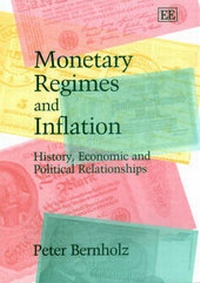
Monetary Regimes and Inflation
History, Economic and Political Relationships
Published on 29. January 2003
Book
Hardback
224 pages
978-1-84376-155-6 (ISBN)
Description
This book explores the characteristics of inflations, comparing historical cases from Roman times up to the modern day. High and moderate inflations caused by the inflationary bias of political systems and economic relationships - and the importance of different monetary regimes in containing them - are analysed. Peter Bernholz demonstrates that certain macroeconomic traits have been stable characteristics of inflations over the centuries, and illustrates their causes; the development of real stock of money, real exchange rate, real budget deficit and of currency substitution. He goes on to explain that metallic monetary regimes allow substantial inflations by debasement - 4th century Roman Empire experiencing the highest of them - but are dwarfed by the experience of hyperinflations. These occurred only under discretionary paper money regimes. To demonstrate this and their characteristics, all twenty-nine hyperinflations are studied. In contrast to the existing literature, the book also examines political conditions that allow a return to stable monetary regimes, given the inflationary tendencies of political systems. Finally, economic measures and institutional reforms to end high and moderate inflations are discussed.
To enliven reading, experiences of contemporary observers like Hemingway and Stefan Zweig, who did not have any knowledge of the economics of inflation, have been inserted. Consequently their evidence is often more convincing than any econometric analysis. Formal mathematical analysis has been kept to a minimum. Exceptions for providing a deeper understanding can be left out without losing the thread of the argument.
Monetary Regimes and Inflation will appeal to a wide audience including students, economists, historians, political scientists and sociologists. The book will also be warmly welcomed by bankers, businessmen and politicians facing, and perhaps attempting to solve, the problems of inflation.
To enliven reading, experiences of contemporary observers like Hemingway and Stefan Zweig, who did not have any knowledge of the economics of inflation, have been inserted. Consequently their evidence is often more convincing than any econometric analysis. Formal mathematical analysis has been kept to a minimum. Exceptions for providing a deeper understanding can be left out without losing the thread of the argument.
Monetary Regimes and Inflation will appeal to a wide audience including students, economists, historians, political scientists and sociologists. The book will also be warmly welcomed by bankers, businessmen and politicians facing, and perhaps attempting to solve, the problems of inflation.
Reviews / Votes
'Monetary Regimes and Inflation can be highly recommended to anybody interested in inflation and its manifold economic, social and political surroundings and consequences. This book by one of the world's leading scholars on monetary inflation and the institutional settings for money creation is a mine of information not only for students, but also for economists, historians, political scientists and sociologists; it is of relevance also for bankers, businessmen and politicians.' -- Gerard Radnitzky, Policy 'Peter Bernholz has spent a career examining the intertwined worlds of politics and economics with special attention to money, its effects, and the institutions critical to its value. His most recent book, Monetary Regimes and Inflation, is the kind of effort that can only be produced after years and even decades spent accumulating ideas and evidence. . . it is a concise, densely-packed, and tightly structured summary of key analytical propositions and data. On one level, it is fast-reading because Bernholz sticks to the most important paths and does not take readers down a bunch of rabbit trails. On another level, there are many parts of the book that demand revisiting, highlighting, and ruminating. . . this is an excellent example of "literary economics" in the best sense of the phrase. . . Put succinctly, it is a book written to be read and not just set on the shelf as a reference tool. . . All-in-all, Monetary Regimes and Inflation can be highly recommended as a book that will educate those with little knowledge of past inflations across the world as well as deepening and broadening the knowledge of those who already know the facts.' -- Brian Goff, Public Choice 'Peter Bernholz has provided us with a highly interesting and illuminating account of the vast sweep of monetary history in easy to read historical terms. The writing is crisp and the knowledge of monetary history is breathtaking. Students of monetary history will no doubt find this a fascinating and useful volume.' -- Pierre Siklos, EH.Net 'For two decades, I have urged Peter Bernholz to write this book. Analytically, historically, and empirically, Bernholz has established himself as the world's premier scholar on monetary inflation, and especially as related to the institutional settings for money creation. His careful evaluation of the comparative results must surely be of assistance in forestalling the social costs that inflation, anywhere and everywhere, produces.' -- James M. Buchanan, George Mason University, US and Nobel Laureate in EconomicsMore details
Language
English
Place of publication
Cheltenham
United Kingdom
Target group
Professional and scholarly
Dimensions
Height: 234 mm
Width: 156 mm
ISBN-13
978-1-84376-155-6 (9781843761556)
Copyright in bibliographic data and cover images is held by Nielsen Book Services Limited or by the publishers or by their respective licensors: all rights reserved.
Schweitzer Classification
Other editions
New editions
Peter Bernholz
Monetary Regimes and Inflation
History, Economic and Political Relationships: Second Edition
Book
04/2015
2nd Edition
Edward Elgar Publishing
€150.05
Shipment within 10-20 days
Person
Peter Bernholz, Professor Emeritus of Economics, Center for Economics and Business (WWZ), University of Basle, Switzerland
Content
Contents: Preface 1. Introduction 2. Inflation and Monetary Regimes 3. Inflation Under Metallic Monetary Regimes 4. Moderate Paper Money Inflations 5. Characteristics of Hyperinflations 6. Currency Competition, Inflation, Gresham's Law and Exchange Rate 7. Ending Mild or Moderate Inflations 8. Currency Reforms Ending Hyperinflations Index