

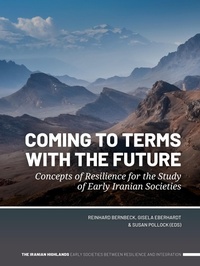
Coming to Terms with the Future
Concepts of Resilience for the Study of Early Iranian Societies
1st Edition
Published on 22. March 2023
Book
Paperback/Softback
270 pages
978-94-6426-145-5 (ISBN)
Description
The collection of essays in this book focuses on the highlands of Iran in pre-modern times, reaching from the Paleolithic to the medieval period. What holds the diverse contributions together is an issue that is closely related to debates in our own times: crises and how societies in the past dealt with them. We start from the premise that general circumstances in the fractured topographic structure of the Iranian highlands led to unique relations between ecological, social, economic and political conditions.In three sections entitled "Climate and palaeoenvironment", "Settlement, subsistence and mobility" und "Political and economic institutions", the authors ask what sorts of crises afflicted past societies in the Iranian highlands, to what extent they proved resilient, and especially what strategies they developed for enhancing the resilience of their ways of life. Looking for answers in paleoenvironmental proxy data, archaeological findings and written sources, the authors examine subsistence economies, political institutions, religious beliefs, everyday routines and economic specialization in different temporal, spatial and organizational scales.This book is the first volume of a series published by the German-Iranian research cooperation "The Iranian Highlands: Resiliences and Integration in Premodern Societies". The goal of the research project is to shine a new light on communities and societies that populated the Iranian highlands and their more or less successful strategies to cope with the many vagaries, the constant changes and risks of their natural and humanly shaped environments.
More details
Edition
1. Auflage
Language
English
Place of publication
Leiden
Netherlands
Target group
Professional and scholarly
Illustrations
64fc / 19bw
Dimensions
Height: 280 mm
Width: 210 mm
Thickness: 19 mm
Weight
1043 gr
ISBN-13
978-94-6426-145-5 (9789464261455)
Copyright in bibliographic data and cover images is held by Nielsen Book Services Limited or by the publishers or by their respective licensors: all rights reserved.
Schweitzer Classification
Persons
Reinhard Bernbeck is Professor of Western Asian archaeology at the Freie Universitaet Berlin and professor emeritus of Anthropology at Binghamton University. His interests include the prehistory of Iran, archaeological manifestations of social and material inequality, economic exploitation and ideological dimensions of archaeological practice. Susan Pollock is professor of Western Asian Archaeology at the Freie Universitaet Berlin and professor emerita of Anthropology at Binghamton University. She has long-standing research interests in village, early state, and urban societies in Western Asia and has conducted fieldwork in Iraq, Iran, Turkey, and Turkmenistan. Her recent work has involved much more recent periods, with field projects on sites of the 20th century in and around Berlin. Her work draws on feminist and political economic approaches to the study of the past, with specific attention to processes of subjectivation and the place of commensality in social life.
She is the author of Ancient Mesopotamia: The Eden that Never Was, editor of Between Feasts and Daily Meals. Toward an Archaeology of Commensal Spaces, and co-editor (with Reinhard Bernbeck and Kamyar Abdi) of The 2003 Excavations at Tol-e Basi, Iran: Social Life in a Neolithic Village and (with Reinhard Bernbeck and Birguel OEguet) of Looking Closely. Excavations at Monjukli Depe, Turkmenistan, 2010 - 2014, Volume I. Gisela Eberhardt is a project manager for the joint research project "The Iranian Highlands. Resiliences and Integration in Premodern Societies" at Freie Universitaet Berlin and an editor in the editorial department at the German Archaeological Institute's (DAI) head office. She holds a PhD in archaeology from Humboldt-Universitaet zu Berlin and was one of the managing editors of Edition Topoi.
She is the author of the book Deutsche Ausgrabung im 'langen' 19. Jahrhundert. Eine problemorientierte Untersuchung zur archaeologischen Praxis (2011) and of the forthcoming chapter "From Deep Holes to the Bigger Picture. A History of Methods in Archaeological Excavation" in The Oxford Handbook of the History of Archaeology as well as co-editor (with Fabian Link) of Historiographical Approaches to Past Archaeological Research (2015).
She is the author of Ancient Mesopotamia: The Eden that Never Was, editor of Between Feasts and Daily Meals. Toward an Archaeology of Commensal Spaces, and co-editor (with Reinhard Bernbeck and Kamyar Abdi) of The 2003 Excavations at Tol-e Basi, Iran: Social Life in a Neolithic Village and (with Reinhard Bernbeck and Birguel OEguet) of Looking Closely. Excavations at Monjukli Depe, Turkmenistan, 2010 - 2014, Volume I. Gisela Eberhardt is a project manager for the joint research project "The Iranian Highlands. Resiliences and Integration in Premodern Societies" at Freie Universitaet Berlin and an editor in the editorial department at the German Archaeological Institute's (DAI) head office. She holds a PhD in archaeology from Humboldt-Universitaet zu Berlin and was one of the managing editors of Edition Topoi.
She is the author of the book Deutsche Ausgrabung im 'langen' 19. Jahrhundert. Eine problemorientierte Untersuchung zur archaeologischen Praxis (2011) and of the forthcoming chapter "From Deep Holes to the Bigger Picture. A History of Methods in Archaeological Excavation" in The Oxford Handbook of the History of Archaeology as well as co-editor (with Fabian Link) of Historiographical Approaches to Past Archaeological Research (2015).
Content
Climate and palaeoenvironment
Holocene Paleoenvironmental Change and Phases of Drought in the Iranian Highlands. A Review
Martin Kehl, Babak Rafiei-Alavi, Hamid Alizadeh Ketek Lahijani
The Impact of Climate on Human Occupations in Iran from the Neolithic to the Early Iron Age: An Attempt to Link Archaeological and Paleoclimate Records
Babak Rafiei-Alavi, Martin Kehl, Hamid Alizadeh Ketek Lahijani
Evidence of Neanderthal Resilience from Forty-five to Thirty-nine Thousand Years Ago at the Bawa Yawan Rockshelter, Kermanshah, Zagros Highlands
Saman Heydari-Guran, Nemat Hariri, Martin Kehl, Samran Asiabani, Faramarz Azizi, Elham Ghasidian
Water Stress and Imperial Politics in the Southern Zagros Mountains: An Interdisciplinary Approach in Long-Term Perspective
Andrea Ricci, Silvia Balatti, Elodie Brisset, Morteza Djamali, Abdolmajid Naderi Beni, Ahmad Azadi, Pejman Firoozbakhsh
Settlement, subsistence and mobility
Resilience in Practice: A View from the Kura-Araxes Cultural Tradition in Iran
Sepideh Maziar
Reaching the Breaking Point? Developments in the Chalcolithic to Early Bronze Age Varamin Plain
Susan Pollock, Morteza Hessari, Reinhard Bernbeck
The Bronze and Iron Age of Mazandaran (3200-1000 BCE): Resilience and Cultural Adaptability
Hassan Fazeli Nashli, Mojtaba Safari, Yunshi Huang, Zhenhua Deng, Hadi Davoudi, Xiaohong Wu
The Environmental Limitations for the Pastoral-Nomadic Way of Life in the Karadagh Highlands of Northwestern Iran: Evidence from the Iron Age I-II and Modern Times
Bahram Ajorloo
Political and economic institutions
Second-Year Cows for Manlari. Elamite State Investment in Cattle Husbandry in the Southern Zagros Mountains
Azam Rayat and Walther Sallaberger
Coping with Problems of Mining: Approaching Resilience Strategies through the Study of Resource-Scapes in the Iranian Highlands
Thomas Stoellner
Imperial Control and Highland Resilience in the Parthian Zagros
Michael Brown and Shelir Amelirad
Resilience in Centralized State Systems. The Persepolis Fortification Archive and Achaemenid Institutional Longevity
Wouter F. M. Henkelman, Kai Kaniuth, Kourosh Mohammadkhani
Prestigious Building and Urban Development in Ilkhanid Iran: The Rab?-i Rashi?di? in Tabriz as an Example of Resilience and Vulnerability in a Long-Term Perspective
Birgitt Hoffmann, Lorenz Korn, Thomas Lorain, Jonas Elbers, Maryam Moeini
Dynamics of Development and Resilience in Western Fars: The Bozpar Valley
Stefan R. Hauser, Giuseppe Labisi, Elnaz Rashidian
Holocene Paleoenvironmental Change and Phases of Drought in the Iranian Highlands. A Review
Martin Kehl, Babak Rafiei-Alavi, Hamid Alizadeh Ketek Lahijani
The Impact of Climate on Human Occupations in Iran from the Neolithic to the Early Iron Age: An Attempt to Link Archaeological and Paleoclimate Records
Babak Rafiei-Alavi, Martin Kehl, Hamid Alizadeh Ketek Lahijani
Evidence of Neanderthal Resilience from Forty-five to Thirty-nine Thousand Years Ago at the Bawa Yawan Rockshelter, Kermanshah, Zagros Highlands
Saman Heydari-Guran, Nemat Hariri, Martin Kehl, Samran Asiabani, Faramarz Azizi, Elham Ghasidian
Water Stress and Imperial Politics in the Southern Zagros Mountains: An Interdisciplinary Approach in Long-Term Perspective
Andrea Ricci, Silvia Balatti, Elodie Brisset, Morteza Djamali, Abdolmajid Naderi Beni, Ahmad Azadi, Pejman Firoozbakhsh
Settlement, subsistence and mobility
Resilience in Practice: A View from the Kura-Araxes Cultural Tradition in Iran
Sepideh Maziar
Reaching the Breaking Point? Developments in the Chalcolithic to Early Bronze Age Varamin Plain
Susan Pollock, Morteza Hessari, Reinhard Bernbeck
The Bronze and Iron Age of Mazandaran (3200-1000 BCE): Resilience and Cultural Adaptability
Hassan Fazeli Nashli, Mojtaba Safari, Yunshi Huang, Zhenhua Deng, Hadi Davoudi, Xiaohong Wu
The Environmental Limitations for the Pastoral-Nomadic Way of Life in the Karadagh Highlands of Northwestern Iran: Evidence from the Iron Age I-II and Modern Times
Bahram Ajorloo
Political and economic institutions
Second-Year Cows for Manlari. Elamite State Investment in Cattle Husbandry in the Southern Zagros Mountains
Azam Rayat and Walther Sallaberger
Coping with Problems of Mining: Approaching Resilience Strategies through the Study of Resource-Scapes in the Iranian Highlands
Thomas Stoellner
Imperial Control and Highland Resilience in the Parthian Zagros
Michael Brown and Shelir Amelirad
Resilience in Centralized State Systems. The Persepolis Fortification Archive and Achaemenid Institutional Longevity
Wouter F. M. Henkelman, Kai Kaniuth, Kourosh Mohammadkhani
Prestigious Building and Urban Development in Ilkhanid Iran: The Rab?-i Rashi?di? in Tabriz as an Example of Resilience and Vulnerability in a Long-Term Perspective
Birgitt Hoffmann, Lorenz Korn, Thomas Lorain, Jonas Elbers, Maryam Moeini
Dynamics of Development and Resilience in Western Fars: The Bozpar Valley
Stefan R. Hauser, Giuseppe Labisi, Elnaz Rashidian