

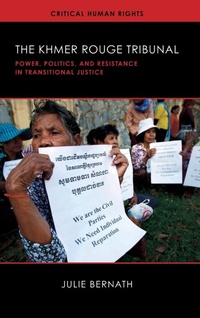
The Khmer Rouge Tribunal
Power, Politics, and Resistance in Transitional Justice
Published on 30. August 2023
Book
Hardback
288 pages
978-0-299-34360-6 (ISBN)
Description
Understanding the ECCC and transnational justice in a local context.
From 1975 to 1979, while Cambodia was ruled by the brutal Communist Party of Kampuchea (Khmer Rouge) regime, torture, starvation, rape, and forced labor contributed to the death of at least a fifth of the country's population. Despite the severity of these abuses, civil war and international interference prevented investigation until 2004, when protracted negotiations between the Cambodian government and the United Nations resulted in the establishment of the Extraordinary Chambers in the Courts of Cambodia (ECCC), or Khmer Rouge tribunal. The resulting trials have been well scrutinized, with many scholars seeking to weigh the results of the tribunal against the extent of the offenses.
Here, Julie Bernath takes a different tack, deliberately decentering the trials in an effort to understand the ECCC in its particular context-and, by extension, the degree to which notions of transitional justice generally must be understood in particular social, cultural, and political contexts. She focuses on "sites of resistance" to the ECCC, including not only members of the elite political class but also citizens who do not, for a variety of tangled reasons, participate in the tribunal-and even resistance from victims of the regime and participants in the trials. Bernath demonstrates that the ECCC both shapes and is shaped by long-term contestation over Cambodia's social, economic, and political transformations, and thereby argues that transitional justice must be understood locally rather than as a homogenous good that can be implanted by international actors.
From 1975 to 1979, while Cambodia was ruled by the brutal Communist Party of Kampuchea (Khmer Rouge) regime, torture, starvation, rape, and forced labor contributed to the death of at least a fifth of the country's population. Despite the severity of these abuses, civil war and international interference prevented investigation until 2004, when protracted negotiations between the Cambodian government and the United Nations resulted in the establishment of the Extraordinary Chambers in the Courts of Cambodia (ECCC), or Khmer Rouge tribunal. The resulting trials have been well scrutinized, with many scholars seeking to weigh the results of the tribunal against the extent of the offenses.
Here, Julie Bernath takes a different tack, deliberately decentering the trials in an effort to understand the ECCC in its particular context-and, by extension, the degree to which notions of transitional justice generally must be understood in particular social, cultural, and political contexts. She focuses on "sites of resistance" to the ECCC, including not only members of the elite political class but also citizens who do not, for a variety of tangled reasons, participate in the tribunal-and even resistance from victims of the regime and participants in the trials. Bernath demonstrates that the ECCC both shapes and is shaped by long-term contestation over Cambodia's social, economic, and political transformations, and thereby argues that transitional justice must be understood locally rather than as a homogenous good that can be implanted by international actors.
Reviews / Votes
Julie Bernath's focus on resistance to the Extraordinary Chambers in the Courts of Cambodia from different sites, levels, and actors adds an important, new analytical dimension to the study of the Khmer Rouge Tribunal. A substantial contribution to the literature on transitional justice in general and on the ECCC in particular." - Kheang Un, author of Cambodia: Return to Authoritarianism"In this authoritative work, Bernath meticulously examines the agency of the ruling Cambodian People's Party and victims of the Cambodian genocide in mounting different forms of resistance to the UN-backed transitional justice process. She painstakingly constructs a convincing account based on evidence closest to the Cambodian sources. It's an important book for students of transitional justice as well as scholars of contemporary Cambodia." - Kosal Path, author of Vietnam's Strategic Thinking during the Third Indochina War
More details
Series
Language
English
Place of publication
Wisconsin
United States
Target group
Professional and scholarly
Product notice
Laminated cover
Illustrations
8 b&w illustrations
Dimensions
Height: 229 mm
Width: 152 mm
Thickness: 18 mm
Weight
556 gr
ISBN-13
978-0-299-34360-6 (9780299343606)
Copyright in bibliographic data and cover images is held by Nielsen Book Services Limited or by the publishers or by their respective licensors: all rights reserved.
Schweitzer Classification
Persons
Julie Bernath, a senior researcher at swisspeace and the University of Basel, is the coeditor of Resistance and Transitional Justice.
Content
Table of contents
List of Illustrations
Acknowledgments
Introduction
1. Transitional Justice, Politics, and Resistance in Cambodia
2. The Khmer Rouge Tribunal: Patronage, Coercion, and Pragmatism
3. Victim Participation: From the Village to the Courtroom, Through Urban Spaces of Protest
4. Non-Participation: Transitional Justice in the Context of Political Violence
Conclusion
Bibliography
Index
List of Illustrations
Acknowledgments
Introduction
1. Transitional Justice, Politics, and Resistance in Cambodia
2. The Khmer Rouge Tribunal: Patronage, Coercion, and Pragmatism
3. Victim Participation: From the Village to the Courtroom, Through Urban Spaces of Protest
4. Non-Participation: Transitional Justice in the Context of Political Violence
Conclusion
Bibliography
Index