

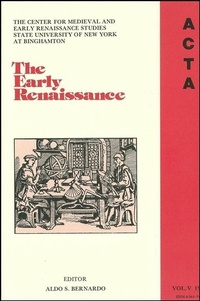
ACTA Volume #5
The Early Renaissance
Published on 1. January 1978
Book
Paperback/Softback
171 pages
978-1-4384-3841-2 (ISBN)
Description
Step into a world where literature, art, and history converge to illuminate the intellectual spirit of the late medieval and early Renaissance periods. This compelling collection of scholarly essays brings together leading voices in literary and cultural studies to explore the enduring power of texts, images, and ideas across Europe from 1300 to 1500.From the symbolic landscapes of Dante's Divine Comedy to the visual theology of Giotto's frescoes, and from Arthurian legend to the evolution of the book in Spanish literature, each chapter offers a rich, thought-provoking perspective on the narratives that shaped Western thought. These essays examine transformation--of myth, language, gender discourse, and urban space--revealing how writers and artists reimagined classical traditions and contemporary realities alike.
Engaging, insightful, and rigorously researched, this volume is an essential resource for students, scholars, and readers passionate about medieval and Renaissance studies. It invites you to rediscover familiar works through fresh critical lenses--and to uncover connections that continue to resonate today.
More details
Language
English
Place of publication
Albany, NY
United States
Publishing group
State University of New York Press
Product notice
Paperback (trade)
Illustrations
Total Illustrations: 10
Dimensions
Height: 222 mm
Width: 152 mm
Thickness: 25 mm
Weight
281 gr
ISBN-13
978-1-4384-3841-2 (9781438438412)
Copyright in bibliographic data and cover images is held by Nielsen Book Services Limited or by the publishers or by their respective licensors: all rights reserved.
Schweitzer Classification
Content
Introduction
1. Florence and Rome, the two cities of Man in The Divine Comedy
Joan Ferrante, Columbia University
2. The Rod of Tiresias: Dante's Metamorphosis of Ovid - Inf. XX 44
Robert Hollander, Princeton University
3. The Significance of Judas in Giotto's Arena Chapel Frecoes
Jame Czarnecki, SUNY Potsdam
4. The Erculean Addition to Ferrara: Contemporary Reactions and Pragmatic Considerations
Charles Rosenberg, SUNY Brockport
5. The Apology of Women in La Chasse et le Depart d'Amours (1509): Another Voice in the "Querelle de la Femme"
Mary Beth Marvin, SUNY Albany
6. Tragic Patterns in Malory's Morte Darthur: Medieval Narrative as Literary Myth
Maureen Fries, SUNY Fredonia
7. "Flyting No Reason Hath": The Inverted Rhetoric of Abuse
David Lampe, State University College at Buffalo
8. Sir Thomas Elyot and "Noble Homere"
Dale Hale, SUNY Brockport
9. The Concept "Book" in Spanish Literature from 1300 to 1500
Colbert Neapaulsingh, SUNY Albany
1. Florence and Rome, the two cities of Man in The Divine Comedy
Joan Ferrante, Columbia University
2. The Rod of Tiresias: Dante's Metamorphosis of Ovid - Inf. XX 44
Robert Hollander, Princeton University
3. The Significance of Judas in Giotto's Arena Chapel Frecoes
Jame Czarnecki, SUNY Potsdam
4. The Erculean Addition to Ferrara: Contemporary Reactions and Pragmatic Considerations
Charles Rosenberg, SUNY Brockport
5. The Apology of Women in La Chasse et le Depart d'Amours (1509): Another Voice in the "Querelle de la Femme"
Mary Beth Marvin, SUNY Albany
6. Tragic Patterns in Malory's Morte Darthur: Medieval Narrative as Literary Myth
Maureen Fries, SUNY Fredonia
7. "Flyting No Reason Hath": The Inverted Rhetoric of Abuse
David Lampe, State University College at Buffalo
8. Sir Thomas Elyot and "Noble Homere"
Dale Hale, SUNY Brockport
9. The Concept "Book" in Spanish Literature from 1300 to 1500
Colbert Neapaulsingh, SUNY Albany