

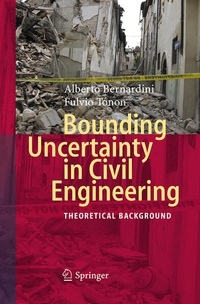
Bounding Uncertainty in Civil Engineering
Theoretical Background
Published on 31. October 2014
Book
Paperback/Softback
X, 322 pages
978-3-642-42542-4 (ISBN)
Description
Taking an engineering, rather than a mathematical, approach, Bounding uncertainty in Civil Engineering - Theoretical Background deals with the mathematical theories that use convex sets of probability distributions to describe the input data and/or the final response of systems. The particular point of view of the authors is centered on the applications to civil engineering problems, and the theory of random sets has been adopted as a basic and relatively simple model. However, the authors have tried to elucidate its connections to the more general theory of imprecise probabilities, Choquet capacities, fuzzy sets, p-boxes, convex sets of parametric probability distributions, and approximate reasoning both in one dimension and in several dimensions with associated joint spaces. If choosing the theory of random sets may lead to some loss of generality, it has, on the other hand, allowed for a self-contained selection of the topics and a more unified presentation of the theoretical contents and algorithms. With over 80 examples worked out step by step, the book should assist newcomers to the subject (who may otherwise find it difficult to navigate a vast and dispersed literature) in applying the techniques described to their own specific problems.
More details
Edition
2010 ed.
Language
English
Place of publication
Berlin
Germany
Publishing group
Springer Berlin
Target group
Professional and scholarly
Research
Illustrations
X, 322 p.
Dimensions
Height: 235 mm
Width: 155 mm
Thickness: 19 mm
Weight
511 gr
ISBN-13
978-3-642-42542-4 (9783642425424)
DOI
10.1007/978-3-642-11190-7
Schweitzer Classification
Other editions
Additional editions
Book
03/2010
Springer
€160.49
Shipment within 7-9 days
Content
Motivation.- Review of Theory of Probability and Notation.- Random Sets and Imprecise Probabilities.- Random Relations.- Inclusion and Mapping of Random Sets/Relations.- Approximate Reasoning.