

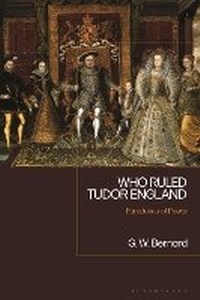
Who Ruled Tudor England
Paradoxes of Power
Published on 9. September 2021
Book
Hardback
240 pages
978-1-350-17689-8 (ISBN)
Description
Henry VIII's wives, his watershed break with Rome, Mary's 'bloody' persecution of Protestants and Elizabeth's fearless reign have been immortalised in history books and the public consciousness. This book widens the scope of established historiography by examining the dynamics of Tudor power and assessing where power really lay. By considering the roles of the monarch, church and individuals it sheds a fascinating light on the study of government in 16th century England.
Addressing different aspects of how Tudor England was governed, the twelve chapters discuss who participated in that government, and the extent of their power and governance. Paying close attention to the scholars who have shaped perceptions of major Tudor political figures, this book re-situates the dynamics of Tudor power and its historiography.
Addressing different aspects of how Tudor England was governed, the twelve chapters discuss who participated in that government, and the extent of their power and governance. Paying close attention to the scholars who have shaped perceptions of major Tudor political figures, this book re-situates the dynamics of Tudor power and its historiography.
Reviews / Votes
G. W. Bernard's Who Ruled Tudor England: Paradoxes of Power is a highly readable and thoughtful book, the core of which is serious criticism of Geoffrey Elton and his work on Thomas Cromwell and the Tudor revolution of government. * H-Net Reivews * George Bernard's clear yet nuanced and wide-ranging answer to his title's question draws on a lifetime's research and reflection. It includes both a trenchant rebuttal of Sir Geoffrey Elton's thesis of a 'revolution in government' and warm acknowledgement of those historians who shaped Professor Bernard's own approach to his subject. * Ralph Houlbrooke, Professor Emeritus, University of Reading, UK * This elegantly written, lucid rumination on the nature of Tudor power and historical interpretation is as brilliant and combative as one expects from G.W. Bernard. Provocative and important, Who Ruled Tudor England? is essential reading for students and scholars. * Suzannah Lipscomb, Professor Emerita of History, University of Roehampton, UK *More details
Language
English
Place of publication
London
United Kingdom
Publishing group
Bloomsbury Publishing PLC
Target group
College/higher education
Illustrations
5 bw illus
Dimensions
Height: 234 mm
Width: 156 mm
Weight
517 gr
ISBN-13
978-1-350-17689-8 (9781350176898)
Copyright in bibliographic data and cover images is held by Nielsen Book Services Limited or by the publishers or by their respective licensors: all rights reserved.
Schweitzer Classification
Other editions
Additional editions
E-Book
08/2021
1st Edition
Bloomsbury Academic
€32.99
Available for download
Person
G.W. Bernard is Professor of Early Modern History at the University of Southampton, UK.
Content
Preface
Introduction
Part I: Historians
Historians of Tudor Government:
Sir Geoffrey Elton
R.B. Wernham
Penry Williams
Gerald Harriss
C.S.L. Davies
Jennifer Loach
Peter Gwyn
Part II: History
1a. Monarchy: legitimacy and personality
1b. Monarchy: ceremony, the arts, tyranny?
2. The power of the nobility
3. Parliament: the political nation
4. Finance
5. Military organisation
6. A 'Tudor revolution in government'?
7. The personal
8. Enforcement, dissent and rebellion
9a. Poverty and policy
9b. The crown and religion in Tudor England
9c. The exception of Ireland
Conclusion: Paradoxes of Power
Epilogue: the influence and legacy of Sir Geoffrey Elton
Bibliography
Index
Introduction
Part I: Historians
Historians of Tudor Government:
Sir Geoffrey Elton
R.B. Wernham
Penry Williams
Gerald Harriss
C.S.L. Davies
Jennifer Loach
Peter Gwyn
Part II: History
1a. Monarchy: legitimacy and personality
1b. Monarchy: ceremony, the arts, tyranny?
2. The power of the nobility
3. Parliament: the political nation
4. Finance
5. Military organisation
6. A 'Tudor revolution in government'?
7. The personal
8. Enforcement, dissent and rebellion
9a. Poverty and policy
9b. The crown and religion in Tudor England
9c. The exception of Ireland
Conclusion: Paradoxes of Power
Epilogue: the influence and legacy of Sir Geoffrey Elton
Bibliography
Index