

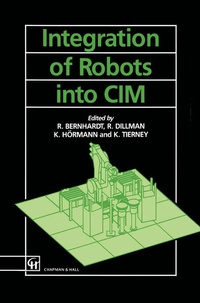
Integration of Robots into CIM
Published on 31. December 1991
Book
Hardback
XIV, 349 pages
978-0-412-37140-0 (ISBN)
Description
From its inception in 1983, ESPRIT (the European Strategic Programme for Research and Development in Information Technology) has aimed at improving the competitiveness of European industry and providing it with the technology needed for the 1990s. Esprit Project 623, on which most of the work presented in this book is based, was one of the key projects in the ESPRIT area, Computer Integrated Manufacturing (CIM). From its beginnings in 1985, it brought together a team of researchers from industry, research institutes and universities to explore and develop a critical stream of advanced manufacturing technology that would be timely and mature for industrial exploitation in a five year time frame. The synergy of cross border collaboration between technology users and vendors has led to results ranging from new and improved products to training courses given at universities. The subject of Esprit Project 623 was the integration of robots into manufacturing environments. Robots are a vital element in flexible automation and can contribute substantially to manufacturing efficiency. The project had two main themes, off-line programming and robot system planning. Off-line programming enlarges the application area of robots and opens up new possibilities in domains such as laser cutting, and other hazardous operations. Reported benefits obtained from off-line program ming include: - significant cost reductions because re-programming eliminates robot down-time; - faster production cycles, in some cases time-savings of up to 85% are reported; - the optimal engineering of products with improved quality.
Reviews / Votes
This work is expected to influence standards set up to describe assembly tasks and factory layouts. - Professional EngineeringMore details
Edition
1992 ed.
Language
English
Place of publication
Dordrecht
Netherlands
Target group
College/higher education
Professional and scholarly
Research
Illustrations
XIV, 349 p.
Dimensions
Height: 241 mm
Width: 160 mm
Thickness: 25 mm
Weight
717 gr
ISBN-13
978-0-412-37140-0 (9780412371400)
DOI
10.1007/978-94-011-2372-3
Schweitzer Classification
Other editions
Additional editions
Roger Bernard | R. Dillman | K. Hormann
Integration of Robots into CIM
E-Book
12/2012
Springer
€149.79
Available for download
Roger Bernard | R. Dillman | K. Hormann
Integration of Robots into CIM
Book
10/2012
Springer
€160.49
Shipment within 15-20 days
Content
Section I Survey of the project.- 1 Robots in CIM.- 2 Objectives, approaches and main benefits.- 3 Introduction and role of the partners.- 4 Structure of the book.- Section II Systems-planning.- 5 Procedure for a computer-aided planning process.- 6 Task sequence planning.- 7 Component selection and layout planning.- 8 Process planning.- 9 Layout optimization.- 10 Conclusion to system planning.- Section III Programming.- 11 Introduction to programming methods.- 12 Robot motion execution planning.- 13 Robot program generation.- 14 Process execution simulation.- 15 Program execution.- 16 Task-level programming.- 17 Exception handling.- 18 Conclusions.- Section IV Information system.- 19 Introduction.- 20 Design management system.- 21 Design of a knowledge-based information system.- 22 Conclusions.- Section V Applications of the system.- 23 Introduction.- 24 Planning and programming of a dot matrix printer assembly.- 25 Programming of the Cranfield assembly benchmark.- 26 Industrial application of the planning and interactive programming system.- 27 Applications at FIAR.- 28 Applications at KUKA and benefits.- 29 Applications at the IPK Berlin.- 30 Conclusions.- Section VI Summary.- 31 Major achievements.- 32 Exploitation of results.- 33 Standardization aspects.- 34 The future of robots in CIM.