

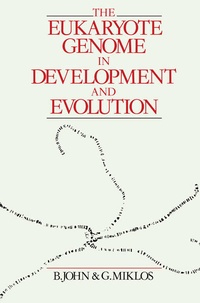
The Eukaryote Genome in Development and Evolution
Published on 26. November 1987
Book
Paperback/Softback
XVIII, 416 pages
978-0-04-575033-7 (ISBN)
Description
'The mind unlearns with difficulty what has long been impressed upon it. ' Seneca Reductionism, is, without question, the most successful analytical approach available to the experimental scientist. With the advent of techniques for cloning and sequencing DNA, and the development of a variety of molecular probes for localizing macromolecules in cells and tissues, the biologist now has available the most powerful reductionist tools ever invented. The application of these new technologies has led to a veritable explosion of facts regarding the types and organization of nucleotide sequences present in the genomes of eukaryotes. These data offer a level of precision and predictability which is unparalleled in biology. Recombinant DNA techniques were initially developed to gather information about the structure and organization of the DNA sequences within a genome. The power and potential of these techniques, however, extend far beyond simple data collection of this kind. In an attempt to use the new technology as a basis for analyzing development and evolution, attention was first focused on the topic of gene regulation, an approach that had proven so successful in prokaryotes. It is now clear that this has not been an adequate approach. Lewin (1984) has quoted Brenner as stating 'at the beginning it was said that the answer to the understanding of development was going to come from a knowledge of the molecular mechanisms of gene control. I doubt whether anyone believes this any more.
More details
Edition
1988 ed.
Language
English
Place of publication
Dordrecht
Netherlands
Publishing group
Kluwer Academic Publishers Group
Target group
Professional and scholarly
Research
Illustrations
XVIII, 416 p.
Dimensions
Height: 235 mm
Width: 155 mm
Thickness: 24 mm
Weight
657 gr
ISBN-13
978-0-04-575033-7 (9780045750337)
DOI
10.1007/978-94-011-5991-3
Schweitzer Classification
Other editions
Additional editions
John Bernard
The Eukaryote Genome in Development and Evolution
E-Book
12/2012
Springer
€96.29
Available for download
Content
1 General Molecular Organization of Genomes.- 1.1 Dissecting genomes.- 1.2 DNA components of genomes.- 2 Developmental Activities of Genomes.- 2.1 From egg to adult.- 2.2 The genetic control of development in Drosophila melanogaster.- 2.3 General principles of development.- 2.4 Genome alterations during development.- 3 Coding Capacities of Genomes.- 3.1 Gene regulation in eukaryotes.- 3.2 Drosophila genomes.- 3.3 Comparative genome organization.- 3.4 Gene dosage relationships.- 3.5 The developmental dilemma.- 4 Genome Change and Evolutionary Change.- 4.1 The basis of evolutionary change.- 4.2 Stability and change in the genome.- 4.3 Nucleotype and genotype.- 4.4 Genome change and speciation.- 4.5 Changes in genome size.- 4.6 Summary statement.- 5 The Unsolved Problem - The Origin of Morphological Novelty.- 5.1 Timing adjustments.- 5.2 Binary switch mechanisms.- 5.3 Cell interactions.- 5.4 Cell position.- 5.5 The evolutionary dilemma.- 6 Coda.- 6.1 Facts and conclusions.- 6.2 Future prospects.- 6.3 Final statement.- References.