

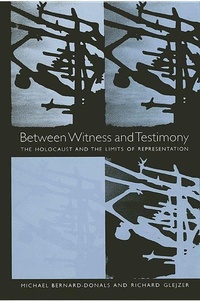
Between Witness and Testimony
The Holocaust and the Limits of Representation
Published on 19. October 2001
Book
Hardback
208 pages
978-0-7914-5149-6 (ISBN)
Description
Examines the ethical and pedagogical stakes of representing the Holocaust in books, films, and museum exhibits.
The Holocaust presents an immense challenge to those who would represent it or teach it through fiction, film, or historical accounts. Even the testimonies of those who were there provide only a glimpse of the disaster to those who were not. Between Witness and Testimony investigates the difficulties inherent in the obligation to bear witness to events that seem not just unspeakable but also unthinkable. The authors examine films, fictional narratives, survivor testimonies, and the museums at Yad Vashem and the United States Holocaust Memorial Museum in order to establish an ethics of Holocaust representation. Traversing the disciplines of history, philosophy, religious studies, and literary and cultural theory, the authors suggest that while no account adequately provides access to what Adorno called "the extremity that eludes the concept," we are still obliged to testify, to put into language what history cannot contain.
The Holocaust presents an immense challenge to those who would represent it or teach it through fiction, film, or historical accounts. Even the testimonies of those who were there provide only a glimpse of the disaster to those who were not. Between Witness and Testimony investigates the difficulties inherent in the obligation to bear witness to events that seem not just unspeakable but also unthinkable. The authors examine films, fictional narratives, survivor testimonies, and the museums at Yad Vashem and the United States Holocaust Memorial Museum in order to establish an ethics of Holocaust representation. Traversing the disciplines of history, philosophy, religious studies, and literary and cultural theory, the authors suggest that while no account adequately provides access to what Adorno called "the extremity that eludes the concept," we are still obliged to testify, to put into language what history cannot contain.
Reviews / Votes
"One of the book's strengths is that it speaks to many of its potential competitors. Reading this book will lead people new to the study of the Shoah to read other books. This is a rare book, one that is interesting not only in terms of what it says but in terms of what it prompts its readers to reconsider." - David Metzger, Old Dominion UniversityMore details
Language
English
Place of publication
Albany, NY
United States
Target group
College/higher education
US School Grade: College Graduate Student and over
Product notice
sewn/stitched
Cloth over boards
Dimensions
Height: 235 mm
Width: 158 mm
Thickness: 17 mm
Weight
386 gr
ISBN-13
978-0-7914-5149-6 (9780791451496)
Copyright in bibliographic data and cover images is held by Nielsen Book Services Limited or by the publishers or by their respective licensors: all rights reserved.
Schweitzer Classification
Other editions
Additional editions
Michael Bernard-Donals | Richard Glejzer
Between Witness and Testimony
The Holocaust and the Limits of Representation
E-Book
02/2012
1st Edition
De Gruyter
€36.49
Available for download
Persons
Michael Bernard-Donals is Professor of English and Jewish Studies at the University of Wisconsin, and the author of The Practice of Theory: Rhetoric, Knowledge, and Pedagogy in the Academy and Mikhail Bakhtin: Between Phenomenology and Marxism. Richard Glejzer is Assistant Professor of English at North Central College. They are the coeditors of Rhetoric in an Antifoundational World: Language, Culture, and Pedagogy.
Content
Preface
Acknowledgments
1. Sublimity, Redemption, Witness
2. History and the Disaster: The(Im)possibility of Writing the Shoah
3. The Epistemology of Witness: Survivor Narratives and the Holocaust
4. Literatures of Presence and Absence: Borowski, Appelfeld, Ozick
5. Film and the Shoah: The Limits of Seeing
6. Museums and the Imperative of Memory: History, Sublimity, and the Divine
7. Conclusion: The Ethics of Teaching (after) Auschwitz
Bibliography
Index
Acknowledgments
1. Sublimity, Redemption, Witness
2. History and the Disaster: The(Im)possibility of Writing the Shoah
3. The Epistemology of Witness: Survivor Narratives and the Holocaust
4. Literatures of Presence and Absence: Borowski, Appelfeld, Ozick
5. Film and the Shoah: The Limits of Seeing
6. Museums and the Imperative of Memory: History, Sublimity, and the Divine
7. Conclusion: The Ethics of Teaching (after) Auschwitz
Bibliography
Index