

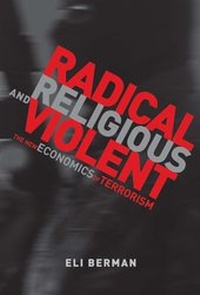
Radical, Religious, and Violent
The New Economics of Terrorism
Published on 1. October 2009
Book
Hardback
314 pages
978-0-262-02640-6 (ISBN)
Description
How do radical religious sects run such deadly terrorist organizations?
Hezbollah, Hamas, Lashkar-e-Taiba, and the Taliban all began as religious groups
dedicated to piety and charity. Yet once they turned to violence, they became
horribly potent, executing campaigns of terrorism deadlier than those of their
secular rivals. In Radical, Religious, and Violent, Eli Berman
approaches the question using the economics of organizations. He first dispels some
myths: radical religious terrorists are not generally motivated by the promise of
rewards in the afterlife (including the infamous seventy-two virgins) or even by
religious ideas in general. He argues that these terrorists (even suicide
terrorists) are best understood as rational altruists seeking to help their own
communities. Yet despite the vast pool of potential recruits -- young altruists who
feel their communities are repressed or endangered -- there are less than a dozen
highly lethal terrorist organizations in the world capable of sustained and
coordinated violence that threatens governments and makes hundreds of millions of
civilians hesitate before boarding an airplane. What's special about these
organizations, and why are most of their followers religious
radicals?
Drawing on parallel research on radical religious Jews,
Christians, and Muslims, Berman shows that the most lethal terrorist groups have a
common characteristic: their leaders have found a way to control defection.
Hezbollah, Hamas, and the Taliban, for example, built loyalty and cohesion by means
of mutual aid, weeding out "free riders" and producing a cadre of members
they could rely on. The secret of their deadly effectiveness lies in their
resilience and cohesion when incentives to defect are strong.These insights suggest
that provision of basic social services by competent governments adds a critical,
nonviolent component to counterterrorism strategies. It undermines the violent
potential of radical religious organizations without disturbing free religious
practice, being drawn into theological debates with Jihadists, or endangering
civilians.
Hezbollah, Hamas, Lashkar-e-Taiba, and the Taliban all began as religious groups
dedicated to piety and charity. Yet once they turned to violence, they became
horribly potent, executing campaigns of terrorism deadlier than those of their
secular rivals. In Radical, Religious, and Violent, Eli Berman
approaches the question using the economics of organizations. He first dispels some
myths: radical religious terrorists are not generally motivated by the promise of
rewards in the afterlife (including the infamous seventy-two virgins) or even by
religious ideas in general. He argues that these terrorists (even suicide
terrorists) are best understood as rational altruists seeking to help their own
communities. Yet despite the vast pool of potential recruits -- young altruists who
feel their communities are repressed or endangered -- there are less than a dozen
highly lethal terrorist organizations in the world capable of sustained and
coordinated violence that threatens governments and makes hundreds of millions of
civilians hesitate before boarding an airplane. What's special about these
organizations, and why are most of their followers religious
radicals?
Drawing on parallel research on radical religious Jews,
Christians, and Muslims, Berman shows that the most lethal terrorist groups have a
common characteristic: their leaders have found a way to control defection.
Hezbollah, Hamas, and the Taliban, for example, built loyalty and cohesion by means
of mutual aid, weeding out "free riders" and producing a cadre of members
they could rely on. The secret of their deadly effectiveness lies in their
resilience and cohesion when incentives to defect are strong.These insights suggest
that provision of basic social services by competent governments adds a critical,
nonviolent component to counterterrorism strategies. It undermines the violent
potential of radical religious organizations without disturbing free religious
practice, being drawn into theological debates with Jihadists, or endangering
civilians.
More details
Language
English
Place of publication
Cambridge, Mass.
United States
Publishing group
MIT Press Ltd
Target group
College/higher education
Professional and scholarly
Interest Age: From 18 years
Illustrations
1 Karte, 28 Schaubilder, 9 s/w Photographien bzw. Rasterbilder
9 b&w photos, 1 map, 28 figures
Dimensions
Height: 229 mm
Width: 152 mm
Thickness: 0 mm
Weight
454 gr
ISBN-13
978-0-262-02640-6 (9780262026406)
Copyright in bibliographic data and cover images is held by Nielsen Book Services Limited or by the publishers or by their respective licensors: all rights reserved.
Schweitzer Classification
Other editions
New editions
Book
09/2011
MIT Press
€27.90
Article exhausted; check different version
Additional editions
Book
09/2011
MIT Press
€27.90
Article exhausted; check different version
E-Book
09/2011
MIT Press
€29.49
Available for download