

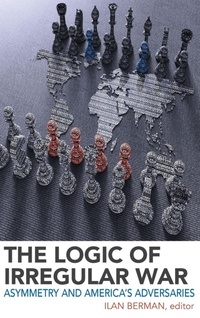
The Logic of Irregular War
Asymmetry and America's Adversaries
Published on 10. November 2017
Book
Hardback
128 pages
978-1-5381-0541-2 (ISBN)
Description
For the United States, asymmetric warfare has emerged as the "new normal." The large-scale conventional campaigns that typified U.S. military engagements for much of the 20th Century are increasingly things of the past. Instead, the quarter-century since the end of the Cold War and the collapse of the U.S.-Soviet balance of power has seen irregular war truly come of age, with more and more hostile nations pursuing asymmetric means in order to secure the strategic advantage vis-a-vis the United States. In this volume, a group of leading national security practitioners and subject matter experts comes together to analyze the asymmetric strategies being pursued today by America's main state-based adversaries-Russia, China, Iran and North Korea-and to explore how U.S. policymakers can respond more effectively to them.
Reviews / Votes
The five well-informed contributors to this slender volume bring varied backgrounds to asymmetric warfare. They have filled a variety of government, academic, and think-tank positions. Berman's historical introduction underscores the global nature of such wars. Irregular war "is as old as conflict itself." However, it "came of age" only at the end of the Cold War. Contemporary weaponry has made asymmetric wars far more lethal. The four countries examined in detail adopt differing approaches. China's strategy involves "adaptation of traditional means of operational confrontation." Basic strategy dates to Sun Tzu around 500 BCE. Major updates have come in political work, cyber-warfare, and other electronic advances. Russian leaders stress a "persistent siege mentality." Information warfare, covert and overt military involvement in "near abroad" states, and electronic-pulse magnetism constitute major initiatives. Iran's strategy revolves around Persian Gulf security, defense needs, and oil revenues. The need for self-sufficiency because of war with Iraq and sanctions have bolstered stress on cyber-warfare and nuclear capability. Finally, North Korea (the DPRK) remains "locked in a zero-sum rivalry" with South Korea. Success in developing missile-based nuclear weapons reflects the DPRK's subordination of civilian priorities. All in all, a sobering, informative book. Summing Up: Recommended. Upper-division undergraduates through faculty * Choice Reviews *More details
Language
English
Place of publication
United States
Publishing group
Bloomsbury Publishing Plc
Target group
Professional and scholarly
Dimensions
Height: 235 mm
Width: 157 mm
Thickness: 12 mm
Weight
347 gr
ISBN-13
978-1-5381-0541-2 (9781538105412)
Copyright in bibliographic data and cover images is held by Nielsen Book Services Limited or by the publishers or by their respective licensors: all rights reserved.
Schweitzer Classification
Other editions
Additional editions
E-Book
11/2017
1st Edition
Rowman & Littlefield Publishers
€73.99
Available for download
Person
Ilan Berman is Senior Vice President of the American Foreign Policy Council in Washington, DC. An expert on regional security in the Middle East, Central Asia, and the Russian Federation, he has consulted for both the U.S. Central Intelligence Agency and the U.S. Department of Defense, and provided assistance on foreign policy and national security issues to a range of governmental agencies and congressional offices. Mr.Berman is also a member of the Associated Faculty at Missouri State University's Department of Defense and Strategic Studies. He holds a M.A. in International Politics from the American University in Washington, DC, and a Juris Doctorate from the Washington College of Law.
Content
Introduction: Thinking about Asymmetry, by Ilan Berman
Chapter 1: The Chinese Way of Asymmetric War, by Larry M. Wortzel
Chapter 2: Russia's Asymmetric Strategy for Contemporary and Future War, by Stephen Blank
Chapter 3: The Strategies and Methods of Iranian Asymmetric War, by Ladan Yazdian
Chapter 4: The Asymmetric Strategies of the DPRK, by Daniel A. Pinkston
Conclusion: Adapting to Asymmetry, by Ilan Berman
List of Contributors
Chapter 1: The Chinese Way of Asymmetric War, by Larry M. Wortzel
Chapter 2: Russia's Asymmetric Strategy for Contemporary and Future War, by Stephen Blank
Chapter 3: The Strategies and Methods of Iranian Asymmetric War, by Ladan Yazdian
Chapter 4: The Asymmetric Strategies of the DPRK, by Daniel A. Pinkston
Conclusion: Adapting to Asymmetry, by Ilan Berman
List of Contributors