

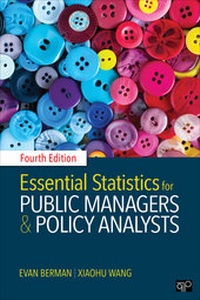
Essential Statistics for Public Managers and Policy Analysts
4th Edition
Published on 24. April 2017
Book
Paperback/Softback
368 pages
978-1-5063-6431-5 (ISBN)
Description
Known for its brevity and student-friendly approach, Essential Statistics for Public Managers and Policy Analysts remains one of the most popular introductory books on statistics for public policy and public administration students, using carefully selected examples tailored specifically for them. The Fourth Edition continues to offer a conceptual understanding of statistics that can be applied readily to the real-life challenges of public administrators and policy analysts. The book provides examples from the areas of human resources management, organizational behavior, budgeting, and public policy to illustrate how public administrators interact with and analyze data.
The text may be paired with the workbook Exercising Essential Statistics, Fourth Edition to help students apply each statistical technique introduced in the text. Use bundle ISBN: 978-1-5063-7366-9.
The text may be paired with the workbook Exercising Essential Statistics, Fourth Edition to help students apply each statistical technique introduced in the text. Use bundle ISBN: 978-1-5063-7366-9.
More details
Edition
4th Revised edition
Language
English
Place of publication
Washington
United States
Publishing group
SAGE Publications Inc
Target group
College/higher education
Edition type
Revised edition
Dimensions
Height: 229 mm
Width: 152 mm
Weight
521 gr
ISBN-13
978-1-5063-6431-5 (9781506364315)
Copyright in bibliographic data and cover images is held by Nielsen Book Services Limited or by the publishers or by their respective licensors: all rights reserved.
Schweitzer Classification
Other editions
Previous edition
Evan M. Berman | Xiaohu Wang
Essential Statistics for Public Managers and Policy Analysts
Book
01/2012
3rd Edition
CQ Press
€102.94
Article exhausted; check for reprint
Persons
Evan M. Berman is Professor of Public Management at Fundacao Getulio Vargas, EAESP (Sao Paulo, Brazil), specializing in human resource management, public performance, and comparative public administration. Previously, he was Huey McElveen Distinguished Professor at Louisiana State University. Dr. Berman is ranked among the very top scholars in public administration world-wide. He has received the Outstanding Scholarship Award from the American Society for Public Administration (Section on Personnel and Labor Relations) for contributions to research, teaching and service in public sector HRM, and many other awards, including from the Network of Schools of Public Policy, Affairs, and Administration (NASPAA), the accrediting body for public administration programs. He has authored 15 books and over 175 publications, in all of the leading journals of the discipline. Dr Berman has chaired ASPA's Section on Personnel and Labor Relations, he is founding editor of ASPA's Book Series in Public Administration and Public Policy, senior editor of Public Performance and Management Review, and a Distinguished Fulbright Scholar. His 2023 book, Performance and Innovation in the Public Sector (with I. Hijal-Moghrabi), won the 2024 ASPA/SPALR Outstanding Book Award. Evan is a Fellow of the National Academy of Public Administration and Visiting Professor at Fudan University (Shanghai) and University of Indonesia (Jakarta).
Content
Tables, Figures, and Boxes
Preface
Acknowledgments
Statistics Roadmap
Section I: Introduction
Chapter 1 Why Statistics for Public Managers and Policy Analysts?
Chapter Objectives
Role of Data in Public Management
Competency and Proficiency
Ethics in Data Analysis and Research
Summary
Key Terms
Section II: Research Methods
Chapter 2 Research Design
Chapter Objectives
Introducing Variables and Their Relationships
Program Evaluation
A Bit More: Extending through Quasi-experimental Design
Summary
Key Terms
Chapter 3 Conceptualization and Measurement
Chapter Objectives
Measurement Levels and Scales
Conceptualization
Operationalization
Index Variables
Measurement Validity
Summary
Key Terms
Chapter 4 Measuring and Managing Performance: Present and Future
Chapter Objectives
Performance Measurement
Managing Performance
Efficiency, Effectiveness, and a Bit More
Peering Into the Future: Forecasting
Summary
Key Terms
Chapter 5 Data Collection
Chapter Objectives
Sources of Data
Sampling
Data Input
Putting It Together
Summary
Key Terms
Section III: Descriptive Statistics
Chapter 6 Central Tendency
Chapter Objectives
The Mean
The Median
The Mode
Summary
Key Terms
Appendix 6.1: Using Grouped Data
Chapter 7 Measures of Dispersion
Chapter Objectives
Frequency Distributions
Standard Deviation
Summary
Key Terms
Appendix 7.1: Boxplots
Chapter 8 Contingency Tables
Chapter Objectives
Contingency Tables
Relationship and Direction
Pivot Tables
Summary
Key Terms
Chapter 9 Getting Results
Chapter Objectives
Analysis of Outputs and Outcomes
Analysis of Efficiency and Effectiveness
Analysis of Equity
Quality-of-Life Analysis
A Bit of Forecasting, Too
Some Cautions in Analysis and Presentation
Summary
Key Terms
Appendix 9.1: Forecasting with Periodic Effects
Section IV: Inferential Statistics
Chapter 10 Introducing Inference: Estimation from Samples
Chapter Objectives
From Sample to Population
Statistical Estimation of Population Parameters
Summary
Key Terms
Chapter 11 Hypothesis Testing with Chi-Square
Chapter Objectives
What Is Chi-Square?
Hypothesis Testing
The Goodness-of-Fit Test
A Nonparametric Alternative
Summary
Key Terms
Appendix 11.1: Rival Hypotheses: Adding a Control Variable
Appendix 11.2: Some Nonparametric Tests for Specific Situations
Chapter 12 The T-Test
Chapter Objectives
T-Tests for Independent Samples
Two T-Test Variations
Nonparametric Alternatives to T-Tests
Summary
Key Terms
Chapter 13 Analysis of Variance (ANOVA)
Chapter Objectives
Analysis of Variance
A Nonparametric Alternative
Summary
Key Terms
Chapter 14 Simple Regression
Chapter Objectives
Simple Regression
Pearson's Correlation Coefficient
Spearman's Rank Correlation Coefficient
Summary
Key Terms
Chapter 15 Multiple Regression
Chapter Objectives
Model Specification
A Working Example
Further Statistics
Use of Nominal Variables
Testing Assumptions
Summary
Key Terms
Section V: Further Statistics
Chapter 16 Logistic and Time Series Regression
Chapter Objectives
The Logistic Model
A Working Example
Time Series in Multiple Regression
Summary
Key Terms
Chapter 17 Survey of Other Techniques
Chapter Objectives
Path Analysis
Statistical Forecasting
Survival Analysis
Factor Analysis
Summary
Key Terms
Appendixes
A: Normal Distribution
B: Chi-Square (c2) Distribution
C: T-Test Distribution
D: Durbin-Watson Distribution
E: F-Test Distribution
Glossary
Index
About the Authors
Preface
Acknowledgments
Statistics Roadmap
Section I: Introduction
Chapter 1 Why Statistics for Public Managers and Policy Analysts?
Chapter Objectives
Role of Data in Public Management
Competency and Proficiency
Ethics in Data Analysis and Research
Summary
Key Terms
Section II: Research Methods
Chapter 2 Research Design
Chapter Objectives
Introducing Variables and Their Relationships
Program Evaluation
A Bit More: Extending through Quasi-experimental Design
Summary
Key Terms
Chapter 3 Conceptualization and Measurement
Chapter Objectives
Measurement Levels and Scales
Conceptualization
Operationalization
Index Variables
Measurement Validity
Summary
Key Terms
Chapter 4 Measuring and Managing Performance: Present and Future
Chapter Objectives
Performance Measurement
Managing Performance
Efficiency, Effectiveness, and a Bit More
Peering Into the Future: Forecasting
Summary
Key Terms
Chapter 5 Data Collection
Chapter Objectives
Sources of Data
Sampling
Data Input
Putting It Together
Summary
Key Terms
Section III: Descriptive Statistics
Chapter 6 Central Tendency
Chapter Objectives
The Mean
The Median
The Mode
Summary
Key Terms
Appendix 6.1: Using Grouped Data
Chapter 7 Measures of Dispersion
Chapter Objectives
Frequency Distributions
Standard Deviation
Summary
Key Terms
Appendix 7.1: Boxplots
Chapter 8 Contingency Tables
Chapter Objectives
Contingency Tables
Relationship and Direction
Pivot Tables
Summary
Key Terms
Chapter 9 Getting Results
Chapter Objectives
Analysis of Outputs and Outcomes
Analysis of Efficiency and Effectiveness
Analysis of Equity
Quality-of-Life Analysis
A Bit of Forecasting, Too
Some Cautions in Analysis and Presentation
Summary
Key Terms
Appendix 9.1: Forecasting with Periodic Effects
Section IV: Inferential Statistics
Chapter 10 Introducing Inference: Estimation from Samples
Chapter Objectives
From Sample to Population
Statistical Estimation of Population Parameters
Summary
Key Terms
Chapter 11 Hypothesis Testing with Chi-Square
Chapter Objectives
What Is Chi-Square?
Hypothesis Testing
The Goodness-of-Fit Test
A Nonparametric Alternative
Summary
Key Terms
Appendix 11.1: Rival Hypotheses: Adding a Control Variable
Appendix 11.2: Some Nonparametric Tests for Specific Situations
Chapter 12 The T-Test
Chapter Objectives
T-Tests for Independent Samples
Two T-Test Variations
Nonparametric Alternatives to T-Tests
Summary
Key Terms
Chapter 13 Analysis of Variance (ANOVA)
Chapter Objectives
Analysis of Variance
A Nonparametric Alternative
Summary
Key Terms
Chapter 14 Simple Regression
Chapter Objectives
Simple Regression
Pearson's Correlation Coefficient
Spearman's Rank Correlation Coefficient
Summary
Key Terms
Chapter 15 Multiple Regression
Chapter Objectives
Model Specification
A Working Example
Further Statistics
Use of Nominal Variables
Testing Assumptions
Summary
Key Terms
Section V: Further Statistics
Chapter 16 Logistic and Time Series Regression
Chapter Objectives
The Logistic Model
A Working Example
Time Series in Multiple Regression
Summary
Key Terms
Chapter 17 Survey of Other Techniques
Chapter Objectives
Path Analysis
Statistical Forecasting
Survival Analysis
Factor Analysis
Summary
Key Terms
Appendixes
A: Normal Distribution
B: Chi-Square (c2) Distribution
C: T-Test Distribution
D: Durbin-Watson Distribution
E: F-Test Distribution
Glossary
Index
About the Authors