

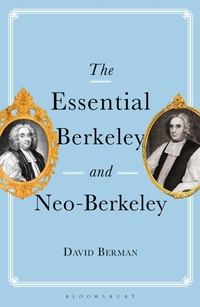
The Essential Berkeley and Neo-Berkeley
Published on 24. March 2022
Book
Hardback
216 pages
978-1-350-21471-2 (ISBN)
Description
The Essential Berkeley and Neo-Berkeley is an introduction to the life and work of one of the most significant thinkers in the history of philosophy and a penetrating philosophical assessment of his lasting legacy.
Written in clear and user-friendly style, Berman provides:
? A concise summary of George Berkeley (1685-1753)'s life and writings
? An accessible introduction to the structure of Berkeley's most authoritative work, The Principles of Human Knowledge
? An overview of common misunderstandings of Berkeley's philosophy, and how to avoid them
Beyond solely an introduction, Berman also gives us a broader and deeper appreciation of Berkeley as a philosopher. He argues for Berkeley's work as a philosophical system with coherence and important key themes hitherto unexplored and provides an analysis of why he thinks Berkeley's work has had such lasting significance. With a particular focus on Berkeley's dualist thinking and theories of 'mental types', Berman provides students and scholars with a key to unlocking the significance of this work.
This introductory text will provide an insight into Berkeley's full body of work, the distinctiveness of his thinking and how deeply relevant this key thinker is to contemporary philosophy.
Written in clear and user-friendly style, Berman provides:
? A concise summary of George Berkeley (1685-1753)'s life and writings
? An accessible introduction to the structure of Berkeley's most authoritative work, The Principles of Human Knowledge
? An overview of common misunderstandings of Berkeley's philosophy, and how to avoid them
Beyond solely an introduction, Berman also gives us a broader and deeper appreciation of Berkeley as a philosopher. He argues for Berkeley's work as a philosophical system with coherence and important key themes hitherto unexplored and provides an analysis of why he thinks Berkeley's work has had such lasting significance. With a particular focus on Berkeley's dualist thinking and theories of 'mental types', Berman provides students and scholars with a key to unlocking the significance of this work.
This introductory text will provide an insight into Berkeley's full body of work, the distinctiveness of his thinking and how deeply relevant this key thinker is to contemporary philosophy.
Reviews / Votes
Short, clear and very readable ... The Berkeleyan scholarship is impeccable, but provocative. * Theology * David Berman creates and develops a dialectical confrontation between Berkeley and himself as Neo-Berkeley. His philosophical target is Berkeley's dualism and its important implications to modern epistemology. His account is truly innovative: no one has approached Berkeley's grand theory from a similar constructive perspective. * Timo Airaksinen, Professor Emeritus, University of Helsinki, Finland * David Berman provides us with a penetrating and highly original assessment of Berkeley's philosophical legacy. * James Hill, Charles University, Prague * In his brief but challenging book, David Berman offers a novel account of the basis of Berkeleanism, resting it on his dualism. Even more challenging, the second half of Berman's book lays out what can be saved if we accept Berkeley's dualism and reject his idealism. A must read! * Margaret Atherton, Distinguished Professor Emerita of Philosophy, University of Wisconsin-Milwaukee, USA *More details
Language
English
Place of publication
London
United Kingdom
Publishing group
Bloomsbury Publishing PLC
Target group
College/higher education
Dimensions
Height: 209 mm
Width: 132 mm
Thickness: 15 mm
Weight
322 gr
ISBN-13
978-1-350-21471-2 (9781350214712)
Copyright in bibliographic data and cover images is held by Nielsen Book Services Limited or by the publishers or by their respective licensors: all rights reserved.
Schweitzer Classification
Other editions
Additional editions
David Berman
The Essential Berkeley and Neo-Berkeley
E-Book
01/2022
1st Edition
Bloomsbury Academic
€22.99
Available for download
David Berman
The Essential Berkeley and Neo-Berkeley
E-Book
01/2022
1st Edition
Bloomsbury Academic
€22.99
Available for download
Person
David Berman is Professor Emeritus Fellow in the Philosophy Department, Trinity College Dublin, Ireland. He is author of A History of Atheism in Britain: From Hobbes to Russell (2013), Berkeley and Irish Philosophy (Bloomsbury, 2005), Berkeley: The Great Philosophers (2008), Images of Berkeley (1986) and editor of George Berkeley (Routledge Revivals): Eighteenth-Century Responses: Volumes 1&2 (2020)
Content
Preface
Abbreviations
Part 1: Berkeley's Philosophy
Section 1: Overview and Summary
Section 2: Berkeley's life and works
Section 3: The structure of Berkeley's Principles
Section 4: Berkeley's dualism and dualistic experience
Section 5: Dualism or monism?
Section 6: The phenomenalistic interpretation
Section 7: Overview
Section 8: Hume's Phenomenalism
Section 9: the cde
Section 10: Alciphron, the TVV and DHP 1734
Section 11: James Hill on the notional
Section 12: The 2 or 3 Advantages of the Section 27 doctrine
Section 13: What underpins the notional
Section 14: The big historical picture
Section 15: Berkeley on objects: the revision
Section 16: Berkeley's Siris
Part 2: Neo-Berkeley
Section 1: Berkeley in 1752-3
Section 2: The DMT: Why it hasn't been accepted
Section 3: Berkeley's Immaterialism and Monotheistic God
Section 4: Neo-B on God and other dualistic minds
Section 5: God and theistic intimacy and dualistic intimacy
Section 6: Dualistic Intimacy: Montaigne and La Boete
Section 7: The Tactual Visual Typology
Notes
Bibliography
Index
Abbreviations
Part 1: Berkeley's Philosophy
Section 1: Overview and Summary
Section 2: Berkeley's life and works
Section 3: The structure of Berkeley's Principles
Section 4: Berkeley's dualism and dualistic experience
Section 5: Dualism or monism?
Section 6: The phenomenalistic interpretation
Section 7: Overview
Section 8: Hume's Phenomenalism
Section 9: the cde
Section 10: Alciphron, the TVV and DHP 1734
Section 11: James Hill on the notional
Section 12: The 2 or 3 Advantages of the Section 27 doctrine
Section 13: What underpins the notional
Section 14: The big historical picture
Section 15: Berkeley on objects: the revision
Section 16: Berkeley's Siris
Part 2: Neo-Berkeley
Section 1: Berkeley in 1752-3
Section 2: The DMT: Why it hasn't been accepted
Section 3: Berkeley's Immaterialism and Monotheistic God
Section 4: Neo-B on God and other dualistic minds
Section 5: God and theistic intimacy and dualistic intimacy
Section 6: Dualistic Intimacy: Montaigne and La Boete
Section 7: The Tactual Visual Typology
Notes
Bibliography
Index