

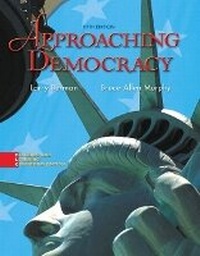
Approaching Democracy
5th Edition
Published on 2. June 2006
Book
Paperback/Softback
728 pages
978-0-13-174401-1 (ISBN)
Description
For undergraduate courses in introductory American Government.
Approaching Democracy is the American Government book with a clear and compelling central theme, designed to elevate student interest.
Approaching Democracy addresses the evolving nature of the American experiment in democratic government. It teaches students the theory and the basics of American political science, the political history of this nation, and provides the critical thinking skills needed to analyze these evolving relationships. This new Teaching and Learning Classroom (TLC) edition introduces new features and incorporates more "student empowerment" tools to reinforce how American Government is relevant to students' lives today.
The title and theme for this book come from Vaclav Havel, a former dissident Czech playwright once imprisoned by the his country's Communist government and later elected president. Addressing a joint session of the U.S. Congress on February 1, 1990, Havel noted that with the collapse of the Soviet Union, millions of people from Eastern Europe were involved in a historically irreversible process: beginning their quest for freedom and democracy. And it was the United Stated of America that provided the model for these newly freed peoples. But Havel put his own spin on the notion of American democracy as a model. "As long as people are people," Havel explained, "democracy, in the full sense of the word, will always be no more than an ideal. In this sense, you too are merely approaching democracy. But you have one great advantage: you have been approaching democracy uninterruptedly for more than two hundred years, and your journey toward the horizon has never been disrupted by a totalitarian system."
Larry Berman and Bruce Allen Murphy, long-time teachers of the introductory American Political science course in both large and small public and private universities, set out to write a book that offers a clear theme - a theme that is just as relevant, if not more so today than when it was first presented - in a highly readable, easy-to-understand format. Both authors enjoy teaching and are actively engaged in new methods of engaging students and empowering them to participate in political discourse.
Approaching Democracy is the American Government book with a clear and compelling central theme, designed to elevate student interest.
Approaching Democracy addresses the evolving nature of the American experiment in democratic government. It teaches students the theory and the basics of American political science, the political history of this nation, and provides the critical thinking skills needed to analyze these evolving relationships. This new Teaching and Learning Classroom (TLC) edition introduces new features and incorporates more "student empowerment" tools to reinforce how American Government is relevant to students' lives today.
The title and theme for this book come from Vaclav Havel, a former dissident Czech playwright once imprisoned by the his country's Communist government and later elected president. Addressing a joint session of the U.S. Congress on February 1, 1990, Havel noted that with the collapse of the Soviet Union, millions of people from Eastern Europe were involved in a historically irreversible process: beginning their quest for freedom and democracy. And it was the United Stated of America that provided the model for these newly freed peoples. But Havel put his own spin on the notion of American democracy as a model. "As long as people are people," Havel explained, "democracy, in the full sense of the word, will always be no more than an ideal. In this sense, you too are merely approaching democracy. But you have one great advantage: you have been approaching democracy uninterruptedly for more than two hundred years, and your journey toward the horizon has never been disrupted by a totalitarian system."
Larry Berman and Bruce Allen Murphy, long-time teachers of the introductory American Political science course in both large and small public and private universities, set out to write a book that offers a clear theme - a theme that is just as relevant, if not more so today than when it was first presented - in a highly readable, easy-to-understand format. Both authors enjoy teaching and are actively engaged in new methods of engaging students and empowering them to participate in political discourse.
More details
Edition
5th edition
Language
English
Place of publication
United States
Publishing group
Pearson Education (US)
Target group
Professional and scholarly
Dimensions
Height: 279 mm
Width: 216 mm
Weight
1492 gr
ISBN-13
978-0-13-174401-1 (9780131744011)
Copyright in bibliographic data and cover images is held by Nielsen Book Services Limited or by the publishers or by their respective licensors: all rights reserved.
Schweitzer Classification
Other editions
New editions
Larry A. Berman | Bruce Allen Murphy | Tucker Gibson
Approaching Democracy, National Edition
Book
02/2008
6th Edition
Pearson
€74.27
Article exhausted; check for reprint
Content
I. FOUNDATIONS OF AMERICAN DEMOCRACY
1. Approaching Democracy
2. The Founding and the Constitution
3. Federalism
II. INSTITUTIONS OF AMERICAN DEMOCRACY
4. Congress
5. The Presidency
6. The Judiciary
7. The Bureaucracy
III. PROCESSES OF AMERICAN DEMOCRACY
8. Public Opinion
9. Political Parties
10. Participation, Voting, and Elections
11. Interest Groups
12.The Media
IV. LIBERTIES AND RIGHTS IN AMERICAN DEMOCRACY
13. Civil Liberties
14. Civil Rights and Political Equality
V. POLICY MAKING IN AMERICAN DEMOCRACY
15. Domestic and Economic Policy
16. Foreign Policy
1. Approaching Democracy
2. The Founding and the Constitution
3. Federalism
II. INSTITUTIONS OF AMERICAN DEMOCRACY
4. Congress
5. The Presidency
6. The Judiciary
7. The Bureaucracy
III. PROCESSES OF AMERICAN DEMOCRACY
8. Public Opinion
9. Political Parties
10. Participation, Voting, and Elections
11. Interest Groups
12.The Media
IV. LIBERTIES AND RIGHTS IN AMERICAN DEMOCRACY
13. Civil Liberties
14. Civil Rights and Political Equality
V. POLICY MAKING IN AMERICAN DEMOCRACY
15. Domestic and Economic Policy
16. Foreign Policy