

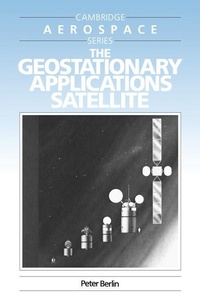
The Geostationary Applications Satellite
Published on 2. December 2004
Book
Paperback/Softback
232 pages
978-0-521-61603-4 (ISBN)
Description
Berlin offers an in-depth look into all the engineering aspects of geostationary satellite design, construction, and launch. Geostationary satellites have opened new doors for the peaceful use of outer space. From vantage points 22,000 miles above the equator, they permit people anywhere on land, at sea, or in the air to communicate with each other, and they provide meteorologists, geologists, and other scientists with photographs of the earth. This book gives equal emphasis to the explanation of launch vehicles, orbital mechanics, the space environment, spacecraft structures, mechanisms, thermal control, telemetry tracking and command, communications technology, meterological payloads, product assurance and testing.
More details
Series
Language
English
Place of publication
Cambridge
United Kingdom
Target group
Professional and scholarly
Product notice
Paperback (trade)
Illustrations
Worked examples or Exercises
Dimensions
Height: 229 mm
Width: 152 mm
Thickness: 14 mm
Weight
383 gr
ISBN-13
978-0-521-61603-4 (9780521616034)
Copyright in bibliographic data and cover images is held by Nielsen Book Services Limited or by the publishers or by their respective licensors: all rights reserved.
Schweitzer Classification
Other editions
Additional editions
Peter Berlin
The Geostationary Applications Satellite
Book
09/1988
Cambridge University Press
€68.20
Article exhausted; check for reprint
Previous edition
Peter Berlin
The Geostationary Applications Satellite
Book
09/1988
Cambridge University Press
€68.20
Article exhausted; check for reprint
Content
Preface; List of acronyms; 1. Launch vehicles; 2. The transfer orbit; 3. The geostationary orbit; 4. The satellite environment; 5. Structures; 6. Mechanisms; 7. Thermal control; 8. Power supply and conditioning; 9. Propulsion and orbit control; 10. Attitude stabilization, measurement and control; 11. Telemetry, tracking and command (TT&C); 12. Communications payload; 13. Meteorological payload; 14. Product assurance; 15. Spacecraft development and testing; Index.