

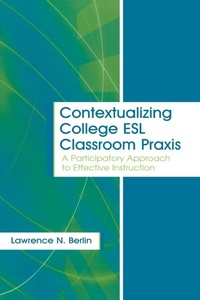
Contextualizing College ESL Classroom Praxis
A Participatory Approach to Effective Instruction
1st Edition
Published on 2. May 2005
Book
Paperback/Softback
158 pages
978-0-8058-4988-2 (ISBN)
Description
Contextualizing College ESL Classroom Praxis: A Participatory Approach to Effective Instruction provides pre-service and in-service teachers with a model for engaging in effective instruction with the variety of students encountered in college English as a second language or foreign language classrooms. Along with the model, the text is designed to help readers develop the tools to use it within a participatory approach. This approach, based on the principles of Paulo Freire's critical pedagogy, is combined with multicultural education and the general tenets of a communicative approach to language teaching. From the philosophical to the theoretical to the practical, these strands are combined into a cohesive whole.
The underlying premise is that the best way to develop an understanding of a participatory approach is to engage in it. Throughout the book, readers are asked to apply problem-posing--a learning process that begins with naming issues, reflecting on them and possible solutions, and acting upon one's ideas. Questions addressed include:
*What is the nature of process over product?
*Is a new definition of effective instruction necessary?
*What are the factors that can affect second language acquisition?
*What do teachers believe about effective language instruction?
*What do students believe about effective language instruction?
*What makes pedagogy effective?
*How do teachers and students relate in the classroom?
*What does instruction mean for students?
*How can effective praxis be adapted to various contexts?
Each chapter includes Pre-Reading Questions, Post-Reading Questions, a topic for a Reflective Journal, and Follow-Up Activities. These provide opportunities to enhance comprehension of the material, to co-construct new knowledge with classmates, and to review personal beliefs and ideas in an effort to modify or reinforce them in one's own developing model for effective language instruction.
The underlying premise is that the best way to develop an understanding of a participatory approach is to engage in it. Throughout the book, readers are asked to apply problem-posing--a learning process that begins with naming issues, reflecting on them and possible solutions, and acting upon one's ideas. Questions addressed include:
*What is the nature of process over product?
*Is a new definition of effective instruction necessary?
*What are the factors that can affect second language acquisition?
*What do teachers believe about effective language instruction?
*What do students believe about effective language instruction?
*What makes pedagogy effective?
*How do teachers and students relate in the classroom?
*What does instruction mean for students?
*How can effective praxis be adapted to various contexts?
Each chapter includes Pre-Reading Questions, Post-Reading Questions, a topic for a Reflective Journal, and Follow-Up Activities. These provide opportunities to enhance comprehension of the material, to co-construct new knowledge with classmates, and to review personal beliefs and ideas in an effort to modify or reinforce them in one's own developing model for effective language instruction.
Reviews / Votes
"...an important contribution to the ongoing discussion on what constitutes effective English as a second language (ESL) teaching practices...Berlin's effective instruction model and participatory framework compel ESL teachers to reflect on and re-examine their perspective on the roles and functions of teachers, students, and the language classroom....this book provides language teacher educators with a valuable supplement to the more traditional texts found in ESL methodology and practicum courses."-TESL-EJ, September 2006, Vol. 10, No. 2
"The voices of the teachers and learners are rich....The approach is inspiring, and can leave readers with will for reflection, an awareness of the complexities of a living multicultural classroom, and with a motivation to embrace and encourage the co-construction of knowledge in a language learning environment."
-Mary E. Wildner-Bassett, University of Arizona
"Berlin guides the reader into a fully developed understanding of what it means to be engaged in a participatory approach to language learning. This approach, based on the combined principles of Paulo Freire's critical pedagogy and communicative language teaching, is more than a method, and more than an approach. It is an entirely new way to view the roles of teacher and students together....After reading this book, to become participatory on one's classroom becomes a haunting responsibility, if one claims at all to be democratic, a believer in social justice, or one who simply recognizes the uniqueness of each individual as a learner."
-Lorrie S. Verplaetse, Southern Connecticut State University
More details
Series
Language
English
Place of publication
New York
United States
Publishing group
Taylor & Francis Inc
Target group
College/higher education
ELT/ESL
Professional and scholarly
Dimensions
Height: 229 mm
Width: 152 mm
Thickness: 9 mm
Weight
242 gr
ISBN-13
978-0-8058-4988-2 (9780805849882)
Copyright in bibliographic data and cover images is held by Nielsen Book Services Limited or by the publishers or by their respective licensors: all rights reserved.
Schweitzer Classification
Other editions
Additional editions
Lawrence N. Berlin
Contextualizing College ESL Classroom Praxis
A Participatory Approach to Effective Instruction
Book
07/2017
1st Edition
Routledge
€282.73
Shipment within 10-20 days
Lawrence N. Berlin
Contextualizing College ESL Classroom Praxis
A Participatory Approach to Effective Instruction
E-Book
06/2017
1st Edition
Routledge
€59.49
Available for download
Lawrence N. Berlin
Contextualizing College ESL Classroom Praxis
A Participatory Approach to Effective Instruction
E-Book
06/2017
1st Edition
Routledge
€59.49
Available for download
Person
Lawrence N. Berlin
Content
Contents: S. Nieto, Foreword. Preface. What Is the Nature of Process Over Product? Is a New Definition of Effective Instruction Necessary? What Are the Factors That Can Affect Second Language Acquisition? What Do Teachers Believe About Effective Language Instruction? What Do Students Believe About Effective Language Instruction? What Makes Pedagogy Effective? (The Pedagogical Function) How Do Teachers and Students Relate in the Classroom? (The Environmental Function) What Does Instruction Mean for Students? (The Societal Function) A Brief Review. (The Effective Instruction Model) How Can Effective Praxis Be Adapted to Various Contexts? (The Application Model)