

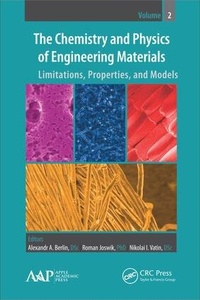
The Chemistry and Physics of Engineering Materials
Limitations, Properties, and Models
1st Edition
Published on 12. July 2018
Book
Hardback
392 pages
978-1-77188-736-6 (ISBN)
Description
This new volume focuses on the limitations, properties, and models in the chemistry and physics of engineering materials that have potential for applications in several disciplines of engineering and science. Contributions range from new methods to novel applications of existing methods.
The collection of topics in this volume reflects the diversity of recent advances in chemistry and physics of engineering materials with a broad perspective that will be useful for scientists as well as for graduate students and engineers. This new book presents leading-edge research from around the world. Topics in the book include:
* aerogels materials and technology
* diffusion dynamics in nanomaterials
* entropic nomograms
* structural analyses of particulate-filled polymer nanocomposites mechanical properties
* protection of rubbers against aging
* structure-property correlation and forecast of corrosion
This volume is also sold as part of a two-volume set. Volume 1 focuses on modern analytic methodologies in the chemistry and physics of engineering materials.
The collection of topics in this volume reflects the diversity of recent advances in chemistry and physics of engineering materials with a broad perspective that will be useful for scientists as well as for graduate students and engineers. This new book presents leading-edge research from around the world. Topics in the book include:
* aerogels materials and technology
* diffusion dynamics in nanomaterials
* entropic nomograms
* structural analyses of particulate-filled polymer nanocomposites mechanical properties
* protection of rubbers against aging
* structure-property correlation and forecast of corrosion
This volume is also sold as part of a two-volume set. Volume 1 focuses on modern analytic methodologies in the chemistry and physics of engineering materials.
More details
Language
English
Place of publication
Oakville
Canada
Target group
College/higher education
Professional and scholarly
Academic and Postgraduate
Illustrations
94 s/w Abbildungen, 10 s/w Photographien bzw. Rasterbilder, 84 s/w Zeichnungen, 23 s/w Tabellen
23 Tables, black and white; 84 Line drawings, black and white; 10 Halftones, black and white; 94 Illustrations, black and white
Dimensions
Height: 229 mm
Width: 152 mm
Weight
920 gr
ISBN-13
978-1-77188-736-6 (9781771887366)
Copyright in bibliographic data and cover images is held by Nielsen Book Services Limited or by the publishers or by their respective licensors: all rights reserved.
Schweitzer Classification
Other editions
Additional editions
Alexandr A. Berlin | Roman Joswik | Nikolai I. Vatin
The Chemistry and Physics of Engineering Materials
Limitations, Properties, and Models
Book
03/2021
1st Edition
Apple Academic Press Inc.
€110.40
Shipment within 3-4 weeks
Alexandr A. Berlin | Roman Joswik | Nikolai I. Vatin
The Chemistry and Physics of Engineering Materials
Limitations, Properties, and Models
E-Book
07/2018
1st Edition
Apple Academic Press Inc.
€173.99
Available for download
Alexandr A. Berlin | Roman Joswik | Nikolai I. Vatin
The Chemistry and Physics of Engineering Materials
Limitations, Properties, and Models
E-Book
07/2018
1st Edition
Apple Academic Press Inc.
€173.99
Available for download
Persons
Alexandr A. Berlin, DSc, is Director of the N. N. Semenov Institute of Chemical Physics at the Russian Academy of Sciences, Moscow, Russia. He is a member of the Russian Academy of Sciences and many national and international associations. Dr. Berlin is world-renowned scientist in the field of chemical kinetics (combustion and flame), chemical physics (thermodynamics), chemistry and physics of oligomers, polymers, and composites and nanocomposites. He is a contributor to over 100 books and volumes and has written over 1000 original papers and reviews.
Roman Joswik, PhD, is Director of the Military Institute of Chemistry and Radiometry in Warsaw, Poland. He is a specialist in the field of physical chemistry, chemical physics, radiochemistry, organic chemistry, and applied chemistry. He has published several hundred original scientific papers as well as reviews in the field of radiochemistry and applied chemistry.
Nikolai I. Vatin, DSc, is Chief Scientific Editor of Magazine of Civil Engineering and Editor of Construction of Unique Buildings and Structures. He is also a specialist in the field of chemical technology. He published several hundred scientific papers (original and review) and several volumes and books.
Roman Joswik, PhD, is Director of the Military Institute of Chemistry and Radiometry in Warsaw, Poland. He is a specialist in the field of physical chemistry, chemical physics, radiochemistry, organic chemistry, and applied chemistry. He has published several hundred original scientific papers as well as reviews in the field of radiochemistry and applied chemistry.
Nikolai I. Vatin, DSc, is Chief Scientific Editor of Magazine of Civil Engineering and Editor of Construction of Unique Buildings and Structures. He is also a specialist in the field of chemical technology. He published several hundred scientific papers (original and review) and several volumes and books.
Content
1. Update on Aerogels Material and Technology 2. Quantum-Chemical Calculation of Pentacontacene and Hectacontacene by MNDO in Approximation of the Linear Molecular Model of Graphene 3. A New Concept of Photosynthesis 4. Entropic Nomogram 5. The Structural Analysis of Particulate-Filled Polymer Nanocomposites Mechanical Properties 6. The Reinforcement of Particulate-Filled Polymer Nanocomposites by Nano-Particles Aggregates 7. The Fractal Model of Polymer Pairs Adhesion 8. A Review on Hyaluronan Biopolymer: Properties and Pharmaceutical Applications 9. Oil Neutralization in the Turbulent Apparatus Confuser-Diffuser Design of Crude Oil Manufacture 10. Structure-Property Correlation and Forecast of Corrosion of the Alkenylarilamines Activity with the Help of Density Functional Theory 11. Protection of Rubbers against Ageing with the use of Structural, Diffusion and Kinetic Effects