

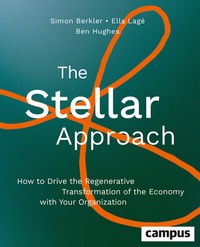
The Stellar Approach
How to Drive the Regenerative Transformation of the Economy with Your Organization
1st Edition
Published on 20. November 2024
Book
Paperback/Softback
270 pages
978-3-593-51959-3 (ISBN)
Description
The transformation toolkit for your company to make a better future for all.
Every company today wants to be sustainable, but that's no easy feat in our current economic system. How do you redesign an entire organization to not only be economically viable but to also actively contribute to preserving and regenerating our planet? And how do you navigate the inevitable conflicts of interest between profit-seeking and sustainability? In fact, if we really want sustainable economic activity, don't we need to transform the entire economic system?
The answer to the last question is: yes. Nevertheless, individual organizations can already get started on this journey, and the Stellar Approach explains how. It's a practical transformation toolkit and step-by-step roadmap that organizations can use to make their economic activities more sustainable and regenerative. This will not only enhance the future viability of their own business but also contribute to the regenerative transformation of the economy.
Today, every job is a sustainability job, and with the Stellar Approach, anyone can start making a difference right in their own circle of influence.
»An important building block for the transformation to a truly sustainable economy.«
C. Otto Scharmer, Senior Lecturer at MIT and Co-Founder of the Presencing Institute
»To understand how complex living systems actually work, and how we can apply these insights to our economy and to our organizations is the Great Work of our time. >The Stellar Approach< offers a very useful field guide for the journey ahead.«
John B. Fullerton, Founder and President of Capital Institute
»A pragmatic, light and encouraging approach! True sustainability needs many to lead the way - businesses will need to undergo a deep transformation that unlocks ambitious action. >The Stellar Approach< provides the necessary context on interrelationships and important tools for successfully developing regenerative skills across your own organisation. This, alongside a deep redesign of businesses, is an important building block for helping humanity into the Doughnut. This book helps to break down the huge task into feasible steps.«
Erinch Sahan, Business & Enterprise Lead at Doughnut Economics Action Lab (DEAL)
More details
Other editions
Additional editions
Simon Berkler | Ella Lagé
The Stellar Approach
How to Drive the Regenerative Transformation of the Economy with Your Organization
E-Book
11/2024
1st Edition
Campus Verlag Digital
€38.99
Available for download
Simon Berkler | Ella Lagé
The Stellar Approach
How to Drive the Regenerative Transformation of the Economy with Your Organization
E-Book
11/2024
Campus Verlag Digital
€38.99
Available for download
Persons
Author
Dr. Simon Berkler ist Co-Founder von TheDive und seit über 20 Jahren als Unternehmer und Organisationsberater tätig. Er studierte Medien- und Kommunikationswissenschaften und promovierte im Bereich der Medienökonomie. Er ist ausgebildeter systemischer und integraler Organisationsentwickler und verfügt über langjährige Erfahrung in der Begleitung mittlerer und großer Unternehmen bei ihren jeweiligen Transformationsprozessen. Mit TheDive arbeitet er an der Frage, wie eine lebensdienliche Weiterentwicklung des Wirtschaftssystems gelingen kann.
Simon Berkler (Ph.D.) is a co-founder of TheDive with over 20 years of experience as an entrepreneur and organizational consultant. He has studied media and communication science and holds a doctorate in media economics. Trained in systemic and integral organizational development, he has a long track record in supporting transformation processes at large and mid-sized companies. At TheDive, he focuses on the question of how the economic system can be developed in a life-serving direction.
ISNI:
ISNI:
Ella Lagé (Dipl.-Des., M.A.) arbeitete viele Jahre als Service Designerin in Innovationsprojekten mit großen Konzernen daran, gewohntes Handeln dauerhaft zu verändern. Heute erkundet sie mit TheDive, was Organisationen brauchen, um Erneuerung zu ermöglichen und als etwas Gutes zu erfahren. Zu ihren Schwerpunkten gehören agile Arbeitsweisen, Führungskräfteentwicklung sowie die Gestaltung der nachhaltig-regenerativen Transformation.
Ella Lagé (M.A. Design) worked for many years as a service designer in innovation projects at large corporations, focusing on creating lasting changes to established behaviors. Today at TheDive, she explores what organizations need in order to foster renewal and embrace it as something positive. Her focus areas include agile methodologies, leadership development, and the design of the sustainable-regenerative transformation.
ISNI:
ISNI:
Translation
Ben Hughes hat einen Hintergrund in Wirtschaftswissenschaften, Psychologie und angewandter Mathematik. Er hat in mehreren internationalen Managementberatungen gearbeitet und leitet den Content-Bereich von Blinkist, einem Start-up, das mit Kurzfassungen von Sachbüchern Tausende Menschen neu fürs Lesen begeistert.
Ben Hughes (M.Sc. Tech.) is a speaker, author, and leader. A former management consultant, he spent ten years building and leading the content team at the Berlin-based start-up Blinkist. Based on his experiences with self-organization there, he co-authored the book The Loop Approach. He speaks about hybrid leadership, self-organization, and the regenerative transformation.
ISNI:
ISNI:
Content
Part 1
1. Introduction 2. Between "No More" and "Not Yet" 3. No More: Is the system broken? 4. Not Yet: The dawn of a regenerative economy 5. The transition: Changing the rules while we play the game 6. How organizations can contribute to regenerative change 7. The Stellar Principles - Our guiding stars 8. The Stellar Approach transformation design
Part 2
9. Preparing for the Stellar Journey 10. Packing the equipment for our journey: The Stellar Practices 11. Inner fitness training: The Stellar Virtues 12. The Stellar Path: Context, direction, and impact 13. How we'll make our way: Even the longest odysseys begin with small steps 14. The Stellar Journey: Modules and methods 15. Module 1:Context 16. Module 2: Direction 17. Module 3: Impact 18. The big picture: The Stellar Approach as a part of the regenerative transformation 19. Conditions and success factors 20. The buliding blocks of broader regenerative transformation architecture
Part 3
21. The 5+1 Model: The Life-Centric Organization 22. Some encouragemant for your regenerative development journey
Appendix and sources
1. Introduction 2. Between "No More" and "Not Yet" 3. No More: Is the system broken? 4. Not Yet: The dawn of a regenerative economy 5. The transition: Changing the rules while we play the game 6. How organizations can contribute to regenerative change 7. The Stellar Principles - Our guiding stars 8. The Stellar Approach transformation design
Part 2
9. Preparing for the Stellar Journey 10. Packing the equipment for our journey: The Stellar Practices 11. Inner fitness training: The Stellar Virtues 12. The Stellar Path: Context, direction, and impact 13. How we'll make our way: Even the longest odysseys begin with small steps 14. The Stellar Journey: Modules and methods 15. Module 1:Context 16. Module 2: Direction 17. Module 3: Impact 18. The big picture: The Stellar Approach as a part of the regenerative transformation 19. Conditions and success factors 20. The buliding blocks of broader regenerative transformation architecture
Part 3
21. The 5+1 Model: The Life-Centric Organization 22. Some encouragemant for your regenerative development journey
Appendix and sources