

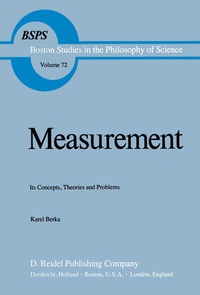
Measurement
Its Concepts, Theories and Problems
Published on 31. December 1982
Book
Hardback
XII, 250 pages
978-90-277-1416-9 (ISBN)
Description
For many years, Karel Berka has worked at some of the central problems of the theory of the sciences. At once a logician, a mathematician, a careful student of the physical sciences and the social sciences, and a sharp but sympathetic critic of the major philosophies of science in this century, Berka brings to this treatise on measurement both his technical mastery and his historical sensitivity. We appreciate his careful analysis of his predecessors, notably Helmholtz, Campbell, Holder, Bridgman, Camap, Hempel, and Stevens, and of his contemporaries such as Brian Ellis and also Patrick Suppes and J. L. Zinnes. The issues to be clarified are familiar but still troubling: how to justify the conceptual transition from classification to a metric; how to explore ways to provide a quantitative understanding of a qualitative concept; indeed how to understand, and thereby control, the Galilean enthusiasm "to measure what is measurable and to try to render measurable what is not so as yet".
More details
Series
Edition
1983 ed.
Language
English
Place of publication
Dordrecht
Netherlands
Publishing group
Springer
Target group
Professional and scholarly
Research
Illustrations
XII, 250 p.
Dimensions
Height: 241 mm
Width: 160 mm
Thickness: 20 mm
Weight
568 gr
ISBN-13
978-90-277-1416-9 (9789027714169)
DOI
10.1007/978-94-009-7828-7
Schweitzer Classification
Other editions
Additional editions
Book
10/2011
Springer
€160.49
Shipment within 15-20 days
Persons
Content
1. Introduction.- 2. Measurement.- 2.1. The Explication of the Concept of Measurement.- 2.2. The Definition of the Concept of Measurement.- 2.3. The Subject Matter, Function and Scope of Measurement.- 3. Magnitudes.- 3.1. Quantities, Magnitudes, Numbers: A Historical Excursion.- 3.2. Quantities and Magnitudes.- 3.3. The Object of Measurement.- 3.4. Measurement Units, Naming and Dimension.- 3.5. The Classification of Magnitudes.- 4. Scales.- 4.1. The Concept of a Scale.- 4.2. The Origin of a Scale.- 4.3. Distance.- 5. Quantification.- 5.1. Scaling.- 5.2. Counting.- 6. Theory of Measurement.- 6.1. Representation Theories of Measurement.- 6.2. Kinds of Measurement.- 6.3. Metrization.- 6.4. The Representation Theorem.- 7. Theory of Scales.- 7.1. The Classification of Scale Types.- 7.2. Scale Transformations and the Uniqueness Theorem.- 8. Methodological Problems of Measurement.- 8.1. Axiomatization of the Systems of Measurement.- 8.2. Empirical Relations and Operations.- 8.3. The Precision of Measurement.- 8.4. Meaningfulness, Validity and Reliability.- 9. Philosophical Problems of Measurement.- 9.1. Materialist Foundations of Measurement.- 9.2. The Possibilities and Limits of Measurement.- Notes.- Index of Personal Names.- Index of Subjects.