

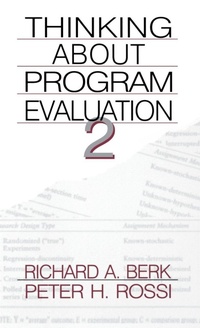
Thinking about Program Evaluation
2nd Edition
Published on 8. December 1998
Book
Hardback
136 pages
978-0-7619-1764-9 (ISBN)
Description
From the first edition . . .
"There are a number of outstanding features to this book. First, introducing the key concepts in an easy-to-understand fashion. Second, using specific examples as concrete illustrations of the methods being utilized. Another positive feature is the in-depth appendix, which provides many additional sources of information on the subject of program evaluation. . . . This comprehensive resource presents a realistic look at the potential and the pitfalls of program evaluation. The authors' examination of the issues from various angles produces a document that can be a useful guide to program evaluation."
--The Journal of Applied Rehabilitation Counseling
"Extremely interesting and well written. . . . Key terms are clearly introduced and the reader is given an excellent introduction to the role program evaluation might play in programs at different stages of development. A wide variety of interesting examples drawn from disparate fields of practice are used to illustrate key points. An appendix is provided to guide the reader toward the literature on program evaluation, professional associations, and organizations engaged in evaluation research."
--Canadian Public Administration
"The book has all the potential of becoming to program evaluation what Strunk and White's (1976) Elements of Style became for writing. Read frequently and faithfully, it could help evaluators do a better job."
--James W. Trent in Adult Residential Care Journal
Have you been looking for an overview of evaluation that will provide you with the big picture rather than so many details that you lose sight of what evaluation research is? Through the use of specific examples to illustrate evaluation research goals and methods, this book provides readers with an overview of the science and politics of evaluation research with comprehensive topics but selective details.
New to this edition is coverage of meta-analysis, selection models, and instrumental variables. In addition, the authors have expanded the coverage of analysis of data, evaluation when the units of analysis are entire organizations of political jurisdictions, and comparisons between evaluation research and other related fields. The rich mix of examples has been expanded to include more illustrations from environmental evaluation, and the most recent studies on welfare reform, managed mental health care, and law enforcement.
"There are a number of outstanding features to this book. First, introducing the key concepts in an easy-to-understand fashion. Second, using specific examples as concrete illustrations of the methods being utilized. Another positive feature is the in-depth appendix, which provides many additional sources of information on the subject of program evaluation. . . . This comprehensive resource presents a realistic look at the potential and the pitfalls of program evaluation. The authors' examination of the issues from various angles produces a document that can be a useful guide to program evaluation."
--The Journal of Applied Rehabilitation Counseling
"Extremely interesting and well written. . . . Key terms are clearly introduced and the reader is given an excellent introduction to the role program evaluation might play in programs at different stages of development. A wide variety of interesting examples drawn from disparate fields of practice are used to illustrate key points. An appendix is provided to guide the reader toward the literature on program evaluation, professional associations, and organizations engaged in evaluation research."
--Canadian Public Administration
"The book has all the potential of becoming to program evaluation what Strunk and White's (1976) Elements of Style became for writing. Read frequently and faithfully, it could help evaluators do a better job."
--James W. Trent in Adult Residential Care Journal
Have you been looking for an overview of evaluation that will provide you with the big picture rather than so many details that you lose sight of what evaluation research is? Through the use of specific examples to illustrate evaluation research goals and methods, this book provides readers with an overview of the science and politics of evaluation research with comprehensive topics but selective details.
New to this edition is coverage of meta-analysis, selection models, and instrumental variables. In addition, the authors have expanded the coverage of analysis of data, evaluation when the units of analysis are entire organizations of political jurisdictions, and comparisons between evaluation research and other related fields. The rich mix of examples has been expanded to include more illustrations from environmental evaluation, and the most recent studies on welfare reform, managed mental health care, and law enforcement.
More details
Edition
2nd Revised edition
Language
English
Place of publication
Thousand Oaks
United States
Target group
College/higher education
Edition type
Revised edition
Dimensions
Height: 222 mm
Width: 145 mm
Thickness: 11 mm
Weight
314 gr
ISBN-13
978-0-7619-1764-9 (9780761917649)
Copyright in bibliographic data and cover images is held by Nielsen Book Services Limited or by the publishers or by their respective licensors: all rights reserved.
Schweitzer Classification
Other editions
Additional editions
Richard A. Berk | Peter H. Rossi
Thinking about Program Evaluation
Book
12/1998
2nd Edition
SAGE Publications Inc
€117.10
Shipment within 15-20 days
Previous edition

Richard A. Berk | Peter H. Rossi
Thinking About Program Evaluation
Book
03/1990
1st Edition
SAGE Publications Inc
€63.40
Article exhausted; check for reprint
Content
What This Books Is About
What is Evaluation Research?
Key Concepts in Evaluation Research
Designing and Testing New Programs
A Chronological Perspective
Examining Ongoing Programs
A Chronological Perspective
What is Evaluation Research?
Key Concepts in Evaluation Research
Designing and Testing New Programs
A Chronological Perspective
Examining Ongoing Programs
A Chronological Perspective