

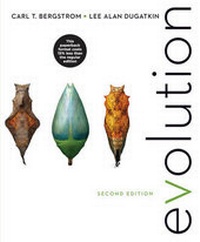
Evolution
2nd Edition
Published on 1. April 2016
Book
Paperback/Softback
896 pages
978-0-393-60103-9 (ISBN)
Description
Evolution presents foundational concepts through a contemporary framework of population genetics and phylogenetics that is enriched by current research and stunning art. In every chapter, new critical thinking questions and expanded end-of-chapter problems emphasising data interpretation reinforce the second edition's focus on helping students think like evolutionary biologists.
More details
Edition
Second Edition
Language
English
Place of publication
New York
United States
Target group
College/higher education
Edition type
Revised edition
Dimensions
Height: 277 mm
Width: 231 mm
Thickness: 33 mm
Weight
2095 gr
ISBN-13
978-0-393-60103-9 (9780393601039)
Copyright in bibliographic data and cover images is held by Nielsen Book Services Limited or by the publishers or by their respective licensors: all rights reserved.
Schweitzer Classification
Other editions
New editions
Carl T. Bergstrom | Lee Alan Dugatkin
Evolution
Book
07/2019
2nd Edition
W. W. Norton & Company
€155.38
Article is exhausted; no reprint
Persons
Carl T. Bergstrom is a professor in the Department of Biology at the University of Washington in Seattle and a member of the external faculty at the Santa Fe Institute. He received his undergraduate degree in 1993 from Harvard University where he worked with Naomi Price and David Haig, and his PhD in 1998 from Stanford University where he worked with Marc Feldman. His postdoctoral work was done with Bruce Levin at Emory University. Dr. Bergstrom's research uses mathematical models and evolutionary theory to understand biological and social processes on scales from intracellular information processing to the population-wide spread of emerging infectious diseases. In addition to teaching the undergraduate evolution course at the University of Washington, Dr. Bergstrom teaches courses on evolution and medicine, game theory and animal behavior, and mathematical biology. He is the co-author of Calling Bullshit: The Art of Skepticism in a Data-Driven World. Lee Alan Dugatkin is a professor and Distinguished University Scholar in the Department of Biology at the University of Louisville. His main area of research is the evolution of social behavior. He is currently studying the evolution of cooperation, aggression, antibiotic resistance, risk-taking behavior, and the interaction between genetic and cultural evolution. Dr. Dugatkin is the author of over 145 articles on evolution and behavior in journals such as Nature and The Proceedings of the National Academy of Sciences and several trade monographs on the evolution of cooperation and the history of science. He is also the author of Principles of Animal Behavior, Second Edition.
Content
PART I?FOUNDATIONS OF EVOLUTIONARY BIOLOGY
1. An Overview of Evolutionary Biology
2. Early Evolutionary Ideas and Darwin's Insight
3. Natural Selection
4. Phylogeny and Evolutionary History
5. Inferring Phylogeny
PART II?EVOLUTIONARY GENETICS
6. Transmission Genetics and the Sources of Genetic Variation
7. The Genetics of Populations
8. Evolution in Finite Populations
9. Evolution at Multiple Loci
10. Genome Evolution
PART III?THE HISTORY OF LIFE
11. The Origin and Evolution of Early Life
12. Major Transitions
13. Evolution and Development
14. Species and Speciation
15. Extinction and Evolutionary Trends
PART IV?EVOLUTIONARY INTERACTIONS
16. Sex and Sexual Selection
17. The Evolution of Sociality
18. Coevolution
19. Human Evolution
20. Evolution and Medicine
1. An Overview of Evolutionary Biology
2. Early Evolutionary Ideas and Darwin's Insight
3. Natural Selection
4. Phylogeny and Evolutionary History
5. Inferring Phylogeny
PART II?EVOLUTIONARY GENETICS
6. Transmission Genetics and the Sources of Genetic Variation
7. The Genetics of Populations
8. Evolution in Finite Populations
9. Evolution at Multiple Loci
10. Genome Evolution
PART III?THE HISTORY OF LIFE
11. The Origin and Evolution of Early Life
12. Major Transitions
13. Evolution and Development
14. Species and Speciation
15. Extinction and Evolutionary Trends
PART IV?EVOLUTIONARY INTERACTIONS
16. Sex and Sexual Selection
17. The Evolution of Sociality
18. Coevolution
19. Human Evolution
20. Evolution and Medicine