

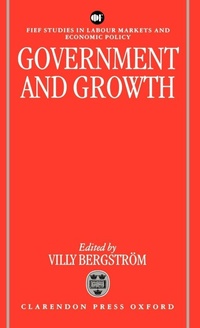
Government and Growth
Published on 18. December 1997
Book
Hardback
276 pages
978-0-19-829037-7 (ISBN)
Description
The sixth volume in the FIEF Studies in Labour Markets and Economic Policy series is a contribution to the empirical literature on endogenous growth theory, which studies the interrelationships of institutions, government policies, distribution, and growth. After an Introductory overview by the editor, the volume contains four main chapters, each of which is followed by review comments:
Alesina and Perotti review recent literature on the political economy of growth, and discuss such topics as the relationship between income instability and growth, whether democratic institutions and civil liberties influence growth performance, and whether income inequality hampers growth or not.
Hansson and Henrekson study the tendency--predicted by neoclassical growth theory--of per capita income and productivity to converge between countries. They focus on the diffusion of technology and the phenomenon of 'catching up', whereby poor countries copy the production methods and possibily organizational methods in advanced countries.
Grier uses a similar neoclassical production-function approach, but brings in some new explanatory factors for the growth process, including union density, the existence of corporatist as opposed to economically liberal governments, and centralized versus decentralized wage formation.
Analysing four cases of late, successful industrialization (South Korea, Taiwan, Finland, and Austria) Juhana Vartiainen shows that, under certain conditions, decentralized market solutions of the problems of resource allocation are inferior to state planning and corporatism with or without government involvement.
Alesina and Perotti review recent literature on the political economy of growth, and discuss such topics as the relationship between income instability and growth, whether democratic institutions and civil liberties influence growth performance, and whether income inequality hampers growth or not.
Hansson and Henrekson study the tendency--predicted by neoclassical growth theory--of per capita income and productivity to converge between countries. They focus on the diffusion of technology and the phenomenon of 'catching up', whereby poor countries copy the production methods and possibily organizational methods in advanced countries.
Grier uses a similar neoclassical production-function approach, but brings in some new explanatory factors for the growth process, including union density, the existence of corporatist as opposed to economically liberal governments, and centralized versus decentralized wage formation.
Analysing four cases of late, successful industrialization (South Korea, Taiwan, Finland, and Austria) Juhana Vartiainen shows that, under certain conditions, decentralized market solutions of the problems of resource allocation are inferior to state planning and corporatism with or without government involvement.
Reviews / Votes
The papers in Government and Growth are at the interface of economics and political science and underscore the importance of both disciplines for economic policy-making. Their empirical findings may well contribute to the materialisation of the principle of "good governance". - Rolf Bergs. Development Policy Review. Vol 16 1998.More details
Series
Language
English
Place of publication
Oxford
United Kingdom
Publishing group
Oxford University Press
Target group
Professional and scholarly
Illustrations
figures, tables
Dimensions
Height: 222 mm
Width: 145 mm
Thickness: 20 mm
Weight
524 gr
ISBN-13
978-0-19-829037-7 (9780198290377)
Copyright in bibliographic data and cover images is held by Nielsen Book Services Limited or by the publishers or by their respective licensors: all rights reserved.
Schweitzer Classification
Person
Content
Introduction ; The Politics of Growth: A Survey ; Comment ; Catching Up, Social Capability, Government Size and Economic Growth ; Comment ; Comment ; Governments, Unions, and Economic Growth ; Comment ; Comment ; Understanding State-led Late Industrialization ; Comment ; Comment