

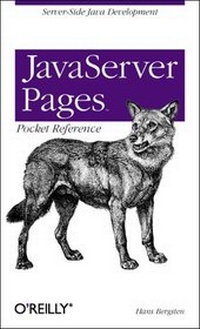
JavaServer Pages Pocket Reference
Server-Side Java Development
Published on 4. September 2001
Book
88 pages
978-0-596-00231-2 (ISBN)
Description
This is a quick reference to a popular but complicated web technology. The component-based technology of JavaServer Pages (JSP) makes it easy for even web designers with little knowledge of Java programming to create dynamic web pages and to simplify the task of building applications that work with a wide variety of web servers, application servers, browsers and development tools. This reference book simplifies the ability to access JSP essentials and provides a quick over-view of the fundamentals of JSP and the servlets technology on which it is based. It also offers succinct information on JSP application development for web page designers, with reference sections on scripting elements, error handling, user session management and security.
More details
Other editions
Additional editions
E-Book
07/2001
1st Edition
O'Reilly
€7.99
Available for download
E-Book
07/2001
1st Edition
O'Reilly
€6.49
Available for download
Person
Hans Bergsten is the founder of Gefion Software, as well as author of O'Reilly's JavaServer Pages. As founder at Gefion, his main product is a JSP-based component suite for developing web applications. Hans has been an active participant in the working groups for both the servlet and JSP specifications from the time they were formed, and contributes to the development of the Apache Tomcat reference implementation for both specifications as a member of the Apache Jakarta Project Management Committee.
Content
JSP processing; directive elements; standard action elements; comments; escape characters; scripting elements; implicit objects; custom actions; creating a tag library descriptor; packaging and installing a tag library; the web archive (WAR) file.