

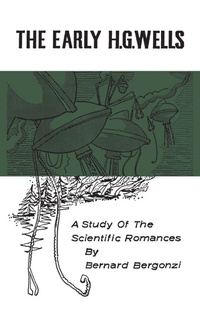
The Early H.G. Wells
A Study of the Scientific Romances
Published on 15. December 1961
Book
Paperback/Softback
236 pages
978-1-4426-5184-5 (ISBN)
Description
This is a sensitive study of Wells' imaginative development during his formative years. It comes at a time when interest in H.G. Wells' early writing is beginning to revive, owing, no doubt, to the current translation into reality of some aspects of science fiction.
Mr. Bergonzi examines Wells' early fiction, from surviving student writings of the late eighties to 1901 when he published The First Men in the Moon, his last significant scientific romance, and Anticipations, his first systematic non-fictional treatise. The main emphasis of his study falls on the scientific romances of the nineties, which are examined in detail. In addition to literary analysis, relevant source material and reviews, which show how contemporaries received Wells' work, are noted.
Wells' early attitude to science is shown to have been deeply ambivalent, as is apparent in his successive uses of the Frankenstein archetype. His intellectual attitudes tended towards scepticism and pessimism rather than to the 'utopian' optimism associated with his later career.
These romances reflect in imaginative and non-discursive form some of the major preoccupations of late-Victorian England: the impact of Darwinism, of Socialism, and an increasing lack of national self-confidence. Mr. Bergonzi sees Wells as essentially a fin de siEcle myth-maker, and he argues that it is this aspect of Wells' work which most requires attention if he is to be remembered in the future. Two early pieces by Wells, now unobtainable elsewhere, are given in an Appendix. One, The Chronic Argonauts, a fragment of a fantastic novel written at the age of 21, is the earliest draft of The Time Machine.
Mr. Bergonzi examines Wells' early fiction, from surviving student writings of the late eighties to 1901 when he published The First Men in the Moon, his last significant scientific romance, and Anticipations, his first systematic non-fictional treatise. The main emphasis of his study falls on the scientific romances of the nineties, which are examined in detail. In addition to literary analysis, relevant source material and reviews, which show how contemporaries received Wells' work, are noted.
Wells' early attitude to science is shown to have been deeply ambivalent, as is apparent in his successive uses of the Frankenstein archetype. His intellectual attitudes tended towards scepticism and pessimism rather than to the 'utopian' optimism associated with his later career.
These romances reflect in imaginative and non-discursive form some of the major preoccupations of late-Victorian England: the impact of Darwinism, of Socialism, and an increasing lack of national self-confidence. Mr. Bergonzi sees Wells as essentially a fin de siEcle myth-maker, and he argues that it is this aspect of Wells' work which most requires attention if he is to be remembered in the future. Two early pieces by Wells, now unobtainable elsewhere, are given in an Appendix. One, The Chronic Argonauts, a fragment of a fantastic novel written at the age of 21, is the earliest draft of The Time Machine.
More details
Series
Language
English
Place of publication
Toronto
Canada
Target group
Primary & secondary/elementary & high school
College/higher education
Product notice
Paperback (trade)
Illustrations
1 b&w illustration
Dimensions
Height: 216 mm
Width: 140 mm
Thickness: 14 mm
Weight
304 gr
ISBN-13
978-1-4426-5184-5 (9781442651845)
Copyright in bibliographic data and cover images is held by Nielsen Book Services Limited or by the publishers or by their respective licensors: all rights reserved.
Schweitzer Classification
Person
Bernard Bergonzi is a British literary scholar, critic and poet. He is Emeritus Professor of English at the University of Warwick and an expert on T. S. Eliot.