

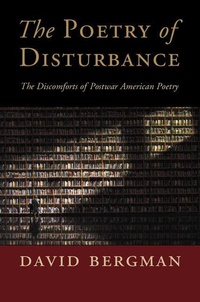
The Poetry of Disturbance
The Discomforts of Postwar American Poetry
Published on 30. June 2015
Book
Hardback
189 pages
978-1-107-08668-5 (ISBN)
Description
In The Poetry of Disturbance, David Bergman argues that post-war poetry underwent a significant if subtle shift in emphasis, moving from the modernist concern with the poem as a visual text to one that was chiefly oral in nature. The resulting change was disturbing, especially for those brought up on the principles of high modernism. This new stress on orality implied a shift in the economy of the poem, away from the austerity of language advocated by Pound and Eliot to a style that conveyed freedom, expansiveness, and an innovative directness.
More details
Series
Language
English
Place of publication
Cambridge
United Kingdom
Target group
Professional and scholarly
Dimensions
Height: 235 mm
Width: 157 mm
Thickness: 15 mm
Weight
440 gr
ISBN-13
978-1-107-08668-5 (9781107086685)
Copyright in bibliographic data and cover images is held by Nielsen Book Services Limited or by the publishers or by their respective licensors: all rights reserved.
Schweitzer Classification
Other editions
Additional editions
E-Book
07/2015
Cambridge University Press
€82.99
Available for download
E-Book
06/2015
Cambridge University Press
€73.99
Available for download
Person
David Bergman is Professor of English at Towson University and the author or editor of more than twenty books, including Gaiety Transfigured: Gay Self-Representation in American Literature and The Violet Hour: The Violet Quill and the Making of Gay Culture. He is also the editor of John Ashbery's Reported Sightings and The Violet Quill Reader. Bergman has won the Lambda Literary Prize for Men on Men 2000 and the George Elliston Poetry Prize for Cracking the Code, the first of four books of poetry. His essays have appeared in American Literary History, American Literature, and Raritan.
Content
1. Poems that disturb; 2. Disturbing modernism; 3. Orality and copia; 4. Disturbing voices; 5. A queer directness; 6. The long poem.