

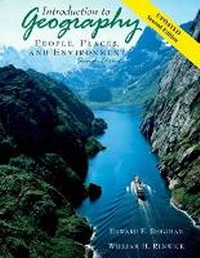
Introduction to Geography
People, Places, and Environment, Updated Edition
2nd Edition
Published on 24. March 2003
Book
Paperback/Softback
597 pages
978-0-13-046037-0 (ISBN)
Description
For courses in Introductory Geography.
The Updated Second Edition provides new materials about recent world events triggered by the September 11th attacks on New York City's World Trade Center and on the headquarters of the U.S. Department of Defense, the Pentagon. It includes new information that helps students understand both the roots of the attacks and the new alliances and strategies adopted by the United States and American allies to combat the enemies revealed and to protect against new tragedies. Additional new material helps students understand terrorism as a concept.
This is the most up-to-date introductory geography text on the market today. The authors provide a firm understanding of the geographic fundamentals behind everyday headlines. They introduce the major tools, techniques, and methodological approaches of the field, and present a wide range of positions currently debated about dealing with provocative current issues. The text emphasizes both scientific and humanistic analytical skills. It demonstrates to students that many basic principles of geography can be studied and demonstrated locally. The theme of human-environmental interaction is woven throughout the book.
The Updated Second Edition provides new materials about recent world events triggered by the September 11th attacks on New York City's World Trade Center and on the headquarters of the U.S. Department of Defense, the Pentagon. It includes new information that helps students understand both the roots of the attacks and the new alliances and strategies adopted by the United States and American allies to combat the enemies revealed and to protect against new tragedies. Additional new material helps students understand terrorism as a concept.
This is the most up-to-date introductory geography text on the market today. The authors provide a firm understanding of the geographic fundamentals behind everyday headlines. They introduce the major tools, techniques, and methodological approaches of the field, and present a wide range of positions currently debated about dealing with provocative current issues. The text emphasizes both scientific and humanistic analytical skills. It demonstrates to students that many basic principles of geography can be studied and demonstrated locally. The theme of human-environmental interaction is woven throughout the book.
More details
Edition
2nd edition
Language
English
Place of publication
United States
Publishing group
Pearson Education (US)
Target group
Professional and scholarly
Dimensions
Width: 276 mm
Thickness: 20 mm
Weight
1224 gr
ISBN-13
978-0-13-046037-0 (9780130460370)
Copyright in bibliographic data and cover images is held by Nielsen Book Services Limited or by the publishers or by their respective licensors: all rights reserved.
Schweitzer Classification
Other editions
New editions
Book
04/2004
3rd Edition
Pearson
€51.98
Article exhausted; check for reprint
Previous edition
Book
11/2002
2nd Edition
Prentice Hall
€79.11
Article exhausted; check for reprint
Persons
Edward F Bergman stands beside the stone wall that is the very eastern edge of the North American tectonic plate, where it is exposed in Iceland (see Figure 3-5).
Professor Bergman was born in Wisconsin and studied at the University of Wisconsin (Madison), the University of Vienna (Austria), and the University of Washington in Seattle. Today he teaches at Lehman College of the City University of New York and widely across Europe. When not lecturing or writing, he enjoys Manhattan's cultural and social life, although, he warns, nobody should come to his house for dinner expecting great food.
William H. Renwick earned a B.A. from Rhode Island College in 1973 and a Ph.D. in geography from Clark University in 1979. He has taught at the University of California, Los Angeles, and Rutgers University, and is currently Associate Professor of Geography at Miami University. A physical geographer with interests in geomorphology and environmental issues, his research focuses on impacts of land-use change on rivers and lakes, particularly in agricultural landscapes in the Midwest. When time permits, he studies these environments from the seat of a wooden canoe.
Professor Bergman was born in Wisconsin and studied at the University of Wisconsin (Madison), the University of Vienna (Austria), and the University of Washington in Seattle. Today he teaches at Lehman College of the City University of New York and widely across Europe. When not lecturing or writing, he enjoys Manhattan's cultural and social life, although, he warns, nobody should come to his house for dinner expecting great food.
William H. Renwick earned a B.A. from Rhode Island College in 1973 and a Ph.D. in geography from Clark University in 1979. He has taught at the University of California, Los Angeles, and Rutgers University, and is currently Associate Professor of Geography at Miami University. A physical geographer with interests in geomorphology and environmental issues, his research focuses on impacts of land-use change on rivers and lakes, particularly in agricultural landscapes in the Midwest. When time permits, he studies these environments from the seat of a wooden canoe.
Content
1. Introduction to Geography.
2. Weather and Climate.
3. Landforms.
4. Biogeochemical Cycles and the Biosphere.
5. Population, Population Increase, and Migration.
6. Cultural Geography.
7. The Geography of Languages and Religions.
8. The Human Food Supply.
9. Earth's Resources and Environmental Protection.
10. Cites and Urbanization.
11. A World of States.
12. National Paths to Economic Growth.
13. The Globalization of Economics and Politics.
Appendix I: Map Scale and Projections.
Appendix II: The Koeppen Climate Classification System.
Appendix III: The World Today: Population, Economy, Environment.
Glossary.
Index.
2. Weather and Climate.
3. Landforms.
4. Biogeochemical Cycles and the Biosphere.
5. Population, Population Increase, and Migration.
6. Cultural Geography.
7. The Geography of Languages and Religions.
8. The Human Food Supply.
9. Earth's Resources and Environmental Protection.
10. Cites and Urbanization.
11. A World of States.
12. National Paths to Economic Growth.
13. The Globalization of Economics and Politics.
Appendix I: Map Scale and Projections.
Appendix II: The Koeppen Climate Classification System.
Appendix III: The World Today: Population, Economy, Environment.
Glossary.
Index.