

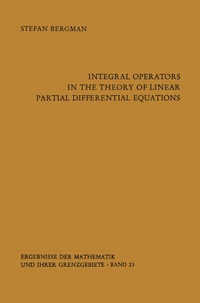
Integral Operators in the Theory of Linear Partial Differential Equations
Published on 11. November 2011
Book
Paperback/Softback
X, 148 pages
978-3-642-64987-5 (ISBN)
Description
The present book deals with the construction of solutions of linear partial differential equations by means of integral operators which transform analytic functions of a complex variable into such solutions. The theory of analytic functions has achieved a high degree of deve lopment and simplicity, and the operator method permits us to exploit this theory in the study of differential equations. Although the study of existence and uniqueness of solutions has been highly developed, much less attention has been paid to the investigation of function theo retical properties and to the explicit construction of regular and singular solutions using a unified general procedure. This book attempts to fill in the gap in this direction. Integral operators of various types have been used for a long time in the mathematical literature. In this connection one needs only to mention Euler and Laplace. The author has not attempted to give a complete account of all known operators, but rather has aimed at developing a unified approach. For this purpose he uses special operators which preserve various function theoretical properties of analytic functions, such as domains of regularity, validity of series development, connection between the coefficients of these developments and location and character of singularities, etc. However, all efforts were made to give a complete bibliography to help the reader to find more detailed information.
More details
Series
Edition
Softcover reprint of the original 1st ed. 1969
Language
English
Place of publication
Berlin
Germany
Publishing group
Springer Berlin
Target group
Professional and scholarly
Research
Illustrations
X, 148 p.
Dimensions
Height: 23.5 cm
Width: 15.5 cm
Weight
254 gr
ISBN-13
978-3-642-64987-5 (9783642649875)
DOI
10.1007/978-3-642-64985-1
Schweitzer Classification
Other editions
Additional editions
E-Book
12/2012
1st Edition
Springer
€53.49
Available for download
Book
01/1961
Springer
€91.98
Article exhausted; check different version
Content
I. Differential equations in two variables with entire coefficients.- § 1. A representation of solutions of partial differential equations.- § 2. The integral operator of the first kind.- § 3. Further representations of integral operators.- § 4. A representation of the operator of the first kind in terms of integrals.- § 5. Properties of the integral operator of the first kind.- § 6. Some further properties of the integral operator of the first kind.- § 7. The differential equation ?2V + F(r2) V = 0.- § 8. Integral operators of exponential type.- § 9. The differential equation ?2? + N (x) ? = 0.- § 10. Differential equations of higher order.- II. Harmonic functions in three variables.- § 1. Preliminaries.- § 2. Characteristic space ?3.- § 3. Harmonic functions with rational B3-associates.- § 4. Period functions.- § 5. Relations between coefficients of a series development of a harmonic function and its singularities.- § 6. Another type of integral representations of harmonic functions.- § 7. The behavior in the large of functions of the class S (E, ?0, ?1) with a rational associate f (?).- III. Differential equations in three variables.- § 1. An integral operator generating solutions of the equation ?3? + A (r2) X · ? ? + C (r2) ? = 0.- § 2. A series expansion for solutions of the equation ?3? + A (r2) X · ? ? + C (r2) ? = 0.- § 3. An integral operator generating solutions of the equation ?3? + F (y, z) ? = 0.- § 4. A second integral operator generating solutions of the equation ?3? + F (y, z) ? = 0.- § 5. An integral operator generating solutions of the equation ?x + ?yy + ?zz + F (y, z) ? = 0.- § 6. An integral operator generating solutions of the equation g???????+h????+k? = 0.- IV. Systems ofdifferential equations.- § 1. Harmonic vectors of three variables. Preliminaries.- § 2. Harmonic vectors in the large and their representation as integrals.- § 3. Integrals of harmonic vectors.- § 4. Relations between integrals of algebraic harmonic vectors in three variables and integrals of algebraic functions of a complex variable.- § 5. Generalization of the residue theorems to the case of the equation ?3? + F (r2) ? = 0.- § 6. An operator generating solutions of a system of partial differential equations.- V. Equations of mixed type and elliptic equations with singular and non-analytic.- § 1. Introduction. The simplified case of equations of mixed type.- § 2. A generalization of the representation (1.12) of solutions of the equation (1.6).- § 3. The operator (1.11b) in the general case.- § 4. Generating functions analogous to solutions of the hypergeometric equation.- § 5. On the solution of the initial value problem in the large.- § 6. Generalized Cauchy-Riemann equations.- § 7. The differential equation ?2? + N(x)? = 0 with a new type of singularity of N.- § 8. An integral operator for equations with non-analytic coefficients.