

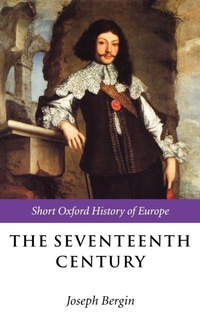
The Seventeenth Century
Europe 1598-1715
Published on 7. December 2000
Book
Hardback
280 pages
978-0-19-873168-9 (ISBN)
Description
The complete Short Oxford History of Europe (series editor: Professor T.C.W. Blanning) will cover the history of Europe from Classical Greece to the present in eleven volumes. In each, experts write to their strengths tackling the key issues - including society, economy, religion, politics, and culture - head-on in chapters that will be at once wide-ranging surveys and searching analyses. Each book is specifically designed with the non-specialist reader in mind; but the authority of the contributors and the vigour of the interpretations will make them necessary and challenging reading for fellow academics across a range of disciplines.
Lying between the two great 'peaks' of European history, the Reformation and the Enlightenment in the centuries fore and aft, the seventeenth century seems not to have a popular identity itself. And yet, as Professor Bergin points out in his Introduction, it is the very proliferation of major events, crises and processes throughout Europe that has made this transitional age so difficult to label.
In this book, the seventeenth century, heavy with significance for the future of Europe, is fully explored by Professor Bergin and six major authors as they address, in turn, economy, society, politics, war and international relations, science, thought and culture ('The Age of Curiosity'), and Europe in the wider world. In a set of chapters covering and contrasting the European experience across the full century and the full continent, the reader is offered a rich, lively, and provocative introduction to the period, and students a superbly authoritative context for more detailed work.
Lying between the two great 'peaks' of European history, the Reformation and the Enlightenment in the centuries fore and aft, the seventeenth century seems not to have a popular identity itself. And yet, as Professor Bergin points out in his Introduction, it is the very proliferation of major events, crises and processes throughout Europe that has made this transitional age so difficult to label.
In this book, the seventeenth century, heavy with significance for the future of Europe, is fully explored by Professor Bergin and six major authors as they address, in turn, economy, society, politics, war and international relations, science, thought and culture ('The Age of Curiosity'), and Europe in the wider world. In a set of chapters covering and contrasting the European experience across the full century and the full continent, the reader is offered a rich, lively, and provocative introduction to the period, and students a superbly authoritative context for more detailed work.
Reviews / Votes
The work succeeds in providing insights into what, as Bergin suggests in his introduction, has been a difficult century to classify./ Andrew Spicer, History Vol 87 No 288More details
Series
Language
English
Place of publication
Oxford
United Kingdom
Target group
College/higher education
Illustrations
maps
Dimensions
Height: 222 mm
Width: 145 mm
Thickness: 20 mm
Weight
529 gr
ISBN-13
978-0-19-873168-9 (9780198731689)
Copyright in bibliographic data and cover images is held by Nielsen Book Services Limited or by the publishers or by their respective licensors: all rights reserved.
Schweitzer Classification
Other editions
Additional editions
Book
11/2000
Oxford University Press
€120.30
Shipment within 15-20 days
Person
Joseph Bergin is Professor of History at the University of Manchester
Content
Contributor's Notes ; Introduction ; 1. The Economy ; 2. Society ; 3. Politics ; 4. War and International Relations ; 5. The Age of Curiosity ; 6. Europe and the Wider World ; Conclusion ; Bibliography ; Chronology ; Maps ; Index