

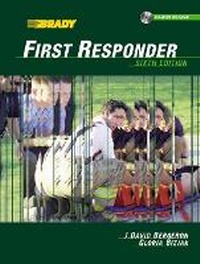
First Responder
6th Edition
Published on 8. August 2001
Book
Mixed media product
614 pages
978-0-13-030726-2 (ISBN)
Description
For First Responder-level training courses.
This text is the foundation for the First Responder curriculum designed to provide students with a patient assessment-based approach to individual and team First Responder-level care. Written in easy-to-understand language with many examples and illustrations, the text provides appropriate details on emergency care procedures, skill steps and application methods.
This text is the foundation for the First Responder curriculum designed to provide students with a patient assessment-based approach to individual and team First Responder-level care. Written in easy-to-understand language with many examples and illustrations, the text provides appropriate details on emergency care procedures, skill steps and application methods.
More details
Edition
6th edition
Language
English
Place of publication
United States
Publishing group
Pearson Education (US)
Target group
Professional and scholarly
Dimensions
Height: 275 mm
Width: 210 mm
Thickness: 23 mm
Weight
1296 gr
ISBN-13
978-0-13-030726-2 (9780130307262)
Copyright in bibliographic data and cover images is held by Nielsen Book Services Limited or by the publishers or by their respective licensors: all rights reserved.
Schweitzer Classification
Other editions
New editions
J. David Bergeron | Gloria Bizjak | George W. Krause
First Responder
Book
10/2004
7th Edition
Pearson
€58.17
Article exhausted; check for reprint
Previous edition

J. David Bergeron | Gloria Bizjak
First Responder
Book
08/1998
5th Edition
Prentice-Hall
€44.76
Article exhausted; check for reprint
Content
I. PREPARATORY.
1. Introducing the EMS System.
2. The Well-Being of the First Responder.
3. Legal and Ethical Issues.
4. The Human Body.
5. Lifting and Moving Patients.
II. AIRWAY.
6. Airway Management.
III. PATIENT ASSESSMENT.
7. Assessment of the Patient.
IV. CIRCULATION.
8. Cardiopulmonary Resuscitation (CPR).
9. Two Rescuer CPR.
V. ILLNESS AND INJURY.
10. Medical Emergencies.
11. Bleeding and Soft-Tissue Injuries.
12. Muscle and Bone Injuries.
VI. CHILDBIRTH AND CHILDREN.
13. Childbirth.
14. Infants and Children.
VII. EMS OPERATIONS.
15. Gaining Access and Triage.
APPENDICES.
Appendix 1: Determining Blood Pressure.
Appendix 2: Breathing Aids and Oxygen Therapy.
Appendix 3: Pharmacology.
Appendix 4: Swimming and Diving Accidents.
Appendix 5: Stress Management.
Appendix 6: First Responder Roles and Responsibilities.
Glossary.
Index.
1. Introducing the EMS System.
2. The Well-Being of the First Responder.
3. Legal and Ethical Issues.
4. The Human Body.
5. Lifting and Moving Patients.
II. AIRWAY.
6. Airway Management.
III. PATIENT ASSESSMENT.
7. Assessment of the Patient.
IV. CIRCULATION.
8. Cardiopulmonary Resuscitation (CPR).
9. Two Rescuer CPR.
V. ILLNESS AND INJURY.
10. Medical Emergencies.
11. Bleeding and Soft-Tissue Injuries.
12. Muscle and Bone Injuries.
VI. CHILDBIRTH AND CHILDREN.
13. Childbirth.
14. Infants and Children.
VII. EMS OPERATIONS.
15. Gaining Access and Triage.
APPENDICES.
Appendix 1: Determining Blood Pressure.
Appendix 2: Breathing Aids and Oxygen Therapy.
Appendix 3: Pharmacology.
Appendix 4: Swimming and Diving Accidents.
Appendix 5: Stress Management.
Appendix 6: First Responder Roles and Responsibilities.
Glossary.
Index.