

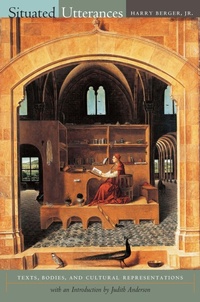
Situated Utterances
Texts, Bodies, and Cultural Representations
Will be published approx. on 15. April 2005
Book
Paperback/Softback
396 pages
978-0-8232-2429-6 (ISBN)
Description
Berger describes himself as "a reconstructed old New Critic," and his
publications over the past fifty years have centered on investigations of the
ways in which texts represent both themselves and their situations of utterance.
The thirteen chapters of the present book illustrate the range of his inquiry
across several cultures and disciplines. They also demonstrate the interpretive
richness, the theoretical acumen, and the energetic prose that characterize the
work of one of America's premier "close readers."
Situated Utterances is divided into four parts. In Part One Berger designs an
analytical model of New Criticism and shows how it was dismantled during the
decades after the Second World War. He then proposes a reconstructed model in
which the practice of ironic and suspicious "close reading" may be directed toward
interactions among bodies, texts, and countertexts in different cultural settings.
Part Two demonstrates this practice in studies of specific works in three genres:
the pastoral Idylls of Theocritus, Edmund Spenser's epic, The Faerie Queene, and
the Diaries of Samuel Pepys. The scope of the practice is broadened in Part Three
to the connection between cultural representations and institutional change, a
connection explored in four chapters that successively examine precapitalist
forms of representation, the Old Testament, Beowulf, and the conflict between
nakedness and nudity in Christian conceptions of the body. Part Four consists
in three chapters on Plato's dialogues, which Berger interprets as critical of the
general situation of utterance in a predominantly oral culture. He argues that
Plato uses the resources of writing to depict the heroic pathos of a Socrates whose
method and message are defeated by the politics of the oral medium.
Situated Utterances concludes with "A Conspectus of Critical Moves:
The Eleven-Step Program." This is a summary account of the interpretive
strategies put into play by the author throughout his long career.
publications over the past fifty years have centered on investigations of the
ways in which texts represent both themselves and their situations of utterance.
The thirteen chapters of the present book illustrate the range of his inquiry
across several cultures and disciplines. They also demonstrate the interpretive
richness, the theoretical acumen, and the energetic prose that characterize the
work of one of America's premier "close readers."
Situated Utterances is divided into four parts. In Part One Berger designs an
analytical model of New Criticism and shows how it was dismantled during the
decades after the Second World War. He then proposes a reconstructed model in
which the practice of ironic and suspicious "close reading" may be directed toward
interactions among bodies, texts, and countertexts in different cultural settings.
Part Two demonstrates this practice in studies of specific works in three genres:
the pastoral Idylls of Theocritus, Edmund Spenser's epic, The Faerie Queene, and
the Diaries of Samuel Pepys. The scope of the practice is broadened in Part Three
to the connection between cultural representations and institutional change, a
connection explored in four chapters that successively examine precapitalist
forms of representation, the Old Testament, Beowulf, and the conflict between
nakedness and nudity in Christian conceptions of the body. Part Four consists
in three chapters on Plato's dialogues, which Berger interprets as critical of the
general situation of utterance in a predominantly oral culture. He argues that
Plato uses the resources of writing to depict the heroic pathos of a Socrates whose
method and message are defeated by the politics of the oral medium.
Situated Utterances concludes with "A Conspectus of Critical Moves:
The Eleven-Step Program." This is a summary account of the interpretive
strategies put into play by the author throughout his long career.
More details
Language
English
Place of publication
New York
United States
Target group
College/higher education
Professional and scholarly
Product notice
Paperback (trade)
Dimensions
Height: 228 mm
Width: 150 mm
Thickness: 31 mm
Weight
767 gr
ISBN-13
978-0-8232-2429-6 (9780823224296)
Copyright in bibliographic data and cover images is held by Nielsen Book Services Limited or by the publishers or by their respective licensors: all rights reserved.
Schweitzer Classification
Persons
Harry Berger (Author)
Harry Berger, Jr., is Professor Emeritus of Literature and Art History at the University of California, Santa Cruz. His most recent books include Figures of a Changing World: Metaphor and the Emergence of Modern Culture and A Fury in the Words: Love and Embarrassment in Shakespeare's Venice (both Fordham).
Harry Berger, Jr., is Professor Emeritus of Literature and Art History and a Fellow of Cowell College at the University of California, Santa Barbara. A Fellow of the American Academy of Arts and Sciences, he is the author of fourteen books, most recently Harrying: Skills of Offense in Shakespeare's Henriad (Fordham, 2016).
Judith H. Anderson (Introducer)
Judith H. Anderson is Chancellor's Professor of English Emeritus at Indiana University. Her books include Words That Matter: Linguistic Perception in Renaissance English; Translating Investments: Metaphor and the Dynamic of Cultural Change in Tudor-Stuart England (Fordham); and Reading the Allegorical Intertext: Chaucer, Spenser, Shakespeare, Milton (Fordham).
Harry Berger, Jr., is Professor Emeritus of Literature and Art History at the University of California, Santa Cruz. His most recent books include Figures of a Changing World: Metaphor and the Emergence of Modern Culture and A Fury in the Words: Love and Embarrassment in Shakespeare's Venice (both Fordham).
Harry Berger, Jr., is Professor Emeritus of Literature and Art History and a Fellow of Cowell College at the University of California, Santa Barbara. A Fellow of the American Academy of Arts and Sciences, he is the author of fourteen books, most recently Harrying: Skills of Offense in Shakespeare's Henriad (Fordham, 2016).
Judith H. Anderson (Introducer)
Judith H. Anderson is Chancellor's Professor of English Emeritus at Indiana University. Her books include Words That Matter: Linguistic Perception in Renaissance English; Translating Investments: Metaphor and the Dynamic of Cultural Change in Tudor-Stuart England (Fordham); and Reading the Allegorical Intertext: Chaucer, Spenser, Shakespeare, Milton (Fordham).